

[비즈한국] Brazil, a South American military power, is currently pushing for a project to modernize its air defense system. While it has been negotiating the acquisition of air defense missiles with India and China since last year, the talks have stalled as neither country's system meets the technical requirements of the Brazilian military. Local Brazilian media and military officials are now showing interest in South Korea’s "Cheongung-II," which has been recognized for its performance through recent deliveries to countries including those in the Middle East, as a strong alternative.
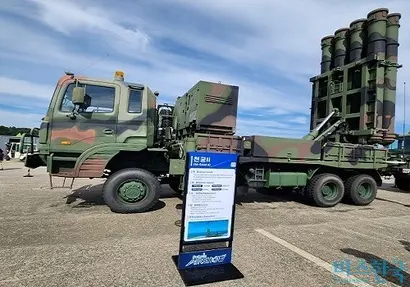
According to local Brazilian military media on the 18th, Brazil has been working to modernize its aging air defense systems since June of last year as part of the Army Strategic Program (Prg EE). Currently, most of Brazil's military air defense systems are only capable of handling short-range missiles, making it difficult to intercept incoming fighter jets, helicopters, drones, cruise missiles, and guided bombs at medium and high altitudes.
The Brazilian military has issued a decree regarding the acquisition of a medium-to-high altitude air defense system, with the goal of securing a system capable of operating at altitudes of 3,000 meters or higher. It is known that Brazil initially limited its project briefing to fellow BRICS members, India and China, due to political considerations.
In response, India proposed the Akash missile system, while China offered the Sky Dragon surface-to-air missile system to the Brazilian Army. India has previously exported 15 Akash systems to Armenia. General Tomás Miguel Miné Ribeiro Paiva, commander of the Brazilian Army, who visited India officially last year, reportedly observed a test engagement of the Akash system firsthand.
China's Sky Dragon has been adopted by the Pakistani military and has also been exported to African nations such as Morocco and Rwanda. It is reported that a Brazilian military delegation visited China last year to evaluate the capabilities of local defense industry facilities and discuss opportunities for bilateral cooperation within the framework of the Army's strategic program.
Although the Brazilian Army intended to provide export opportunities to BRICS partners India and China last year, both systems failed to meet the performance requirements set by the Brazilian military. India had actively proposed the Akash system to Vietnam, but the adoption fell through, largely because the system failed to accurately strike target drones during live-fire tests conducted by the Vietnamese military.
China has also deployed the Sky Dragon in limited numbers within its own military, and despite its export track record in Africa, there are ongoing concerns regarding its overall performance. China had attempted to export the Sky Dragon to the Middle East at a low price, but has struggled in the export market after losing out in competitive bids.
For these reasons, local media expect the Brazilian authorities to open the bidding process to other non-Western countries this year. South Korea’s Cheongung-II, in particular, is emerging as a strong alternative.
South Korea’s Cheongung-II, a medium-range surface-to-air missile system, is equipped with an advanced AESA radar capable of tracking multiple targets simultaneously. Its modular structure allows for the construction of integrated systems, including flexible operation launch vehicles, mobile radars, and replenishment units.
Other advantages include faster delivery times compared to competitors, options for localized customization, and competitive pricing. The system’s superior performance has already been proven through its operation by the South Korean military and several Middle Eastern nations. In fact, India's Akash missile system has previously lost out to the Cheongung-II in competitive bids in Saudi Arabia and the United Arab Emirates (UAE).
Given the vast territory of Brazil, it is expected that multiple batteries will be acquired in the future. If a contract is secured, it is projected that South Korean defense firms such as LIG Nex1079550, Hanwha Systems272210, and Hanwha Aerospace012450 will see significant revenue.
Brazil is expected to demand technology transfers and offset agreements from the air defense system exporter. A KOTRA official explained, "Brazil's final selection will likely be determined by several factors. Conditions for technology transfer and economic benefits will be key considerations. The Brazilian Army is scheduled to complete a feasibility study, which will determine the specific direction of the acquisition."