

[비즈한국] Recently, astronomers discovered a massive galaxy with distinct spiral arms that existed in the very young universe, shortly after the Big Bang, within James Webb Space Telescope observation data! This spiral-shaped primordial galaxy, found in images observing the direction of the Abell 2744 galaxy cluster, existed when the universe was only 1.5 billion years old.
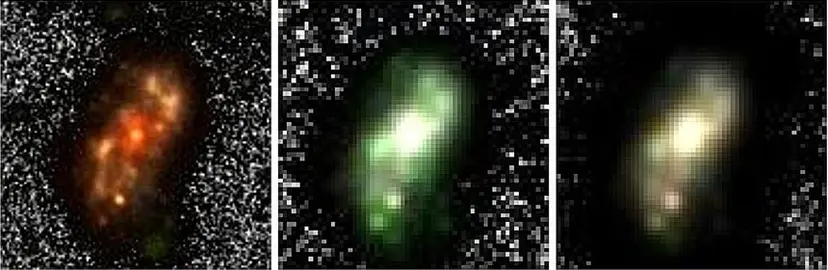
In fact, swirling spiral galaxies are very familiar to us. Our own Milky Way is one, and Andromeda, the most widely known galaxy, is also a spiral. Why are astronomers so excited about this discovery when it is merely a common type of galaxy found in the distant universe?
It is because we still do not know exactly how a galaxy's spiral arms are formed. Even more surprising is that the newly discovered galaxy, A2744-GDSp-z4, possesses clear spiral arms at such an early stage. Astronomers previously believed that galaxies needed billions of years to form clear, distinct spiral arms. Yet, at a time when the universe was only one-tenth of its current age, this primordial galaxy—which is 32,000 light-years in diameter, or one-third the size of the Milky Way—is wrapped in "grand design" spiral arms. This suggests that galactic spiral arms can take shape much faster than previously thought.
Spiral arms are a very common phenomenon, appearing in over 70% of all observed disk galaxies. However, we still do not know the exact origin and mechanism behind these arms. How exactly are these spiral arms formed? How is the spectacular "cosmic latte art" of galaxies being created?
Spiral arms have been known for a long time—even from before the term "galaxy" was commonly used. Until the 20th century, humanity believed our Milky Way was the entire universe. The swirling gas clouds occasionally visible in the night sky were considered small clouds contained within our vast galaxy. In 1840, astronomer William Parsons drew a detailed depiction of M51, well-known today as the Whirlpool Galaxy. Back then, astronomers called these gas clouds with swirling arms "spiral nebulae."
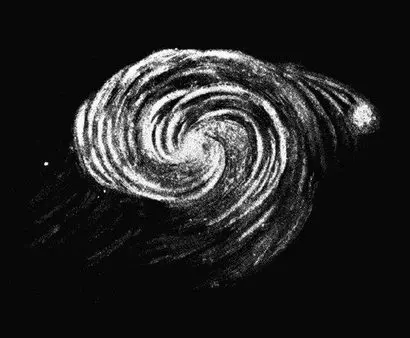
Later, through the discoveries of astronomer Edwin Hubble, it was revealed that spiral nebulae, including Andromeda, were distinct universes outside our own galaxy. This marked the beginning of a renaissance in galactic astronomy—the recognition and exploration of external galaxies. Hubble created a classification system for galaxies based on their appearance, distinguishing between rounded elliptical galaxies and spiral galaxies with arms. Spiral nebulae were subsequently called spiral galaxies.
For a long time, astronomers thought of spiral arms as a fixed structure. They believed stars belonging to a spiral arm remained part of it as they moved. However, there was a problem. When astronomer Jan Oort (the creator of the Oort Cloud) and his colleague Bertil Lindblad studied the movement of stars in the galactic disk, they discovered that stars near the center of the galaxy orbit much faster than stars near our Sun. While it takes our Sun and neighboring stars 200 million years to orbit the galaxy, stars near the center move much faster, with orbital periods of less than 20 years.
Similarly, astronomers assumed that parts of the spiral arms closer to the center would move at drastically different speeds than those further out. If that were the case, the arms would eventually become tightly wound and tangled. In reality, however, no spiral galaxy shows its arms winding tighter over time; they maintain their large, beautiful spiral forms. This is known as the "winding problem" of spiral arms.
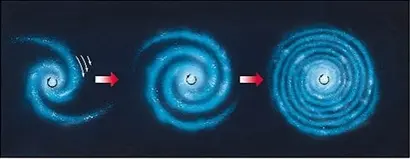
In 1964, a brilliant idea was proposed to solve the winding problem. Interestingly, the exact same phenomenon occurring in galactic spiral arms can be found on a congested highway. Sometimes, while driving, you experience traffic suddenly bunching up in a specific section. Even without an obvious cause, this persistent congestion is sometimes called a "phantom traffic jam." The reason is simple: assume a car on the road suddenly hits the brakes. The cars behind it begin to brake in sequence. The first car that caused the jam eventually speeds up and leaves the congested area, but the wave of congestion, once started, continues to propagate backward.
We can learn something interesting here: the same cars are not trapped in the congested area indefinitely. In other words, the congested area is a type of wave that is independent of the actual road and the cars driving on it. It is not a solid structure existing on the road. All vehicles drive at their own speeds, entering the congested area momentarily before exiting. No single car stays in the congested zone forever. This phenomenon is called a density wave—meaning that a region of high density is maintained just like a wave.
If a density wave occurs in a galactic disk for any reason, causing stellar orbits to overlap and density to increase, a massive, grand-design spiral arm can be maintained stably. If this hypothesis is correct, the distinct spiral arms seen in many galaxies can be viewed as traffic jams that have persisted on the "highway of stars" for billions, or even over 10 billion years. When stuck in a traffic jam on a road, thinking of it this way makes me feel like a star briefly passing through the middle of a giant spiral arm.
However, the density wave theory only explains how a spiral arm can maintain its shape for a long time; it does not explain how those arms began in the first place. In other words, it explains why a traffic jam doesn't disappear once it starts, but it doesn't reveal who caused the traffic jam in the first place, or what they did.
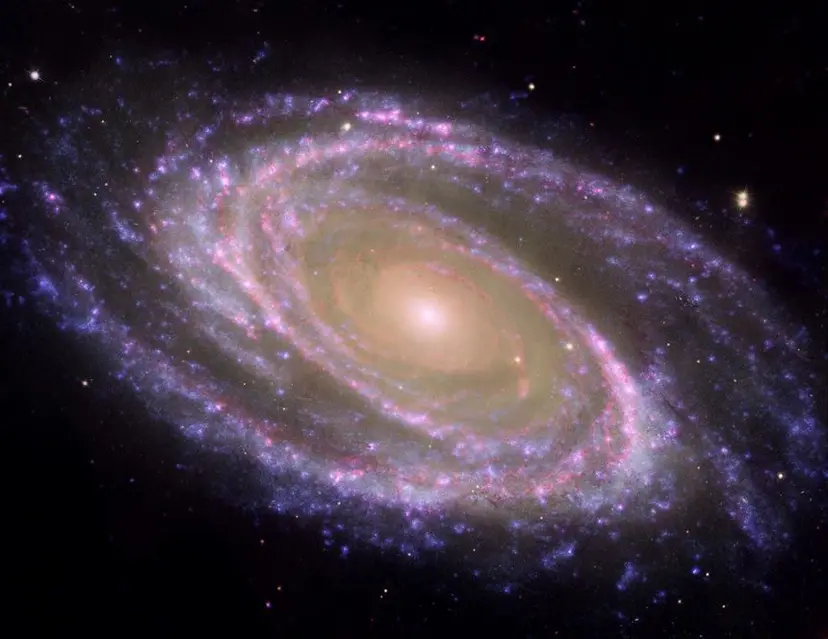
To complement this, some astronomers look for the cause in the violent lives of stars, which repeatedly undergo birth and explosion in the galactic disk. This is a very interesting model first proposed by astronomers Mark Mueller and David Arnett in 1976. The galactic disk is particularly dense with gas, leading to the continuous birth of new stars. The massive ones among them finish their evolution quickly and eventually end in supernova explosions. The shockwaves generated at this time spread into the surrounding gas in the disk, compressing it to high densities and triggering the birth of even more stars. A supernova explosion of a massive star in one part of the disk leads to the birth of new stars and subsequent supernova explosions in the surrounding areas.
As this process occurs, the newly born stars and supernovae all drift across the galactic disk. As a result, the shockwave gradually spreads in a circular motion, eventually forming regions of high stellar density in a spiral shape across the entire disk. Because this model suggests that spiral arms grow on their own through the repeated probabilistic cycle of star births and explosions, it is called the Stochastic Self-Propagating Star Formation, or SSPSF model.
However, this model is also insufficient. According to recent high-resolution simulations, spiral galaxies explained by the SSPSF model are mostly irregular galaxies with several faint, thin arms. It does not well explain "grand design" spiral arms, which exhibit only two or three large, distinct arms.
Is there an observational way to verify which is correct—the density wave theory or the SSPSF model? Interestingly, the density wave theory makes a very important prediction. By explaining spiral arms like traffic jams, it predicts that as the arms move through the galactic disk, they compress gas in the surrounding disk, creating new stars.
At this time, a variety of stars are born, from low-mass to high-mass. Heavy blue stars finish their evolution quickly and disappear in supernova explosions. On the other hand, low-mass, cooler red stars survive for a long time and can move further away from the density wave zone where they were born. Therefore, according to the density wave theory, one should observe a gradient in the color and age of stars along the spiral arms, transitioning from blue to red.
This is a very intuitive and important prediction that can observationally prove the density wave theory! Many observational studies have attempted to verify this. It is also a field I am very interested in and conduct research on. However, to our frustration, different studies yield different results. Some galaxies show the distinct stellar color distribution predicted by the theory, while others do not. Some even show the exact opposite tendency. To explain this difficult situation, some astronomers have even considered the hypothesis that spiral arms in some galaxies might rotate backwards.
In reality, spiral arms contain so much dust—along with stars and gas clouds—that we must carefully consider how starlight is dimmed by this dust. Space telescopes launched recently, such as the James Webb, perform observations in the infrared, which can penetrate the dust that obscures our vision. Therefore, we expect to be able to verify the density wave theory more systematically through additional observations.
With the common use of ultra-high-resolution cosmological simulations utilizing supercomputers, the way we depict galaxy evolution has changed significantly. Astronomers no longer think of any galaxy as evolving in isolation. Every galaxy has experienced various interactions, such as bumping into or passing by other galaxies, both large and small.
In the past, when computing power was insufficient, simulations were run by creating isolated, ideal hypothetical galaxies with nothing around them. However, this was just an ideal simulation that failed to reflect the reality of the actual universe where galaxies interact in chaotic ways. Today, astronomers estimate that the influx and collision of small satellite galaxies wandering around large galaxies created ripples in the galactic disk, and the stellar waves started that way continue to this day, forming large grand design spiral arms.
However, this method requires a sufficient amount of time. The primordial spiral galaxy discovered this time existed when the universe was only 1.5 billion years old. Considering all the necessary processes—forming a galaxy, forming a flat disk, starting to create spiral arms, and then growing into two distinct grand design spiral arms—1.5 billion years is quite a tight timeframe.
To resolve this confusion, we must confirm whether the discovered galaxy is just a lucky exception, or if distinct spiral galaxies are truly common at the edge of the universe. We need extensive statistical research, observing a map of the wider early universe and determining how many galaxies possess spiral arms.
Starting with the James Webb Space Telescope, which has been pouring out excellent data for over three years, to the Euclid space telescope that will soon release its observational data, and the Vera C. Rubin Observatory which begins its first observation tests next year, massive amounts of data totaling tens of terabytes will soon be flooding in. By analyzing how the proportion of spiral galaxies has changed and how the size or scale of spiral arms has evolved from the early universe just after the Big Bang to the nearby modern universe, we will eventually be able to uncover the exact origins of spiral arms.
References
https://ui.adsabs.harvard.edu/abs/2024arXiv241204834J/abstract
https://ui.adsabs.harvard.edu/abs/1926ApJ....64..321H/abstract
Who is the author Ji Woong-bae? He loves cats and the universe. After watching 'Galaxy Express 999' as a child, he dreamed of sharing the beauty of the universe. He currently researches the evolution of galaxies through their interactions at the Yonsei University Galaxy Evolution Center and the Near-Universe Cosmology Laboratory, and engages in various science communication activities, including lectures and writing. He has authored books such as 'The Observatory of Flirting,' 'Thinking About the Universe All Day,' and 'Stars, the Science of Light.'