

[비즈한국] As artificial intelligence (AI) technology advances rapidly, it is increasingly being integrated into weaponry. This has led to the emergence of "UMUM-T" (Unmanned-Unmanned Teaming), or "Unmanned-Unmanned Teaming Systems," which represent fully autonomous unmanned systems and are poised to become game-changers on future battlefields. Domestic defense companies are also showcasing various Unmanned-Unmanned Teaming systems, including combinations of drones and unmanned vehicles, drone-to-drone swarms, and unmanned naval vessels with integrated drones.
Currently, Manned-Unmanned Teaming (MUM-T) is the mainstream on the battlefield. MUM-T involves pairing human personnel with unmanned weapon systems to conduct operations, serving as an intermediate step toward fully autonomous, unmanned weapon systems. As military drone technology continues to evolve, it has reached a stage where these systems operate in tandem with existing infantry, armored, and artillery units. The effectiveness of such Manned-Unmanned tactics has been proven on the battlefields of Ukraine-Russia and the Middle East.
Recently, with the steady advancement of AI and drone technologies, Unmanned-Unmanned Teaming (UMUM-T) power, which is more evolved than Manned-Unmanned Teaming, has emerged. At the "2025 Drone Show Korea," the largest drone exhibition in Asia held on the 26th of last month, domestic defense companies unveiled weapons based on Unmanned-Unmanned Teaming systems.
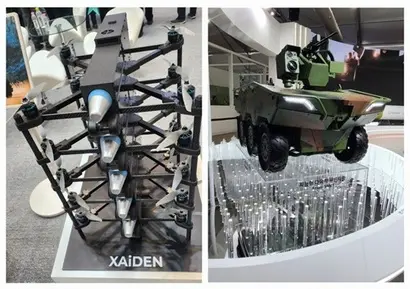
Autonomous flight drone solution company "Nearthlab" unveiled its tactical strike swarm drone solution, "XiDEN." XiDEN is a next-generation autonomous swarm attack drone capable of reconnaissance, autonomous tracking, precision strikes, and dynamic missions. A key advantage is its ability to stack up to 10 drones, allowing for rapid deployment without the need for a separate launch pad.
Nearthlab announced plans to utilize these drones on "multipurpose unmanned vehicles" in the future. The multipurpose unmanned vehicles currently being developed by Hyundai Rotem and Hanwha Aerospace are electrified, unmanned platforms. Depending on the mission—such as search, reconnaissance, logistics, or fire support—various equipment can be mounted and operated. By deploying stacked XiDEN drones on these multipurpose unmanned vehicles for surprise use in rugged field environments where human troops have difficulty operating, military forces can maximize firepower in locations that are difficult for enemies to detect. XiDEN is scheduled to undergo military operational evaluation through Army combat experiments by September.
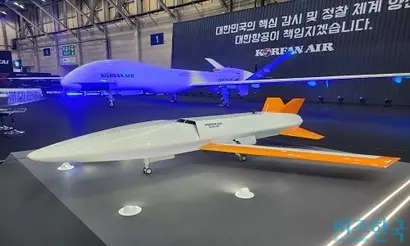
Unmanned-Unmanned systems that link large unmanned aircraft with suicide drones have also appeared. The expendable unmanned collaborative combat aircraft (KUS-RP) recently unveiled by Korean Air003490 are expected to conduct collaborative operations with large unmanned aircraft. Because expendable collaborative combat aircraft are small, they have limitations in communication range and operational radius; however, if mounted on large unmanned aircraft, communication can be relayed, thereby extending their operational range. In particular, mounting and launching the KUS-RP from the medium-altitude unmanned aerial vehicle (MUAV) developed by Korean Air could broaden its range and expand the operational environment.
More than 70% of the Korean Peninsula consists of mountains or hills. Due to the nature of this mountainous terrain, such drones are highly effective, as they mitigate restrictions on logistics support during wartime and securing ground maneuver routes during peacetime. Small, simplified drones also require less maintenance, making them advantageous in terms of operation and management.
There are also Unmanned-Unmanned systems utilizing unmanned naval vessels and drones. On the battlefield at sea, which is more challenging than on land, drones and unmanned surface vehicles (USVs) offer significant advantages. They are difficult to identify, require more resources to defend against, and can precisely strike enemy centers of gravity. LIG Nex1079550 has begun development of the "M-Hunter" unmanned surface vehicle, collaborating with the Korea Research Institute of Ships and Ocean Engineering (KRISO) under a Korea-Australia international joint research project aimed at mine countermeasure operations. In the future, the Navy plans to carry out operations where an unmanned power command and control vessel manages unmanned surface vehicles, unmanned underwater vehicles, and drones as a single weapon system. If equipped with multi-drone launchers, these unmanned vessels are expected to be used in coastal guard operations to deter North Korean air-cushion vehicles and special forces infiltrations.
Kim Min-seok, a member of the Korea Defense and Security Forum, explained, "Unmanned-Unmanned systems can achieve significant synergy by combining unmanned platforms of various sizes. The effect will be even greater when these unmanned weapons are deployed in dangerous combat zones. Given the reality of a shrinking military-age population, the military and defense industries are expected to accelerate the development of unmanned weapon systems. Utilizing advanced unmanned systems can also reduce the burden of human casualties."