

[비즈한국] It is not widely known that the ‘Jangbogo-3,’ considered a promising export item for the domestic defense industry, is surprisingly expensive for a conventional submarine. Its nature differs from other popular K-Defense products that compete based on price-to-performance ratios.
Building a single Jangbogo-3 Batch-2 submarine requires a budget of 1.1019 trillion KRW. Excluding Germany’s TKMS 212CD or France’s Naval Group conventional Barracuda submarines, this price point is among the highest. In terms of size among conventional submarines, it is also similar to or larger than the two mentioned above. Excluding Japanese submarines that are not available on the export market, unlike other K-Defense products, submarines are uniquely competing in a ‘large and luxurious’ market.
The problem is that demand for large conventional submarines is very limited, and market outlets are constrained. Aside from Israel, all nuclear-armed states utilize nuclear-powered submarines, and most countries operating conventional submarines are small to medium-sized nations with limited defense budgets or military personnel.
For this reason, while the Jangbogo-3 is an excellent submarine demonstrating world-class technology, its marketability has certain limitations. In particular, competitors from France and Germany have advantages in areas like stealth performance, meaning the Jangbogo-3 does not necessarily hold a clear edge in submarine competitions in Poland or Canada.
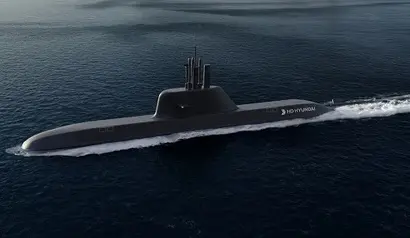
The only way to solve this is to expand the portfolio. HD Hyundai Heavy Industries has unveiled the HDS-1500, a new submarine design, to challenge the global market with a new class of export-oriented submarine.
The HDS-1500 submarine made its debut at ‘Colombiamar 2025,’ an international maritime defense conference held at the Cartagena Convention Center in Colombia. The event, held on the 12th, is a biennial conference and exhibition hosted by the Colombian Navy and the state-owned shipyard Cotecmar, aimed at exchanging technology and information for the advancement of the shipbuilding and defense industries. HD Hyundai stated that it conducted active promotion of the new submarine by setting up a joint booth with LIG Nex1079550.
The HDS-1500 is an economically attractive submarine proposed for countries like Colombia that have limited defense budgets and military personnel. With a length of 65m, a beam of 6.5m, and an underwater displacement of 1,500 tons, it is less than half the size and weight of the Jangbogo-3, offering excellent price competitiveness. Much like an ‘entry car’ that is most accessible to consumers in the automotive market, the HDS-1500 is an entry-level submarine. In fact, the HDS-1500 is similar in size and armament capacity to the Son Won-il-class (Type 214), the main submarine of the Republic of Korea Navy.
True to its status as an entry-level model, the HDS-1500 was developed with a focus on affordability. Its most significant feature is the absence of an Air Independent Propulsion (AIP) fuel cell system found in the Son Won-il-class or Jangbogo-3 submarines. While fuel cells have the advantage of significantly extending underwater endurance, they require specialized facilities to handle liquid oxygen and hydrogen, and the equipment is highly complex, necessitating long-term training for operators. The HDS-1500 has boldly removed this, drastically reducing the infrastructure required for submarine operation in smaller nations.
Instead, the HDS-1500 uses lithium-ion batteries, which are being rapidly adopted in modern conventional submarines. Currently, almost all submarines worldwide use heavy, low-energy-efficiency lead-acid batteries, and only a few countries, such as Japan and South Korea, are building new conventional submarines equipped with lithium-ion batteries. Through this, while the HDS-1500 might have slightly less continuous underwater endurance than comparable AIP-equipped submarines, its underwater endurance is several times longer than that of older submarines using lead-acid batteries.
The requirement for fewer operating personnel is another key point. While the Jangbogo-class submarine, which is similar in size to the HDS-1500, requires a crew of 32, the HDS-1500 can be operated by a crew of 25. This is half the personnel required for the Jangbogo-3. Given that highly specialized submarine crews are costly to train, it is estimated that the HDS-1500 will have significantly stronger price competitiveness in terms of Total Life-Cycle Cost compared to the Jangbogo-3.
According to HD Hyundai, the mission equipment for the HDS-1500, including the armament system, combat system, and sonar system, is built on an Open Architecture, allowing for flexible integration based on user requirements.
HD Hyundai is conducting joint marketing as a team with LIG Nex1. At the Colombiamar 2025 exhibition, the two companies set up a joint booth to conduct marketing for visitors interested in the HDS-1500. LIG Nex1 showcased imagery at the booth featuring the HDS-1500 equipped with weapon systems such as Tiger Shark and White Shark heavyweight torpedoes, sonar systems including bow sonar, flank array sonar, and ranging sonar, as well as self-propelled decoys and combat systems.
What is the export potential for the HDS-1500? What is certain is that the HDS-1500 is perfectly suited for the replacement demand for the Type 209 submarine from Germany’s TKMS (formerly HDW), which accounts for the majority of the global submarine market. The Type 209 is a best-selling submarine operated by 13 countries including the South Korean Navy. Most of these vessels have exceeded 30 years of service life and are in dire need of replacement, yet many of these nations find it difficult to build new submarines due to budget constraints. Targeting this, the HDS-1500 is expected to appeal to export markets by combining strong price competitiveness with underwater endurance capabilities far superior to previous-generation submarines due to its lithium-ion batteries, as well as upgraded offensive capabilities powered by an advanced combat system.
In particular, since the Type 209 is operated or has been operated by countries such as Colombia—where this exhibition was held—as well as Argentina, Peru, Chile, Ecuador, and Venezuela, significant order successes are expected if exports focus on the South American market.