

[비즈한국] Chile, currently pushing for the modernization of its navy, has launched an acquisition project for next-generation large submarines to replace its decommissioned fleet. Domestic special vessel manufacturers Hanwha Ocean042660 and HD Hyundai Heavy Industries329180 are expected to participate in the bidding. In particular, it is anticipated that the financial burden on companies will be significantly reduced as Chile does not require defense export financing.
According to recent reports by local Chilean media, the Chilean Navy is finalizing paperwork with the Ministry of Defense to retire two aging submarines that have reached the end of their service life and replace them with new vessels. In an interview with local media, Juan Andrés De la Maza, Commander-in-Chief of the Chilean Navy, explained that the Navy intends to retire two old German-made submarines that have been in operation for over 40 years and introduce replacement vessels.
Chile possesses a coastline stretching over 4,300 km, protruding toward the Pacific basin, and maritime trade accounts for 93% of its total foreign trade. Consequently, the country has long been heavily invested in its maritime power. Currently, Chile operates two German conventional submarines and two French Scorpène-class submarines.
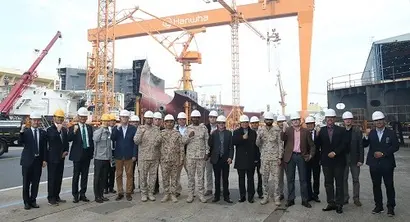
Chile raised the requirement for the new submarine project in May last year and has completed research on performance specifications and expected costs. On November 14 last year, Chilean military officials visited the Hanwha Ocean Geoje shipyard to receive briefings on submarine construction technology, ability to meet delivery deadlines, and submarine operational capabilities.
They also visited an HD Hyundai facility, where they personally examined a new export-oriented submarine model being developed by the company. It is known that HD Hyundai provided briefings on the basic design of its 3,000-ton class submarines.
The Chilean military, like South Korea, employs Western weapons systems and follows NATO standards, which offers the advantage of easy interoperability with Korean military systems. Furthermore, since Chile does not require export financing for the procurement of strategic goods, the burden on contractors can be reduced. Chile plans its mid-to-long-term requirements in advance and reflects them in its budget before pursuing the acquisition of strategic goods, meaning there is no need to offer export financing to Chile for defense exports.
It is predicted that the competition for this submarine acquisition project will involve the French Scorpène-class submarines. Chile has already been operating Scorpène-class submarines delivered in the mid-2000s.
Chile is currently a key security cooperation partner for South Korea. In 2022, marking the 60th anniversary of diplomatic ties, the two countries elevated their relationship to a "Strategic Partnership." Both nations maintain defense cooperation by dispatching military attachés (Republic of Korea Marine Corps and Chilean Navy). The Korea-Chile Defense Cooperation Agreement came into effect in September 2023, defining various areas of military cooperation and provisions to support such efforts.
An industry insider explained, "The upcoming next-generation submarine project is not just a simple procurement of defense materiel; it is expected that Chile's civil and military sectors will seek to strengthen national defense and develop their defense industry by receiving expertise from the exporting nation. Because the Chilean defense industry has a foundation for regional expansion, it is possible for the two countries to be mutually complementary rather than competitive in terms of industrial structure."