

[비즈한국] Megabox JoongAng has acquired the TV broadcasting rights for Seoul city buses. Starting this month, it has begun installing dedicated TV terminals on buses to broadcast video content and advertisements. With the domestic film industry mired in a slump and persistent poor performance, Megabox JoongAng appears to be accelerating its search for new business models.

Deficits since 2020, Urgent Need to Find New Revenue Sources
Megabox JoongAng, which continues to face declining performance, is focused on identifying new revenue streams. Starting this year, the company is launching a TV business for Seoul city buses. This business involves broadcasting video content and commercials through TV monitors installed inside city buses.
Megabox JoongAng began installing the TV monitors this month. The setup features a 37-inch wide monitor attached to the ceiling, directly behind the driver's seat. Currently, it is in an operational test phase, displaying content such as trailers for upcoming films at Megabox theaters.
A Seoul city official explained, "Megabox JoongAng was selected as the new operator (for the city bus TV business) this year. The contract period runs until December 31, 2031. Because the project requires a full replacement of the TV terminals, a long contract term was set."
Until last year, the city bus TV business was managed by Korea Bus Broadcasting (YapTV). With Megabox JoongAng winning the rights this year, it has secured exclusive rights to provide video advertising services on approximately 5,000 buses. Megabox JoongAng has previously engaged in advertising through cinema screens and outdoor media, and this year, it appears to be expanding its platform to include bus TVs.
Megabox JoongAng is deeply focused on exploring new business opportunities. The KINTEX branch, which closed in September last year, is currently being converted into an ice rink. The company also established a subsidiary named Mega Ice Box in May of last year to operate the rink.
Megabox JoongAng reported revenue of 291.6 billion KRW and an operating loss of 13.4 billion KRW last year. It has struggled to break free from the cycle of deficits that began in 2020. It recorded operating losses of 67.7 billion KRW in 2020 and 68.3 billion KRW in 2021, and posted net losses of 7.8 billion KRW in 2022 and 14 billion KRW in 2023. Its debt ratio is also worsening. As of the end of last year, Megabox JoongAng’s debt ratio stood at 806%, with total capital at 108.6 billion KRW and total liabilities at 876 billion KRW. The debt ratio, which was 605% at the end of the third quarter, surged by more than 200 percentage points in the fourth quarter.
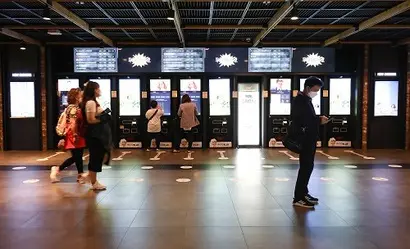
'Cliff's Edge' Film Market, Growing Sense of Crisis for Megabox without Overseas Operations
The multiplex industry has seen a growing sense of crisis since COVID-19. The pandemic reduced the frequency of theater visits, and as the OTT market expanded during this period, people increasingly turned to watching movies at home. With the price of a movie ticket being compared to a monthly OTT subscription fee, moviegoers have begun to perceive theater ticket prices as expensive.
According to the Korean Film Council, the total number of moviegoers visiting domestic theaters last year was 123.13 million, a 55.7% decrease compared to pre-pandemic levels (2017–2019). One moviegoer remarked, "I watched a movie that was released in late January for free on an OTT platform early this month, less than two months later. Since works shown in theaters are appearing on OTT platforms so quickly, it feels like there is less and less reason to visit theaters."
Lee Eun-hee, a professor of Consumer Science at Inha University, forecasted, "With the expansion of OTT services during the pandemic, the consumer habit of enjoying content at home has solidified. From now on, the number of audiences visiting theaters solely to watch films will continue to decrease."
CJ CGV, the top player in the multiplex industry, implemented voluntary retirement last month for assistant manager-level employees with seven or more years of service. CGV stated that about 80 employees left the company through this program. CGV has been reducing its workforce through voluntary retirement since 2020. It previously held voluntary retirement programs in 2020 for employees with 10 or more years of service and again in 2021.
This month alone, CGV is shutting down three of its theater locations. The CGV Yeonsu Station branch and Songpa branch will close on March 23, and the Gwangju Terminal branch on March 31. Notably, with the closing of the CGV Songpa branch, the company will no longer have any theaters in Songpa-gu, the most populous district in Seoul.
The prevailing observation is that the film market will be even more difficult this year than the last. This is because the slump in the film market is leading to fewer new investments, productions, and theatrical releases. Even during peak seasons like school breaks and holiday periods, the number of people visiting theaters is on the decline.
Prospects for a recovery in Megabox's performance also appear dim. Industry experts express concern that Megabox is the only one of the three major multiplex chains that relies solely on its domestic business. Despite poor domestic performance last year, CJ CGV and Lotte Cinema managed to maintain overall profits by achieving results in their overseas operations. In contrast, Megabox is heavily affected by the shrinkage of the domestic film market because it lacks an international presence.
Seo Yong-gu, a professor of Business Administration at Sookmyung Women's University, explained, "The film industry is in a very difficult situation due to OTT services. Now, the multiplex industry must change its business model itself to survive. The entire industry will likely attempt transitions to new business models."
A Megabox JoongAng representative stated, "We are striving to consistently offer exclusive screenings that can only be seen at Megabox, and we are continuing to make investments, such as replacing all seats at the Gangnam branch with recliners. Although the theater business is difficult, we aim to consistently provide reasons for audiences to visit. We are also considering areas where we can be a business partner in various spaces, not just theaters."