

[비즈한국] Lotte Himart071840 Jamsil branch, the largest home appliance retailer in Seoul’s Songpa District. In the TV section here, Chinese electronics manufacturer TCL’s ‘QD-Mini LED’ models are displayed side-by-side with premium TVs from Samsung Electronics005930 and LG Electronics066570. While TCL previously showed limited growth in the domestic market—a stronghold for the two Korean giants—it has recently begun a full-scale offensive on the premium TV market and is strengthening its offline retail channels. Products once relegated to online sales have returned to physical stores, moving out of the budget corners to take their place among high-end, large-appliance lineups.
Domestic companies, confident in their hold on the premium TV market, are also engaged in a fierce strategic battle to maintain their dominance. On the 10th, both Samsung Electronics and LG Electronics signaled a new product rivalry by simultaneously unveiling premium TVs equipped with artificial intelligence (AI) features. These go beyond simple control through natural language instead of a remote; they incorporate capabilities such as diagnosing issues on their own or serving as home security hubs. LG's parallel strategy of OLEDE and QNED to counter China's premium LCD TV offensive is also drawing attention.
OLED Powerhouse LG, Moving Forward with QNED as Well
LG Electronics is a traditional powerhouse in the OLED (Organic Light-Emitting Diode) TV market. Leveraging superior technology, it has focused its marketing on OLED TVs within the premium segment. As self-emissive displays, OLEDs have clear advantages in volume and weight over LCDs, which require backlights and color filters. The structure is inherently more favorable for color reproduction, contrast ratios, response speeds, and viewing angles.
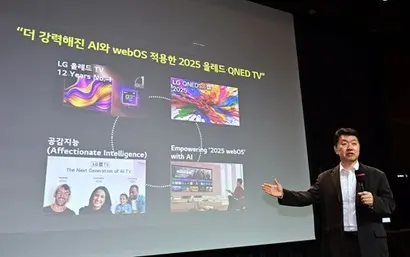
A shift can be detected in LG Electronics' strategy this year. On the 10th, LG Electronics held a 2025 new product briefing at LG Science Park in Gangseo-gu, Seoul, and introduced its ‘dual track’ strategy. The plan is to target both markets simultaneously with new OLED and QNED TV models. As Chinese manufacturers expand their influence in the premium market with LCD-based ultra-large Mini LED TVs, LG intends to proactively secure this segment as well.
QNED (Quantum Nano-Emitting Diode) is an intermediate stage between LCD and OLED, and is fundamentally LCD-based. It significantly reduces the size of the LEDs in the backlight, improving upon the drawbacks of conventional LCD TVs, such as contrast ratios. Because the unit cost is relatively lower, it offers price competitiveness compared to OLED.
Paek Seon-pil, Head of TV Product Planning at LG Electronics (Senior Vice President), explained the parallel strategy by saying, “Think of it as the Genesis (OLED) and the Grandeur (QNED). There are customers who want a very high level of high-definition imagery at price points of $1,500 or $2,000 and above, as well as those who want to enjoy high-quality video at a reasonable price.”
Although domestic firms are widening the gap with China, tensions are high as China’s influence in the global TV market grows. In the $2,500-plus high-end premium TV market, Samsung and LG hold approximately 50% and 30% shares, respectively, while Chinese companies account for about 3% in total. In terms of revenue, Samsung Electronics was the No. 1 TV brand last year, and LG Electronics leads the OLED market. These represent 19 and 12 consecutive years of leadership, but the gap with China is narrowing.
In particular, based on shipment volume, China caught up last year. According to market research firm Omdia, China (TCL, Hisense, Xiaomi) achieved a combined shipment share of 31.3% in 2024, surpassing Samsung and LG’s combined 28.4%. This is the first time Korea has fallen behind China.
Will Samsung and LG Succeed in Capturing the Utility and Differentiation of 'AI'?
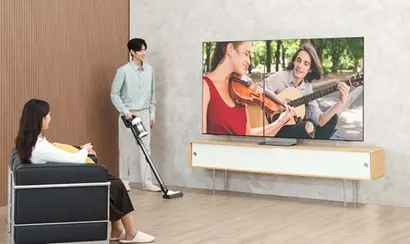
The most prominent feature in the 2025 new products from Samsung and LG is AI. Moving beyond the early stages of AI introduction, the expansion into functions like a "home butler" or a "problem-solving assistant" is notable. AI upscaling has also been advanced for optimized picture and sound quality.
While AI is being incorporated into almost all product lines, whether small or large appliances, there are varying perspectives on the utility of AI TVs. Some argue that for TVs, which are used to change channels and watch news, movies, or dramas, the necessity or utilization of AI features is not significant. Some users feel it is "complicated," worrying about price hikes, finding that AI gets in the way of operation, or experiencing inaccurate recommendations and voice recognition errors.
Looking at the AI features of both companies, one can see signs of careful consideration regarding where AI can be applied to maximize user satisfaction. Samsung Electronics’ 'Home Insight' feature recommends necessary actions—such as turning off devices while away or turning on the kitchen hood while cooking—by considering the user's lifestyle patterns, usage history, and current home environment. Home monitoring to detect abnormal movement and real-time alerts are also included. A 'Click to Search' button for content recommendations has been added to the remote control.
LG Electronics has focused on improving convenience while using the TV. Beyond features like 'AI Picture/Sound Mode' and 'AI Voice' for personalization, it provides an 'AI Chatbot' to solve simple problems without calling customer service, and an 'AI Search' that understands and searches for content based on customer requests using a Large Language Model (LLM).
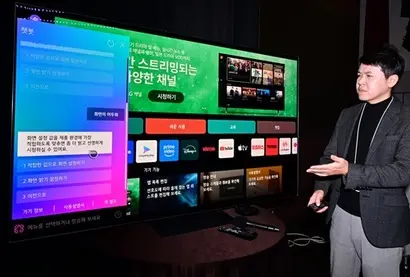
Heo Seung-hyun, Head of the AI Service Development Team, explained, “A TV is a family device, so personalization is difficult, but Voice ID allows for recognizing users to provide customized recommendations, screen settings, and voice configurations. If you ask, ‘What was the movie Yuh-jung Youn won an Academy Award for?’, it can also search for content by utilizing generative AI based on its hybrid structure of empathetic intelligence.”
The TV's internal chatbot operates based on Microsoft’s Copilot, OpenAI’s ChatGPT-4o, and Google’s Gemini, running on top of LG’s proprietary webOS (operating system). Currently, the AI chatbot supports 47 problem-solving scenarios, which is limited for addressing all situations, but there are plans to expand Gemini’s support in the second half of this year.
Beyond picture and sound quality, will additional functions like AI be an effective differentiation strategy in the premium TV market? Executive Paek emphasized, “Supporting 23 languages to the point where the TV even provides verbal answers is a significant difference compared to other TV manufacturers. While China has grasped hegemony through panels, they do not have the SoC (System on Chip) or webOS. I believe the technological gap is clear.”