

[비즈한국] The 'Frontline Anti-Drone Integrated System' project, designed to counter the threat of North Korean small unmanned aerial vehicles (UAVs), is set to begin in earnest this year. Hanwha Systems272210 and LIG Nex1079550, which previously locked horns in a low-bid battle for the 'Critical Area Anti-Drone Integrated System' project, are expected to participate in this one as well. Both LIG Nex1 and Hanwha Systems are pushing anti-drone systems as their new growth engines. Since the procurement system selects vendors primarily based on their bid price, this project is expected to see an intense battle of nerves over pricing rather than a competition of technical prowess.
According to the Defense Acquisition Program Administration (DAPA) on the 11th, the feasibility study for the Frontline Anti-Drone Integrated System project has been completed, and the procurement contract will follow after the project strategy is established this year. The total budget for the project is 121.7 billion KRW, and it is reported that deployment will be completed by 2027.
Initially, the project faced a potential delay as nearly the entire budget was slashed by the National Assembly last year. The Democratic Party of Korea cut 9.954 billion KRW of the 10 billion KRW allocated for this year, effectively eliminating the funding.
While the 'Critical Area Anti-Drone Integrated System' project for rear-echelon areas is proceeding normally after being won by Hanwha Systems, it was widely expected that the 'Frontline Anti-Drone Integrated System,' which focuses on General Outpost (GOP) areas, would be delayed this year due to the budget cuts. However, according to the medium-term defense plan, the project is expected to proceed this year, with budget allocations normalizing starting next year following the vendor selection.
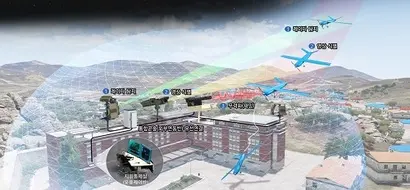
The Frontline Anti-Drone Integrated System project pushed by DAPA aims to establish drone detection and protection systems across border regions adjacent to North Korea. Mentioned methods include equipping frontline and critical areas with UAV defense capabilities, not only neutralizing enemy drones via jammers but also employing "hard-kill" methods to directly strike UAVs and trash-filled balloons.
Hanwha Systems and LIG Nex1 are expected to participate in this project. In particular, since it is a procurement project, a lowest-bidder approach is anticipated, leading to an intense war of nerves. Tories Square is considered a strong candidate for a subsystem supplier.
Hanwha Systems won the 'Critical Area Anti-Drone Integrated System' project in 2023. They secured the contract by bidding 29 billion KRW, which is less than 60% of the total budget of 48.6 billion KRW. Their stance is that they entered the project, even at the cost of profitability, as an "investment" to gain a foothold in subsequent projects and the broader drone defense market. At the time, their competitor LIG Nex1 reportedly bid 37.3 billion KRW.
Hanwha Systems is expected to invest heavily in this project as well, with the goal of winning all front and rear-echelon anti-drone related contracts. Han Sang-yoon, Senior Vice President of Hanwha Systems, emphasized during the earnings conference call on the 7th of last month that "the Frontline Anti-Drone Integrated System is a key project for this year."
LIG Nex1 is also reportedly contemplating a bid. Having learned from their defeat in the Critical Area anti-drone project, they are determined to win this contract by further advancing their anti-drone technology. LIG Nex1 is currently developing a "soft-kill" type Korean jammer called the 'Small UAV Countermeasure System (Block-1),' which detects small drones and emits jamming signals to deviate them from their flight paths or induce a crash.
The defense industry is concerned about the negative impacts on system integrators and their partners due to excessive lowest-bid competition. An industry official explained, "In the previous anti-drone project, both Hanwha Systems and LIG Nex1 lowered their bids because the vendor selection was centered on the proposed price, sparking controversy over low-cost bidding. If the lowest-bid system dictates which companies are chosen over technological merit, system providers have no choice but to bid low, and that damage may be passed on entirely to subcontractors. Systemic improvements are necessary."