

[비즈한국] Foreign investors continue to flee the domestic stock market. The proportion of foreign market capitalization has failed to recover to the 30% range since August 2024, and the value of foreign holdings dropped from 738 trillion won at the end of 2023 to 666 trillion won by January 2025. Sensing a crisis, the government pushed for a "Value-Up Program" to resolve the "Korea Discount" and introduced the "Korea Value-up Index," consisting of 105 undervalued blue-chip stocks. Each week, we select one stock from the index to analyze its management status and corporate value enhancement plans, determining whether it is a promising pick that can prevent the "fall of the Korean stock market."
In the stock market, Kia moves in tandem with Hyundai Motor005380. The two companies, often described as "two families under one roof," are the leading finished car manufacturers in the domestic stock market. As of the 11th, Kia ranked 5th among the stocks in the Korea Value-up Index, with a market capitalization of 39.131 trillion won, a share price of 98,400 won, and a price-to-book ratio (PBR) of 0.84x. Its 1-year return is –23.7%, 6-month return is –2.2%, and 3-month return is 2.3%, indicating that its share price has fallen significantly compared to a year ago.
The reason for the large decline is that its share price rose sharply in early 2024. Kia had been moving while maintaining a market cap and share price lower than those of Hyundai Motor. However, on January 31, 2024, Kia's share price hit a 3-year high (102,900 won), and its market capitalization (41.3703 trillion won) surged, surpassing that of Hyundai Motor (41.164 trillion won). The upward trend continued until the end of July, with the share price exceeding the 120,000-won range. On June 19, 2024 (closing price of 132,300 won), the day it recorded its annual high, it reached a market cap of 52.9013 trillion won.
At the time, the market attributed Kia’s surge in market capitalization to its strong performance and robust shareholder return policies. Having recorded record-breaking results in 2023 with 99.8084 trillion won in revenue and 11.6079 trillion won in operating profit, Kia introduced measures to enhance shareholder value, such as increasing dividends and repurchasing/canceling treasury shares, which effectively boosted its stock price.
However, the effect did not last long. Since August 2024, the share prices of both Kia and Hyundai Motor have fallen due to the "chasm" (a temporary stagnation in demand) for electric vehicles. The decline in global sales, driven by shrinking overseas demand and intensifying competition during the same period, also played a role. Furthermore, with the stock market overall struggling due to deteriorating internal and external conditions, the stock has been unable to easily recover.
Nevertheless, considering its earnings and shareholder return policies, the potential for a stock price boost remains. Kia’s 2024 performance reached a new record high, following the previous year. Revenue exceeded 100 trillion won (107.4488 trillion won) for the first time on an annual basis, and it recorded its highest operating profit margin (11.8%) with an operating profit of 12.6671 trillion won. Vehicle sales set a record at 3.0893 million units. Kia has set its 2025 performance targets at 112.5 trillion won in revenue, 12.4 trillion won in operating profit, and an 11.0% operating profit margin.
It also aggressively expanded its dividends and treasury share buyback/cancellation plans. On January 23, Kia announced a year-end dividend of 6,500 won per common share. The dividend record date is March 19. In addition, it announced plans to repurchase 700 billion won worth of treasury shares in the first and second halves of this year and cancel 100% of them. Last year's year-end dividend was 5,600 won, and the buyback scale was 500 billion won; these figures represent increases of 16% and 40%, respectively. Kia’s projected total shareholder return (the actual yield investors can get while holding the stock) for 2025 is 33.3%.
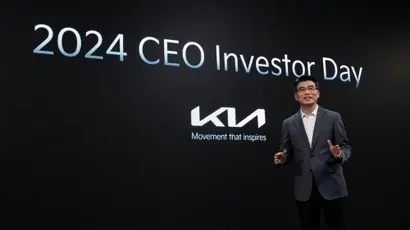
In December 2024, Kia announced its mid-to-long-term corporate value enhancement plan for 2025–2027. The mid-to-long-term goals set by Kia are primarily divided into: long-term external growth (average annual revenue growth of over 10%), maintaining high profitability (operating profit margin of over 10%), and enhancing capital efficiency (total shareholder return of over 35%), starting with a sustained ROE of 15% or higher.
Regarding concrete shareholder return policies, it is notable that the total shareholder return target has been fixed at 35% for the next three years. It was set at 25–30% for 2019–2023 and 30–35% for 2024. To achieve this, Kia announced it would split treasury share buyback periods, maintain a dividend payout ratio of over 25%, and provide stable returns by setting a minimum dividend of 5,000 won per share.
Kia, which is transitioning into a "sustainable mobility solution manufacturer," also unveiled plans for new business expansion. Kia's flagship products are leisure vehicles (RVs) such as the Carnival, Sportage, and Sorento, but it has recently been expanding its business by focusing on Purpose-Built Vehicles (PBV) as a future growth engine. PBVs refer to simple transportation and delivery vehicles designed with a focus on their purpose rather than existing driver-centric vehicles. Kia aims to create new revenue streams by establishing a dedicated PBV lineup, such as the PV5 and PV7, and expanding platform services for Software-Defined Vehicles (SDVs).
However, the volatility of the market environment, such as the Trump administration's tariff policies in the U.S., is a key variable. Park Gwang-rae, a research fellow at Shinhan Securities, analyzed, "In the short term, variables like tariffs and exchange rates will have a greater impact on the stock price than sales performance. In the case of U.S. tariffs, it will increase stock price volatility until the final plan is announced. In Europe, the proposed relaxation of carbon emission regulations has made a readjustment of the electric vehicle strategy inevitable."
Song Sun-jae, an analyst at Hana Securities Research Center, predicted, "It is positive that Hyundai Motor and Kia have increased their market share as sales exceeded expectations, but they are bound to be sensitive to policy variables that affect market demand. Uncertainties will continue to be reflected in the stock price, causing continued fluctuations."