

[비즈한국] U.S. President Donald Trump's fluctuating stance on tariffs against Mexico and Canada has fueled ongoing uncertainty. As a result, there is a growing movement to identify sectors that can benefit while being less affected by Trump's policies. In particular, as the Trump administration aims to revive the shipbuilding industry and weaken China's dominance in the global shipping market, projections are emerging that it will have a positive impact on Korea's shipbuilding and shipping industries.
In his speech at a joint session of the Senate and House of Representatives at the U.S. Capitol in Washington D.C. on the 4th, President Trump stated, "I will create a new department for the U.S. shipbuilding industry in the White House," adding, "We will revive both the military and commercial shipbuilding industries to boost the U.S. defense industry." This move is interpreted as a measure to keep China in check from a security perspective. The U.S. shipbuilding and shipping industries have historically been under protectionist policies as they form the core of U.S. military and economic power. However, criticism has been persistent that U.S. maritime hegemony is being threatened by China.
Last year, the U.S. Congress proposed the ‘SHIPS for America Act’ (Securing Maritime Equipment and Logistics for America), which would allow U.S. ships to be built in allied countries with mutual defense treaties and encourage domestic shipbuilding. By the end of World War II, the number of U.S.-flagged international trade merchant vessels (including naval support ships) had reached 10,000, but that number has now dwindled to 80. The number of shipyards in the U.S. has also decreased to 20, and most of those remaining are dedicated to building naval warships.
In contrast, while the U.S. shipbuilding and shipping industries were in decline, China has overwhelmed the global market share since its entry into the World Trade Organization (WTO) in 2001. It is evaluated that China has even seized maritime hegemony in East Asia by increasing its warship construction capabilities based on its shipbuilding infrastructure.
Although the bill was scrapped due to the end of the congressional session, observations have been raised that opportunities might open up for the Korean shipbuilding industry as President Trump sent a message of cooperation to the domestic industry.
Lee Young-ju, an analyst at Hana Securities, predicted, "Even U.S. companies will have to reduce their networks with China and seek alternative supply chains," adding, "The possibility of rising additional costs and pressure on corporate margins will grow." The analyst further forecasted, "China will also try to expand its influence in new markets such as Asia and Europe in the long term."
On the 21st of last month, the Office of the United States Trade Representative (USTR) unveiled a sanction plan to impose fees on Chinese shipping companies' vessels or Chinese-made vessels entering U.S. ports. Regarding the impact on the shipping industry, Jung Yeon-seung, an analyst at NH Investment & Securities, said, "While there are expectations of reflected benefits for domestic shipping companies, domestic carriers cannot completely avoid the fee measures either." He added, "Since container shipping companies are hit hardest by these measures, HMM011200, which has a low proportion of Chinese-made ships, is expected to receive reflected benefits, but a slowdown in performance is inevitable as spot freight rates are recently falling."
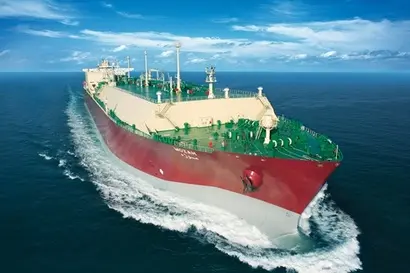
Regarding the shipbuilding sector, he analyzed, "The price advantage of Chinese ships will be partially undermined," adding, "For LNG carriers that export a large amount of U.S. cargo, the merit of ordering Chinese-made ships has disappeared." Analyst Jung also noted, "The value of slots (shipbuilding space) at Korean shipyards will increase further," and said, "Although new shipbuilding prices are not rising due to the current sluggishness in the shipping market, it will be possible to maintain at least current price levels due to recent moves to resume container ship orders and the expansion of LNG development." This suggests that it has become easier for Korean shipbuilders to secure orders, and their bargaining power for ship prices will also increase. Along with this, he expected, "In the long term, the need for ships built within the U.S. will rise, increasing the value of U.S. shipyards as well."
Of course, there is a cautious view that it remains to be seen whether this will become an opportunity. It is assessed that it takes significant capital to invest in the dilapidated U.S. shipbuilding industry, and it is uncertain whether it will yield returns proportional to the investment. Global financial group ING analyzed, "The U.S. shipbuilding industry lacks the capability to build next-generation large container, tanker, and bulk carriers," adding, "New construction costs will soar, and it will be difficult to secure necessary personnel."
Lee Dong-heon, a research fellow at Shinhan Securities, advised, "Pressuring tariffs and responses to war trends may be part of Trump's extreme negotiation strategy, but it is a risk that will persist throughout the next four years of the Trump administration," adding, "One should maintain at least a market-weight position in shipbuilding and defense, and respond based on the differentiation between individual stocks."