

[비즈한국] One week after the breakdown of a national policy consultative group, the floor leaders of the ruling People Power Party and the main opposition Democratic Party of Korea met again on the 6th to discuss livelihood issues, including the compilation of a supplementary budget. The ruling and opposition parties agreed to hold a third meeting on the 10th to further discuss the supplementary budget bill prepared primarily by the government and the ruling party.
While both sides agree on the need for a supplementary budget, the Democratic Party’s 13 trillion won "livelihood recovery consumption coupon" project remains a variable. However, there is a possibility of reaching a compromise, as Democratic Party leader Lee Jae-myung proposed a youth job creation budget last month in lieu of the consumption coupon budget, considering the ruling party's opposition. Nevertheless, despite the massive budget poured into job projects, the effect on increasing the number of employed individuals is declining, and employment among the youth, in particular, is deteriorating.
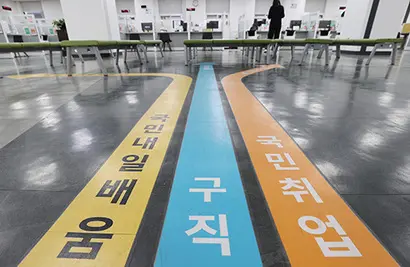
In fact, while the government has been investing around 30 trillion won in government-supported job projects over the past five years, the results in terms of the increase in employed individuals have not been very good. Recently, the job growth effect per 100 million won of the job budget has fallen to 0.54 this year, breaking below the 1-person threshold once again. Furthermore, although the budget for job projects is increased every year, the age group benefiting from these projects is concentrated in those in their 60s, suggesting a need for more targeted budget allocation for the youth.
According to the Ministry of Employment and Labor and other sources, the budget for government-supported job projects has shown a significant upward trend over the past 10 years, with the exception of 2023 and 2024. The budget, which was 13.9766 trillion won in 2015, surged by 12.9% to 15.7796 trillion won in 2016 and continued to rise significantly each year. In 2019, it surpassed the 20 trillion won mark, reaching 22.9308 trillion won, a 19.2% increase from the previous year (19.2312 trillion won). Subsequently, as the COVID-19 pandemic hit the economy and caused job losses, the government invested 25.4998 trillion won in job projects in 2020 and crossed the 30 trillion won mark in 2021 by allocating 30.5131 trillion won.
This upward trend continued in 2022, with the budget for job projects rising to 31.5808 trillion won. After the COVID-19 situation subsided, the budget declined to 30.3481 trillion won in 2023 and 29.1914 trillion won in 2024. However, as forecasts emerged that the nation's economic growth rate would remain in the 1% range this year, the job project budget increased by 4.2% from last year to 30.4089 trillion won, crossing the 30 trillion won threshold again after two years.
While the government allocates around 30 trillion won to job projects, critics point out that the ability to increase employment through budget injections has reached its limit. In 2020, when the COVID-19 crisis was at its peak, the number of employed people decreased by 218,000 compared to the previous year. Although the job creation effect per 100 million won was negative, it could be argued that it prevented a worse employment situation.
Indeed, there were times when the job creation effect improved. In 2021, the number of employed people increased by 369,000 compared to the same period of the previous year, showing a job creation effect of 1.21 persons per 100 million won. In 2022, as the number of employed people surged by 816,000, 2.58 jobs were created per 100 million won of the budget.
However, from 2023, the job creation effect began to decline. In 2023, the increase in the number of employed people was 327,000, and job creation per 100 million won fell to 1.08. In 2024, the increase in employment dropped to 159,000, and job creation per 100 million won stagnated at just 0.54.
In particular, given that the employment rate for the youth (aged 15-29) has continued to decline during this period while the employment rate for those aged 60 and older has been on the rise, critics point out that the benefits of the job budget may be overly concentrated on the elderly. The youth employment rate rose from 44.2% in 2021 to 46.6% in 2022, but has since fallen to 46.5% in 2023 and 46.1% in 2024. Conversely, the employment rate for those aged 60 and older has risen every year, from 42.9% in 2021 to 44.5% in 2022, 45.5% in 2023, and 45.9% in 2024.