

[비즈한국] North Korea is nearing the completion of an indigenous airborne early warning and control (AEW&C) aircraft. Known as the "command post in the sky," the AEW&C is a high-tech asset that South Korea is currently seeking to acquire from abroad due to a lack of domestic technological capabilities. How was this possible, and how should we respond?
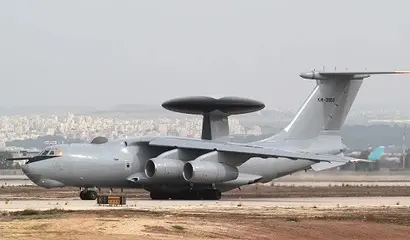
In August 2024, the U.S.-based North Korea analysis outlet '38 North' reported that North Korea had begun suspicious activities in a corner of Sunan International Airport, based on commercial satellite imagery. An old Soviet-made IL-76 transport aircraft, previously used by the civilian carrier 'Air Koryo', had been cordoned off, and the North began modifying the airframe. 38 North analyzed this as foundational work to convert the IL-76 into an AEW&C aircraft.
On March 4, 38 North released a new model of the transport aircraft parked at Sunan Airport. A radome housing a massive radar had been installed on the transport. There is now no doubt that this aircraft is an AEW&C. North Korea's indigenous development of such an aircraft is now a confirmed fact.
Why is this a problem? As mentioned earlier, the AEW&C is nicknamed the "command post in the sky," but it actually possesses capabilities far beyond that. Equipped with high-output, long-range radar, an AEW&C can not only detect the movements of enemy air forces but also carry flight controllers on board to direct friendly aerial operations in real-time. Because it can detect targets from much farther away than fighter jets or other aircraft, a country with an AEW&C has a significant advantage in aerial warfare. Until now, the Republic of Korea Air Force has maintained superiority using the E-737 'Peace Eye', a platform North Korea did not possess.
However, once North Korea begins operating its own AEW&C, the situation changes. As the information gap narrows, we could find ourselves at a disadvantage in air battles against the North Korean Air Force.
Of course, some argue that the AEW&C North Korea is building isn't the real deal. South Korea also faces difficulty in domestic AEW&C development, which is why foreign companies have offered to transfer development technology during our ongoing second-phase acquisition project. However, Iraq, which possessed far less technological prowess than North Korea, successfully created the 'Baghdad' and 'Adnan' AEW&C aircraft by modifying IL-76 transports in the late 1980s. Furthermore, North Korea has already secured phased-array radar technology—the core of an AEW&C—and deployed it on surface-to-air missiles and new combat ships.
Visually, the new AEW&C under development in North Korea features a radar design similar to the Indian Air Force's 'A-50EI' and the Chinese Air Force's 'KJ-2000'. Both of those aircraft, like the North Korean model, were modifications of the IL-76 transport, which differ in configuration from the Russian-modified IL-76 AEW&C versions. The black disc-shaped radar with white triangles suggests that the North Korean aircraft utilizes three phased-array radar panels and does not mechanically rotate the radar.
However, there are two differences compared to the IL-76 AEW&C aircraft of other countries. First, there are no visible ESM (Electronic Support Measures) or IFF (Identification Friend or Foe) antennas. As noted, an AEW&C is not just for detection; it must distinguish between friend and foe, identify unknown aerial objects, and possess self-defense capabilities, which require various antennas and electronic warfare equipment. These are not yet identifiable on the North Korean aircraft.
The other difference is the location of the radar. Unlike the Chinese or Indian versions, the North Korean radar appears larger and is positioned in the center of the fuselage. This suggests that rather than simply importing the radar from China or Russia, North Korea developed it domestically; the radar became large, forcing them to move its mounting point to the center of the fuselage to balance the aircraft's center of gravity.
What are the military implications once this North Korean AEW&C is completed? In my personal opinion, it will significantly bolster the defense of North Korea, particularly the capital, Pyongyang. Given the size and performance of the radar, it is highly likely that the North Korean AEW&C could detect aircraft operating not only near the Military Demarcation Line but also within parts of South Korean airspace while flying over Pyongyang. For North Korea, this means they could detect South Korean fighter jets taking off for airstrikes in advance, significantly improving their air defense posture.
While it is unlikely they would deploy their precious AEW&C—of which they will likely only produce one or two—to the front lines, if it patrols areas around Kim Jong-un, it would certainly pose a major obstacle to our military's preemptive strike and Kill Chain strategies.
However, we do have countermeasures. Several weapon systems currently under development can counter North Korea's AEW&C. Since the AEW&C was built by modifying a transport plane, its agility is limited. If the warheads and seekers of supersonic anti-ship missiles currently under development are slightly modified, a "sniper" mission to shoot down the AEW&C from long range becomes possible. Furthermore, small jet-powered drones such as the AAP-150 and KUS-RP, currently being developed by Korea Aerospace Industries047810 and Korean Air003490, could be equipped with electronic warfare gear to act as decoys, feeding false information to the North Korean AEW&C.
It is an undeniable fact that North Korea's military science and technology lag behind those of South Korea. Yet, due to its abnormal state system, North Korea occasionally achieves indigenous production of assets like AEW&C or air-to-air missiles ahead of South Korea. Given the recent rapid strengthening of ties between North Korea and Russia, we must be vigilant about the possibility of such "anomalous overtaking" occurring again in the realms of defense science and the defense industry.