

[비즈한국] Huawei, China's largest telecommunications equipment manufacturer, is making a dramatic comeback to the global smartphone market, overcoming U.S. sanctions. By unveiling the industry's first "tri-fold smartphone," the company is attempting to project an image as a cutting-edge, innovative brand while embarking on a recovery beyond China.
Having skipped CES, the world's largest consumer electronics show held in the U.S., for several years, Huawei selected this year's "Mobile World Congress (MWC)" as its global stage for re-entering the smartphone ecosystem. The company is also accelerating its collaboration with DeepSeek, the Chinese generative AI that has shaken the global information and communications technology (IT) industry since the start of the year. As China’s rise, fueled by advanced technology as a new engine for economic development, expands into the mobile sector, attention is focused on whether major companies like Huawei can achieve the same level of success overseas as they did in the past.
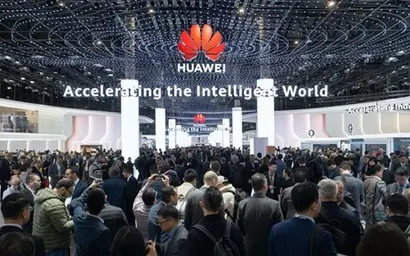
Starting the Comeback with a 5 Million Won Ultra-Premium Tri-fold Phone
At MWC, Huawei put two of its latest flagship smartphones and AI-focused network solutions at the forefront. The world's first tri-fold phone, the "Mate XT," began global sales two weeks ago following its release in the Chinese market last September. Although this product was effectively revealed six months ago, it is drawing attention at the event for being the first commercially available tri-fold phone, beating competitors like Samsung, and for its high price tag, which well exceeds 5 million KRW.
The price barrier is interpreted as a sophisticated strategy. The Mate XT is priced at 3,499 euros (approximately 5.41 million KRW) for the main overseas sales model (16GB RAM/1TB storage). As one of the most expensive smartphones currently on the market, it is scheduled to be sold first in countries such as Saudi Arabia and the UAE. The Mate XT can be used as a 6.4-inch smartphone when folded and opens up to 10.2 inches when fully unfolded. Despite the additional folding elements, it is designed to be as thin as 3.6mm.
Previously, the foldable smartphone "Mate X6" (12GB RAM/512GB), released last December, was priced at 1,999 euros (approximately 3.09 million KRW). This is 1,500 euros (approximately 2.32 million KRW) more expensive than the "Magic V3," a foldable phone from Honor, a Chinese smartphone brand that spun off from Huawei.
The competitiveness of Huawei smartphones was previously defined primarily by their low prices. However, to compete with the likes of Samsung and Apple in a mature smartphone market, securing competitiveness through a premium product lineup and a high-end strategy has become vital. Such a pricing strategy is also advantageous for expanding margins and maintaining technological prowess.
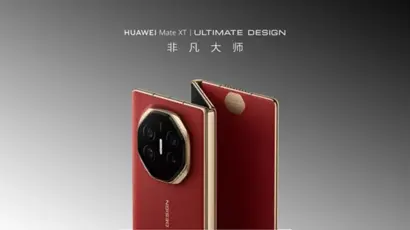
Foreign media outlets have assessed that Huawei has established its position as an unrivaled innovative company with its tri-fold design. Quoting experts, the Associated Press analyzed, "Huawei was unable to access semiconductors and Google (due to U.S. technology restrictions), yet it overcame these hurdles. The resurrection of Huawei that we have witnessed over the past year is a significant victory."
Huawei, which recorded the world's second-highest sales volume in 2019, was severed from the global high-tech market due to U.S. semiconductor export control policies and export sanctions against foreign companies. Its supply lines, such as Google’s Android operating system (OS) and Qualcomm semiconductors, were cut off, and it was unable to sell smartphones for some time. Huawei had been struggling, losing even its domestic market share to other Chinese firms that were bypassed by U.S. sanctions.
Will China's Independent Ecosystem, Built on 'Self-Sufficiency', Succeed Globally?
Last year, Huawei stood out in its domestic smartphone and electric vehicle markets, with its revenue reaching 860 billion yuan (approximately 171 trillion KRW), chasing the 890 billion yuan (approximately 177 trillion KRW) revenue from four years ago. Having entered a recovery phase, Huawei is also focusing on building a uniquely Chinese ecosystem in the fields of AI semiconductors and operating systems (OS).
Huawei's proprietary OS, Harmony, is cited as a symbol of China's mobile technology independence. While it was a breakthrough found to avoid Google usage restrictions, the intention is to go beyond individual device sales to build an ecosystem in the software and service sectors and find new sources of revenue.
DeepSeek, which has faced usage bans in various Western countries due to security concerns, is being embraced by Huawei Cloud. Huawei filled a 9,000-square-meter (approximately 2,700-pyeong) booth—the closest to the entrance of Hall 1 among the eight halls—showcasing modular data centers and AI services linked with DeepSeek. The company plans to provide services that connect the open-source DeepSeek with Huawei servers and Ascend chips. As the path to utilizing it in large-scale usage environments opens up, the commercial use of DeepSeek via Application Programming Interfaces (APIs) is expected to become easier.
However, it remains to be seen whether such a strategy will be effective. At this point, Huawei's own app ecosystem is thin, and the fact that it is not compatible with Google apps remains a fatal weakness in the global market. Huawei has announced that it will load the "HarmonyOS NEXT" version onto all tablets released this year, starting with the "Mate X6" and "Mate 70." However, setting aside the North American market, most regions, including Europe, are accustomed to Apple's iOS and Google's Android. So far, no competitor has emerged to break the dominance of those two operating systems.
The high-end strategy, including the Mate XT, is also currently aimed at affluent early adopters rather than the universalization of tri-fold phones, and there are assessments that it is difficult to secure appeal without Google Play.
Xiaomi, which has built a solid position in the global market while Huawei was the primary target of sanctions, has also unveiled the Xiaomi 15 series, which is equipped with its own OS. By incorporating Google Gemini into its proprietary "HyperOS 2" and utilizing Qualcomm's latest chipsets, the company appears to be improving its closed nature, which was previously a weakness. The strategic difference from Huawei is clear. Xiaomi explained that by supporting Hyper-based functions, they "will provide an enhanced mobile experience in terms of system fluidity, security, and next-generation AI interaction."