

[비즈한국] There is a lesson left to us by the history of astronomy that has spanned the last several thousand years: we are not special at all. In the distant past, humanity long believed that we held a special place in the universe. I call this a form of "cosmic narcissism." However, astronomical discoveries have ruthlessly trampled that human arrogance, showing us that we are placed in a random, unremarkable corner of the universe.
We hoped that the Earth was the center of the universe, but it wasn't; we hoped the Sun was the center of our galaxy, but that wasn't true either. We expected that our galaxy might be the only, special world in the universe, but even that turned out to be false. Astronomy feels as if it forces the fact upon us that we occupy no special position in the universe. This perspective, which underpins modern astronomy, is called the Copernican principle, named after Nicolaus Copernicus, the first to argue that the Earth is not a special entity.
Through experience and history, astronomers have considered the Copernican principle to be a fundamental rule of the universe. They believed that the universe would always look similar regardless of where one is or which direction one looks. However, as various recent observations have begun to map the vast expanse of the cosmos, questions have arisen as to whether the universe might not be fair to everyone. Enormous asymmetries and irregularities that appear to contradict the Copernican principle have been discovered in the universe.
Can we prove or refute whether the Copernican principle is correct through actual observation? To answer this question, it is necessary to systematically break down the somewhat ambiguous Copernican principle.
Astronomers generally divide this perspective into two parts. First, the universe is homogeneous: regardless of the observer's location, the universe looks similar from any point. Second, the universe is isotropic: as an observer looks around in different directions, the universe always appears the same. Based on the homogeneity and isotropy of the universe, astronomers have assumed that the universe presents itself fairly to everyone. This is why we naturally assumed that we are in a completely unremarkable position in the universe; after all, no place in the universe should have any special significance.
In fact, various discoveries and observations made up until about a decade ago supported the Copernican principle. Projects such as the Sloan Digital Sky Survey, which completed a three-dimensional map of countless galaxies across the universe, show that on a macroscopic scale, galaxies appear to be uniformly distributed. The same holds true for observations of the Cosmic Microwave Background (CMB), which shows traces of heat spread across the universe just after the Big Bang. Even with high-resolution confirmation of the minute temperature differences and fluctuations in the CMB, the universe shows similar patterns in almost every direction.
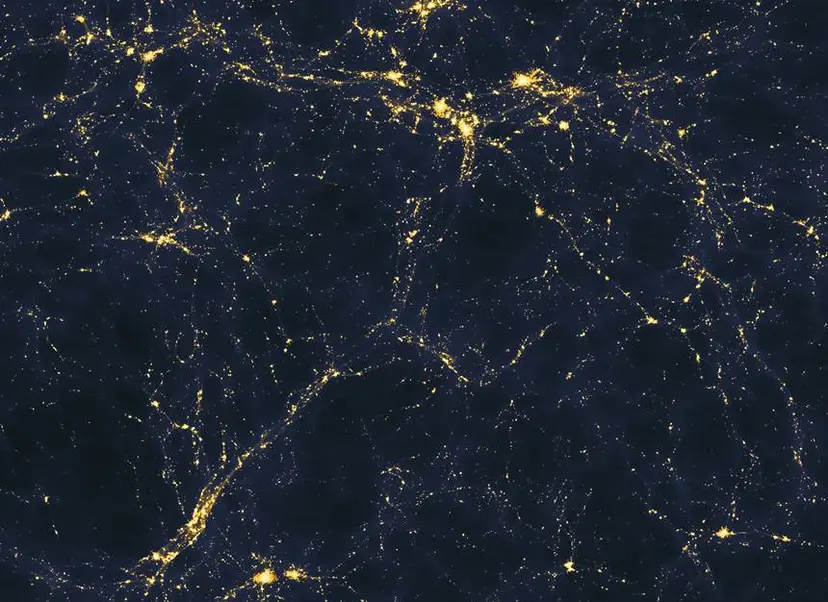
However, as more precise space telescopes like Hubble and the James Webb, along with large ground-based telescopes, have made observations, asymmetrical features that were previously unknown have begun to emerge. Interestingly, astronomers have confirmed that our galaxy is located near a massive "void" where there are very few galaxies compared to the cosmic average. This is not just a small "local void" where there are slightly fewer galaxies right next to us.
In 2013, astronomers Ryan Keenan, Amy Barger, and Lennox Cowie discovered that our galaxy is located in a very large void where the density of surrounding matter is lower than the universe's average. This massive void spans a staggering 2 billion light-years in diameter and is called the KBC void or "local hole," named after the initials of the three discoverers. It was given the name because it feels literally as if a 2-billion-light-year-wide hole has been punched in the universe.
The fact that our galaxy happens to be in a massive, empty region becomes a significant issue when trying to calculate the expansion rate of the universe through the movement of galaxies. This is because the movement of galaxies is a mixture of not only the expansion effect of the spacetime in which they are embedded but also the gravitational effect of neighboring galaxies pulling on each other. If our galaxy is in a massive void with less matter than the cosmic average, the galaxies being pulled faster toward the higher-density regions outside the void could make it look to us as if the universe is expanding more rapidly. If the universe is not an entirely fair world and we are viewing it from a quite unique perspective, the image of the universe we have seen so far cannot be said to fully represent the entire universe.
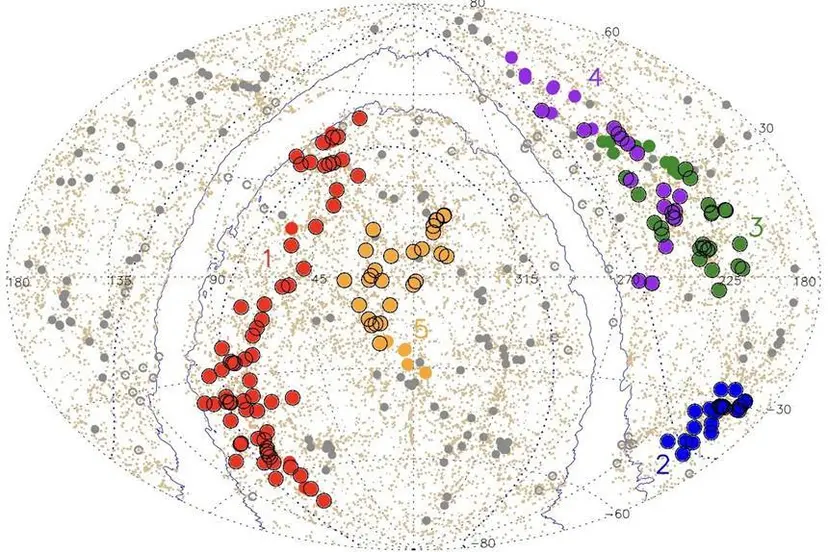
In addition to these giant voids, filaments and clusters where galaxies extend for hundreds of millions of light-years have also been discovered. Most recently, a huge super-structure was found in which galaxies are connected in a long, circular shape on a scale of 1.3 billion light-years. The total mass of the galaxies forming this structure reaches 2 quintillion times the mass of the Sun. At least five independent superclusters have gathered to form this massive super-structure. It is more than twice as heavy and three times longer than Laniakea, the well-known supercluster to which our galaxy belongs.
This is the largest super-structure discovered so far in the process of mapping the universe; it accounts for 13% of the total volume of the observable universe and contains 25% of the total matter in the universe. As indicated by the fact that the ratio of mass to volume is higher, this massive super-structure has matter concentrated at a much higher density than the cosmic average.
Astronomers have given this huge super-structure the interesting name "Quipu." A Quipu refers to the knotted strings used by the Inca civilization to record numbers. The super-structure of galaxies discovered this time also has galaxies connected like long strings, similar to the Inca Quipu. The name was chosen because the way galaxies are linked along the filaments of the cosmic web looks like several knots tied along a rope.
The existence of voids—where galaxies are distributed at lower densities—or giant super-structures with higher densities on scales exceeding hundreds of millions of light-years cannot be easily explained by existing standard models alone. No matter how much dark matter and dark energy are introduced, the expansion of the universe and the birth of galaxies should occur uniformly across the cosmos. We have yet to find a satisfying answer as to why there are particularly more or fewer galaxies in specific regions of the universe.
The suspicion that the universe might not be a homogeneous and isotropic world is represented by two major problems in modern astronomy and cosmology. The first is the "Hubble tension," which refers to the problem where the result of the expansion rate of the universe varies depending on the method used to estimate it. Generally, the expansion of the universe estimated from the movement of galaxies is measured to be faster than that estimated from the cosmic background radiation. Some astronomers argue that the cause is that we live in a void region with a lower density of galaxies.
Second, there is a problem where the actual distribution density of galaxies in the universe differs from the results estimated from density differences in the early universe, as confirmed by the cosmic background radiation. This is also called the "S8 tension," utilizing the parameter S8 used in astronomy to calculate the density distribution of galaxies.
The Hubble tension and the S8 tension are not mere measurement errors. This is a shocking discrepancy where calculations based on the assumption that the universe will always look similar, regardless of where or what you look at, do not sufficiently reflect the actual state of the universe. Contrary to our thoughts, the universe may not be a very even world even from a macroscopic perspective, and we may have reached the point where we need to apply new physical laws that we do not yet understand.
The reason why the concern that the universe might not be entirely homogeneous and isotropic is becoming a bigger issue lately is that we are in an era where we can observe and study the universe with unprecedentedly high precision. Regions where matter is concentrated at higher densities distort spacetime more, causing light passing behind them to refract and bend. Depending on the degree of spacetime curvature, the rate at which time flows also varies. Previously, the image of the universe we could confirm through observation was too crude and imprecise, so we did not need to pay attention to the differences created by the distortion of spacetime and bent light.
However, now that we can see the universe with enough precision to notice such minute differences, it has become a critical problem in modern cosmology. In other words, it can be seen that problems are pouring out because astronomy has entered a transition period of becoming a new area of precision science.
Does the Copernican principle really apply equally everywhere in the universe? To confirm this with the most certainty, we would need to leave Earth, go to another location, and observe the universe while looking in all directions. But we cannot escape our prison called Earth. We cannot know whether beings living elsewhere are looking at the same universe as us or a slightly different one.
What if the Copernican principle does not apply to the entire universe? There might be many civilizations in this universe like ours that are curious about the universe and actively looking at and studying it, and there might be as many different astronomical theories and cosmologies as there are such civilizations. Could it be that we understand and view the universe with different astronomical theories depending on where in the universe we live? On the surface, the Copernican principle seems to say that we are not special at all, but the very wish that the universe would look fair to everyone might have been the most human illusion and expectation of all.
Reference
https://ui.adsabs.harvard.edu/abs/2025arXiv250119236B/abstract
About the author, Ji Ung-bae: He loves cats and the universe. After watching 'Galaxy Express 999' as a child, he developed a dream to share the beauty of the universe. He currently researches galaxy evolution through interaction at the Yonsei University Galaxy Evolution Research Center and the Near-Field Cosmology Lab, and is engaged in various science communication activities, including lectures and writing. He has authored books such as 'The Observatory of Flirting,' 'Thinking About the Universe All Day,' and 'Stars, the Science of Light.'