

[비즈한국] The three major New York stock indices plunged as the Trump administration expanded the imposition of tariffs. The growing uncertainty surrounding tariffs was the cause of the financial market sell-off. On the 2nd (local time), U.S. President Donald Trump announced plans to implement a 25% tariff on Canada and Mexico starting on the 4th, and signed an executive order raising tariffs on China to 20%. He also announced that starting next month, he would impose "reciprocal tariffs," taking into account the tariffs and non-tariff barriers that other countries impose on U.S. products.
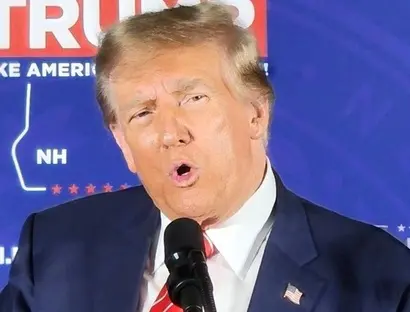
Until now, many in the market analyzed that Trump's remarks on tariffs were merely for negotiation purposes to secure benefits for the U.S. There was high expectation that President Trump would gain advantages through negotiations and ultimately not impose the tariffs. However, as President Trump reaffirmed the tariff imposition on this day, investor sentiment froze rapidly.
Cho Yeon-ju, a researcher at NH Investment & Securities005940, stated, "The impact on prices and the economy will vary depending on how substitutable companies' goods are," adding, "It is a time when portfolio adjustments may be necessary depending on the intensity of the implementation of Trump's future tariff policies." Cho further suggested, "Portfolios oriented toward defensive stocks, such as essential consumer goods that can benefit from a strong dollar centered on domestic demand, are positive."
The virtual asset market, including Bitcoin, which had seen a boost the previous day, also shook on this day as President Trump announced he would push for a strategic reserve including Bitcoin and Ethereum, as well as Ripple, Solana, and Cardano, to foster the virtual asset industry.
President Trump remarked, "I am making it clear that I will make America the crypto capital of the planet," adding, "We are making America great again." Bitcoin, which had once dipped below the $80,000 mark, showed a massive rally the previous day, crossing the $95,000 mark. However, this upward trend ended in a single day due to his tariff remarks. The virtual asset market is riding a roller coaster on every word from President Trump.
Recently, a variety show featured a discussion on investment. Alongside the story of mixed martial artist and broadcaster Kim Dong-hyun, who once hit rock bottom due to Bitcoin investments but recently recovered to make significant profits, actor Shin Sung-rok replied that he invests in Tesla. In response, mixed martial artist and broadcaster Choo Sung-hoon said, "Since Tesla is investing in Bitcoin, it's the time to invest (in Bitcoin)." Is that really the case? To reach a conclusion, while predicting Bitcoin's movements is as difficult as predicting exchange rates, it seems it could serve as an alternative investment option in a portfolio from a long-term perspective.
The market expects that the optimism enjoyed following the launch of U.S. spot Bitcoin ETFs and the election of "pro-crypto" President Trump will continue, driven by issues such as the establishment of a Bitcoin strategic reserve and the launch of spot ETFs for altcoins (virtual assets other than Bitcoin). For this reason, analysts believe that the extreme drops seen in the past will not recur. Furthermore, there is an observation that the participation of institutional investors will reduce volatility in the virtual asset market.
Lim Min-ho, a researcher at Shinyoung Securities, predicted, "The U.S. regulatory agencies under Trump's second term are focusing on establishing an institutional foundation that enables financial institutions to participate in the virtual asset market," adding, "Financial institutions will be able to build diverse investment strategies and launch new products." Researcher Lim also noted, "The adoption of Bitcoin centered on ETFs by financial institutions will gradually expand, and it is necessary to continuously monitor whether large hedge funds, major investment advisory firms, pension funds, and sovereign wealth funds adopt virtual assets."
Along with this, some analysts suggest that Bitcoin may receive a ripple effect as the phenomenon of domestic gold prices exceeding international trading prices has recently emerged.
Hong Sung-wook, a researcher at NH Investment & Securities, stated, "We were able to confirm once again through the 'Kimchi Premium' formed in domestic gold that domestic investors have a high desire to hedge KRW assets with U.S. stocks and gold," adding, "An environment has been created where Bitcoin can also stand out as a hedge against KRW assets." Researcher Hong pointed out, "In particular, as the inconveniences of gold become more prominent, Bitcoin, which is perceived as 'digital gold' by many, could benefit from the spillover effect."
Now, market participants are turning their eyes to the White House-hosted virtual asset roundtable (Crypto Summit) on the 7th (local time). The event, chaired by David Sacks, the White House official in charge of Artificial Intelligence (AI) and virtual assets, will be attended by CEOs of the virtual asset industry and investors, and it appears the remarks made at this meeting will once again influence the virtual asset market.