

[비즈한국] The Bank of Korea significantly lowered its economic growth forecast for this year to 1.5%, citing U.S. President Donald Trump's tariff policies as the primary reason for the downward adjustment. This is because, following President Trump's announcement of reciprocal tariffs on countries worldwide, he has made it clear that he will impose tariffs on South Korea's key export items: automobiles, semiconductors, and pharmaceuticals. The reciprocal tariffs, with their announced implementation timeline, are expected to deal an immediate blow to the overall economy of South Korea, which relies heavily on exports.
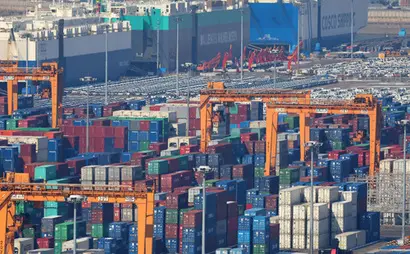
The U.S. government has stated that it will assess non-tariff barriers, primarily focusing on each country's Value-Added Tax (VAT), by April 1, and impose reciprocal tariffs in response starting on the 2nd. Given that South Korea's VAT is 10%, there is a possibility that exports to the U.S. could decrease by nearly $13 billion. With only 11 countries in the world lacking a VAT (including central government-level sales taxes), South Korea, which had been recommended by the Organization for Economic Cooperation and Development (OECD) to raise its VAT because it is lower than the OECD average, has been dealt an unexpected blow.
Bank of Korea Governor Rhee Chang-yong announced on February 25, following a Monetary Policy Committee meeting, that the benchmark interest rate had been lowered (from 3.00% to 2.75%) and that the economic growth forecast for this year had been drastically revised downward from 1.9% to 1.5%. Explaining the factors behind this revision, Governor Rhee stated, "While domestic situations such as the martial law incident were significant factors in January, the uncertainty surrounding tariff policies following President Trump's inauguration has become much greater for this forecast." During the January Monetary Policy Committee meeting, Governor Rhee had previously hinted at lowering the growth forecast from 1.9% to 1.7%–1.6%, mentioning that "domestic situations such as the emergency martial law incident" were major factors.
In fact, economic uncertainty stemming from President Trump's tariff policies is continuing to grow. In his first cabinet meeting at the White House in Washington, D.C., on February 26 (local time), President Trump announced plans to impose a 25% tariff on the European Union (EU). Two days prior, on the 24th, during a meeting with French President Emmanuel Macron, President Trump also expressed his intention to impose reciprocal tariffs on countries around the world as planned.
In particular, since President Trump has stated that he will consider the VAT situation of each country when imposing reciprocal tariffs, South Korea, with a 10% VAT, is highly likely to be targeted. If reciprocal tariffs are imposed, it is certain that South Korea's exports to the U.S. will decrease significantly. In its report, "Analysis of the Impact of Tariff Measures by the Second Trump Administration," the Korea International Trade Association (KITA) estimated that South Korea's exports to the U.S. would decrease by $12.93 billion in the event of a 10% universal tariff, an additional 10% tariff on China, and a 25% tariff on Mexico and Canada.
Therefore, if the U.S. imposes a 10% reciprocal tariff on South Korea in line with its 10% VAT, a similar reduction in exports could occur. For South Korea, which has a Free Trade Agreement (FTA) with the U.S. and does not impose tariffs on American products, this has become an unexpected obstacle in the form of a tariff on VAT.
Notably, South Korea received a recommendation from the OECD last year to increase its VAT rate, which has remained unchanged since its introduction in 1977, stating, "There is a need to find new sources of fiscal revenue. In the long term, it is necessary to increase the Value-Added Tax." The OECD also presented the fact that South Korea's VAT rate of 10% is about half the average rate of OECD member countries (19.2%) as a reason for its recommendation. However, the government at the time took a negative stance, stating it was "not considering it in any way" due to concerns over public tax resistance. If the VAT had been raised according to the OECD's recommendation at the time, South Korea would have faced even greater pressure for reciprocal tariffs from President Trump.
President Trump is using VAT to pressure countries with reciprocal tariffs because only 11 countries, including the U.S., do not have a VAT or a central government-level sales tax similar to VAT. The United States has no VAT or federal-level sales tax, only state-level sales taxes ranging from 2.9% to 7.2%.
According to the global accounting firm PricewaterhouseCoopers (PWC), the only countries without a VAT or sales tax other than the U.S. are the Cayman Islands, Gibraltar, the Channel Islands, Greenland, Hong Kong, Macau, Qatar, Kuwait, Libya, and Guyana. Most of these countries are either small nations used as global tax havens due to their non-tax policies, or oil-producing nations that have no need to impose taxes on their citizens due to massive oil revenues. Unlike South Korea, which relies on manufacturing exports, these are countries that will not be significantly affected by Trump's tariff policies.