

[비즈한국] At the '2025 Drone Show Korea,' the largest drone exhibition in Asia, domestic and international drone companies unveiled a vast array of new drones and anti-drone technologies. Marking its 10th anniversary this year, the 'Drone Show Korea' is the largest in its history, featuring 306 companies from 15 countries across an exhibition area of 26,508㎡. At this event, domestic drone manufacturers drew significant attention from attendees by showcasing next-generation products and technologies nearing commercialization.
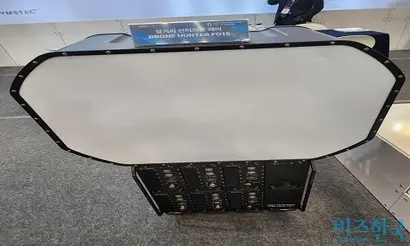
DamsTech, Anti-Drone Solution 'Drone Hunter XD'
Anti-drone company 'DamsTech' unveiled its portable anti-drone solution, Drone Hunter XD, for the first time. It is an all-in-one device capable of rapidly detecting, identifying, and tracking the location of unknown threat drones.
The device has the advantage of quickly and accurately detecting drones approaching through the blind spots of fixed radio jamming equipment. It provides real-time information including the drone's serial number, model number, frequency band, azimuth, speed, altitude, and location. The detection response time is under 5 seconds, and it can track up to 30 drones simultaneously. It has a detection range of over 2.5km, a 360-degree detection radius, and weighs 7kg.
The Drone Hunter XD comes in three types: PM (pole-mounted), MP (man-portable), and VM (vehicle-mounted). The MP type, in particular, is expected to significantly enhance the defensive capabilities and survivability of individual soldiers outside of base operations. For users operating drones, it provides detection information on both the drone and its controller, displaying both the user's and the drone's positions.
Founded in 1995, DamsTech is a company specializing in the development and production of radio jamming equipment and plans to expand into long-range detection in the future. The company has previously supplied anti-drone products, such as jamming equipment, to government agencies and the military. It has also exported its anti-drone products to numerous countries including Saudi Arabia, Poland, Singapore, Indonesia, and Malaysia. Song Seong-jong, CEO of DamsTech, explained, "We receive many inquiries from domestic and international companies as well as the military. We will strive to further develop our technical capabilities to advance long-range detection and anti-drone systems, positioning ourselves as a company that leads exports to markets like Eastern Europe and Asia."
Nearthlab, Mortar Swarm Drone 'XiDEN'
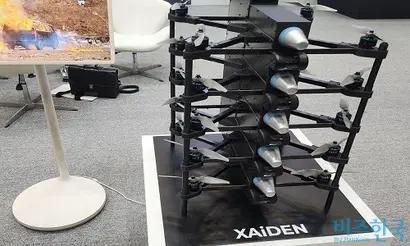
Autonomous flight drone solution company 'Nearthlab' unveiled its tactical bombing swarm drone solution, 'XiDEN,' for the first time at this exhibition.
XiDEN is a next-generation autonomous swarm attack drone capable of reconnaissance, autonomous tracking, precision strikes, and dynamic missions. It has the advantage of being able to stack up to 10 drones to launch rapidly without the need for a separate launcher. It is also designed to counter communication and satellite navigation signal jamming caused by electronic warfare.
Equipped with mortar shells, it can rapidly strike multiple targets or a single target simultaneously, and it can also identify and pursue targets using AI-based swarm reconnaissance and autonomous tracking technology. XiDEN weighs 4kg, reaches a top speed of 120km/h, and has an operational radius of up to 10km.
XiDEN can utilize 60mm mortar shells already stockpiled by the military. Na Young-ho, an executive at Nearthlab, explained, "While the accuracy of 60mm mortar shells can be somewhat low, they provide significant firepower for platoon-level units. By using swarm drones to deliver mortar shells, we can achieve more precise and devastating strikes. Furthermore, utilizing the military’s existing stockpiles of mortar shells through XiDEN allows for efficient weapon usage."
Another advantage of XiDEN is that it can be utilized with 'Multi-Purpose Unmanned Vehicles' used by the military. By deploying stacked XiDEN units on these vehicles, firepower can be maximized. XiDEN is scheduled to undergo military operational evaluation through Army combat experiments until September.
Nearthlab is an autonomous drone startup founded in 2015 by CEO Choi Jae-hyuk and CTO Jung Young-seok, both alumni of the Department of Aerospace Engineering at KAIST (Korea Advanced Institute of Science and Technology). Since 2024, the company has been introducing drone hardware that integrates AI autonomous flight technology, expanding its business into all safety-related areas, including national defense, public safety, and infrastructure inspection. The autonomous hard-kill drone 'KAIDEN,' showcased at this exhibition, is known to have been exported to Singapore and the UAE.
Pablo Air, Swarm Drone Combat System R10s/S10s
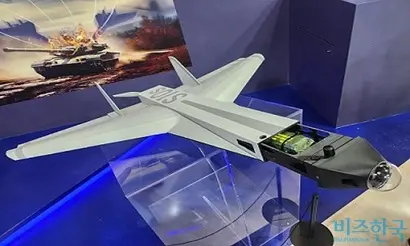
UAM (Urban Air Mobility) specialist Pablo Air unveiled its 'Swarm Drone Combat System' for the first time at Drone Show Korea. Notably, they debuted the reconnaissance drone (R10s) and the strike drone (S10s), which are part of the 'PabloX M' series of military drones.
Pablo Air explained that it has overcome the operational limitations of existing small drones by applying a 'Salvo Strike' method, which uses multiple swarm drones carrying distributed lightweight warheads. The 'Salvo Strike' method is a strategic concept where multiple drones attack simultaneously or in staggered intervals to neutralize defense systems and maximize damage. Compared to traditional single-drone operation, this provides a tactical advantage. By striking targets from various angles and timings, it maximizes impact and effectively renders enemy defense systems useless.
The reconnaissance drone (R10s) acquires and transmits target coordinates, while the strike drone (S10s) generates and inputs swarm flight trajectories. The S10s weighs a light 3.2kg and can carry a payload of up to 1kg. Its flight time is over 30 minutes, and its maximum flight distance is 144km. By applying K-MOSA (modular mission equipment), the equipment can be quickly swapped and installed to optimize for specific missions. The R10s weighs 25kg and can operate for over 120 minutes. A Pablo Air official stated, "Pablo Air's CTO and researchers are former staff of the Agency for Defense Development (ADD), giving us a deep understanding of the business. Since our military drones have a price advantage over competitors, we expect to demonstrate great strength in the future drone market."