

[비즈한국] Naver035420 Shopping, which has primarily focused on price comparison and goal-oriented purchasing, is transforming into a discovery and exploration-centered shopping platform. The grand strategy is to induce product "discovery" and lead to actual purchases by providing a hyper-personalized shopping environment that deeply understands customers based on the vast data Naver possesses. To achieve this, it is mobilizing all existing capabilities, including artificial intelligence (AI) technology, search, shopping, and data from blogs and cafes. The "Naver Plus Store" service, launched last year, is slated for an independent app release in the first half of the year. With global companies like Amazon, Walmart, and Alibaba shaking up the shopping paradigm armed with personalization and AI, attention is focused on whether Naver can secure its own unique competitiveness.
Countdown to First Independent Shopping App Launch
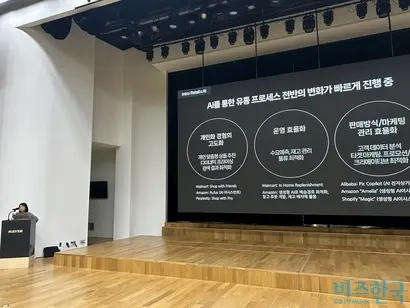
"We are advancing the shopping experience to fit individual contexts by multi-dimensionally utilizing users' empirical history, such as review ratings, coupons, membership benefits, and preferred brands. Now, we intend to offer this 'Naver Plus Store' as a separate app. We believe Naver has a competitive advantage here."
Jung Kyung-hwa, Naver Plus Store Product Leader, said this while introducing the business direction at a Naver Commerce Study held at Naver 1784 in Seongnam, Gyeonggi Province, on the afternoon of the 25th. Starting in 2003 with "price comparison" to find the lowest prices through search, Naver Commerce has advanced by adding services such as "Shopping Window" (2013) for mobile shopping of offline products, the online store platform "Smart Store" (2018), "Naver Plus Membership" and "Shopping Live" (2020), and "Arrival Guarantee" (2022). All these services have been operated within the main Naver app, but as early as March, the Plus Store will be released as an independent app—a first for the Naver shopping sector.
The Plus Store is a separate shopping space newly created to allow users to enjoy customized shopping. It has been in beta (trial) service since the end of October last year. The idea is to pull in all meaningful available data to assist in purchasing decisions and even capture potential demand that customers might not have thought of. Seo Myung-won, Naver Commerce Design Director, explained the background of the app launch, saying, "The basic Naver platform itself was somewhat heavy for users to have a personalized recommendation experience in shopping."
Naver summarized the direction of its commerce division as "a different shopping experience for all 50 million citizens." If a pregnant woman searches for "childbirth," the AI shows related questions such as how to prepare for childbirth or "essential national items for childbirth," and recommends nursery essentials like swaddles even without the user entering specific keywords like product names. If a user is looking for a cordless vacuum cleaner, it uses a complex analysis of previous search and purchase history to provide a recommendation guide that distinguishes whether the user is a single-person household, buying for parents, or looking for a product with "good value for money (performance relative to price)."
At the time of the app launch, an "AI Shopping Guide" feature will be included in beta. This is a feature where users can receive consultations on various product purchase-related information, such as which product is suitable for their specific type or situation. Lee Jung-tae, Naver Commerce AI Technology Leader, emphasized, "An initial version will be included for now. It's not yet at a satisfactory level, but we plan to keep improving it."
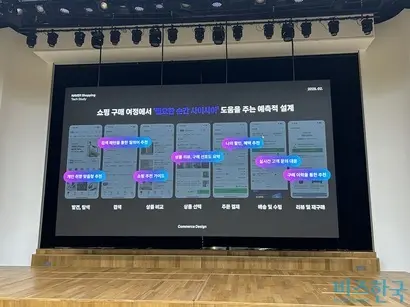
Director Seo stated, "Product reviews and purchase preference summaries are not presented with the same information to everyone; for customers who prioritize value for money, reviews related to value are exposed first. It is a predictive design that naturally provides help at necessary moments during shopping."
Following Alibaba and Amazon, Naver Enters AI Shopping, Differentiating with 'UGC'
While Naver Shopping's product-specialized AI and personalization technology are currently in the early stages, the explanation is that they are being gradually strengthened. Naver has been improving the accuracy and precision of recommendations since 2017 by introducing the AI recommendation technology "AiTEMS." Naver's primary weapon is the vast amount of content and data accumulated in UGC (User Generated Content) sectors such as Knowledge iN, blogs, cafes, and Clips.
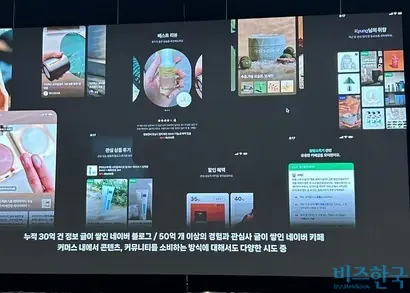
Director Seo explained, "Naver has a cumulative total of 3 billion blog posts and information from cafes with over 5 billion posts on experiences and interests. We will try various approaches to select content related to commerce from these and expose it within the commerce platform." The plan is to combine existing commerce capabilities, such as the 300,000 sellers including 3,000 brands within Smart Store, with the technology of its own LLM (Large Language Model), HyperCLOVA X.
Global commerce companies' interest is definitely on AI. AI is an essential tool in the work of personalizing shopping services, and its effectiveness has been proven in actual metrics. Alibaba, China's largest e-commerce company that operates AliExpress, has boosted its purchase conversion rate by over 20% by strengthening its personalization system. Beyond enhancing personalized experiences such as customized suggestions based on search terms and categories, and product ranking exposure, Alibaba is also actively using AI for tasks like generating product images for sellers and supporting translations into local languages.
Amazon confirmed the performance of its AI-based shopping assistant chatbot, 'Rufus', during Black Friday and Cyber Monday last November. During this period, which saw the highest ever sales and number of items sold, the ratio of purchases made using Rufus reached approximately 20%. In the case of Rufus searches, it is known that existing ranking systems, such as the "Amazon's Choice" badge, do not significantly affect the weighting. Foreign media like Reuters observed, "Personalization is a field showing promise in early experiments using Rufus," suggesting that "Amazon is developing an AI-based framework that relies more on individual shopping history than on existing ranking factors."
Compared to global big tech companies that introduced AI-based personalization services full-scale one to two years ago, Naver's strategy change cannot be called rapid. There are also concerns about data usage, given that information left in other Naver services is being utilized in the shopping realm.
Naver's policy is to build its own competitiveness by concurrently supporting the ecosystem through incorporating AI into seller growth policies and ensuring the ethical use of data. Assisting in the production of product detail pages and optimizing delivery were introduced as features that can increase seller operational efficiency. The Seller Center is also expected to undergo advanced automation work within this year.
Director Seo said, "In personalization design, informing users about data collection is very important. We are proceeding with a checklist to check whether the design is appropriate and whether it is having a positive influence on brands," adding, "We will focus on finding the optimal way for the majority so that users of various ages can naturally follow the changes."
Leader Jung stated, "We plan to actively invest in AI-based technology. Ultimately, it is a direction to mutually increase the efficiency of buyers and sellers, sustain growth, and strengthen the competitiveness of the entire ecosystem."