

[비즈한국] In the KBS entertainment show ‘Gag Concert’, school-themed sketches have never ceased to appear. In particular, ‘Bongsunga Hakdang’ has continued like a phoenix. The variety show ‘Knowing Bros’ has long been considered a long-running program with a classroom as its backdrop. Even in web novels and webtoons, school-themed content has become a dominant trend, accounting for the largest share. Recently, on OTT platforms, dramas such as ‘Study Group’, ‘Pyramid Game’ (or ‘Good Rival’), and ‘Heart Stain’ have been drawing attention.
The reason there is so much content that uses school as a subject or setting is because of its universality. Almost everyone has gone through their school days. Therefore, it can form a consensus regardless of the generation. It is not limited to Korea but can be called a universal cultural experience item for the whole world. The school cultural experience item is a phenomenon where related content products are consumed because people have experienced school life.
However, what is the background behind the global popularity of Korean school dramas, especially nowadays? To understand this, we must look at what makes them different from previous school dramas.

Among drama series set in schools, the representative one is the KBS ‘School’ series, which aired from 1999 to 2021. This series attracted attention for its public service role and popular interest, and it served as a gateway to stardom by discovering new actors. However, at some point, the attention of viewers or the public dropped because it could not overcome the limitations of youth dramas. Moreover, since it was a drama on the public broadcaster KBS, which is operated by license fees, the subject matter, as well as the method and level of expression, were inevitably restricted. The disappearance of the ‘School’ series from the public eye symbolizes the limitations of terrestrial dramas. It is undeniable that it was global OTT platforms that broke through those limitations.
The Netflix original series ‘All of Us Are Dead’, released in January 2022 and ranked in the top 10 in 91 countries, opened a new chapter in K-zombie content by combining the zombie theme with school violence and issues of class and hierarchy. Following this, ‘The Glory’, released in December of that year, focused more on school violence and presented a full-scale revenge drama, taking second place globally for two consecutive weeks. The impact of this drama was so great that it sparked public discourse on school violence in many countries around the world.

Since then, school-themed dramas have begun to diversify. The 2023 drama ‘Boyhood’, which claimed to be a school action noir, gained significant attention for its action and comedy by blending school violence with local dialects, based on retro codes. The 2024 ‘Pyramid Game’ embodied how class and hierarchy, as shown in ‘The Glory’, more subtly reproduce and expand school violence through an ant-hell-like game format. In ‘High School Return of a Gangster’, the action-packed retribution against school violence stands out, containing episodes that occur when a gangster possesses the body of a weak high school student.
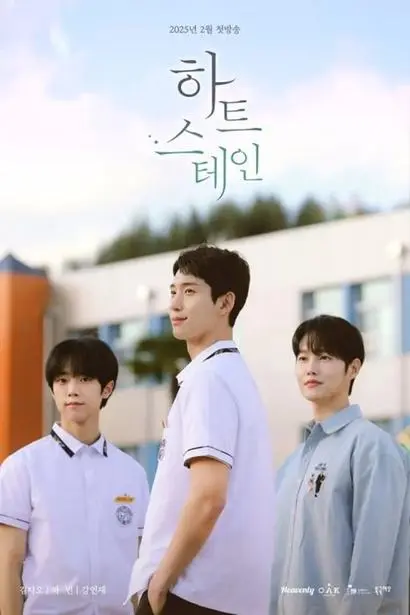
In the 2025 drama ‘Study Group’, the story went beyond personal revenge against school violence to positively depict how teachers and students gradually change through study groups. In ‘Good Rival’ (Seon-ui-ui Gyeongjaeng), the hierarchical entrance exam competition of Korean society was shaped from the perspective of a subtle psychological drama through two protagonists competing for medical school admission. And in ‘Heart Stain’, the BL (Boys' Love) code was finally applied to present a love triangle between a teacher and a student.
At times, they are labeled with a "not for youth" rating due to violent and provocative content, but K-school dramas are establishing a new position in that they show the reality of schools without additives. Some express concern or discomfort, fearing it might plant misunderstandings and prejudices about Korean schools. However, those concerns and discomforts can be forgotten. This is because such aspects do not exist only in Korean society.
The conflict between classes or polarization depicted in the movie ‘Parasite’ is actually more severe in North America or advanced Western European countries. The reason people around the world watched ‘Parasite’ was not only because of their interest in Korean society itself. It is because they empathized with the story of class through ‘Parasite’. People around the world who watch K-school dramas also immerse themselves in them, thinking they are their own stories.
On the other hand, some say that school dramas actually alienate students. It is said that they are stories about adults, not stories about students. That is correct. However, because school is a place where people must live in groups, it is also a place where human relationships, organizations, and social phenomena can be identified. Because it is a microcosm of the human world, it is suitable for projecting the reality-based problems we face.
As long as they do not excessively distort schools, K-school dramas will continue to evolve and diversify. Revealing the current topics of reality explicitly while seeking popular hope or alternatives is the reason why K-content has received attention in the global OTT environment.
The author, Kim Heon-sik, has walked through or navigated the forest of popular culture phenomena since his 20s with the expectation that there is a way to make the world a better place through culture. In the 21st century, where artificial intelligence and quantum computers are active, he is still walking the same path with the same belief.