

[비즈한국] The drones that made their mark in the Ukraine war were not limited to the skies. Despite losing most of its naval strength early in the war, Ukraine used so-called "maritime drones" to sink the Ivanovets corvette of the Russian Navy's Black Sea Fleet. They also destroyed the piers of the Crimean Bridge, the lifeline of the Crimean Peninsula. According to claims by the Ukrainian military, up to 20 large and small Russian warships have been sunk by drone boats.
A fleet consisting of unmanned surface vessels (USV) or unmanned underwater vehicles (UUV) that operate without human control is known as a "Ghost Fleet." In a 2016 novel of the same name, the U.S. Navy suffers catastrophic losses but strikes back against a powerful Chinese naval force by mobilizing a ghost fleet.
The appearance of a ghost fleet, once limited to fiction, is expected to become reality soon. This is because the reality of the Ghost Fleet currently being researched by the Navy was unveiled for the first time at 'DSK 2025,' held in Busan on February 26.
Our Navy has been researching a fleet made up of unmanned vessels under the name "Navy Sea Ghost" since 2022. This shift toward cost-effective unmanned vessels came as the Navy's ambitious future fleet construction plans, such as "aircraft carriers" and "nuclear-powered submarines," faced difficulties in progress.
However, compared to the name "Navy Sea Ghost," the level of the Navy's unmanned vessels had been in its infancy until now. While USVs like Hanwha Systems' 272210 'Haeryeong' and LIG Nex1's 079550 'Haegum' had been completed, and LIG Nex1 won the contract for reconnaissance USVs last year, it is true that there was a lack of a concrete vision for a "unmanned fleet."
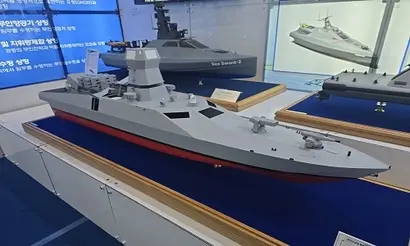
At this DSK 2025, the Navy unveiled designs for six types of maritime combat drones developed up to last year, as well as models that have completed conceptual design, the foundation of ship design. It is unprecedented in naval history to unveil plans for six types of new combat vessels simultaneously, and the fact that they produced scale models rather than simple CG graphics is evidence of how ambitious the Navy's plans for this project are.
All models unveiled by the Navy at DSK 2025 are conceptual design models, and the designs will be finalized through subsequent Basic Design and Detailed Design processes. Among them, the combat UUV, which completed its conceptual design in December 2023, is a 25-meter-long, 7-meter-high submersible capable of carrying mines or torpedoes. It is designed to be deployed to the battlefield aboard future submarines or underwater unmanned command-and-control vessels, after which it can launch from underwater to fire torpedoes at enemy submarines or covertly lay mines in enemy territorial waters.
The remaining unmanned vessels all completed their designs last December, making them state-of-the-art designs less than two months old. The most eye-catching ship is undoubtedly the "combat USV." There are two designs for the combat USV: a standard type and an extended type, the latter of which was produced as a model. They differ in size with lengths of 30m and 38m respectively, with the extended version of the combat USV reaching a displacement of 220 tons.
The extended version carries an impressive five types of weaponry. Designed to engage targets from a minimum distance of 2km to over 200km, it is equipped with an SNT Dynamics 20mm Remote Controlled Weapon Station (RCWS) for close-range combat, LIG Nex1's 70mm Bigung guided rockets, 130mm guided rockets, eight anti-ship missiles, and a suicide drone launcher. It also features a miniaturized Active Electronically Scanned Array (AESA) Multi-Function Radar (MFR), similar to those intended for the Chungnam-class frigates and KDDX destroyers, allowing it to defend against aerial attacks.
The smaller standard combat USV is also equipped with a 20mm RCWS, 130mm guided rockets, and an SPS-560K multi-function radar, making it capable of replacing the PKMR fast boats currently performing missions at the Northern Limit Line (NLL).
Many smaller ships are also tasked with critical missions. For instance, while the reconnaissance UUV is smaller than the combat version, it can be carried aboard surface combatants such as destroyers or unmanned command vessels, potentially giving the South Korean Navy the ability to "possess ships and submarines simultaneously." Even if only for reconnaissance, the ability to detect underwater movements and provide early warnings to surface ships is a massive advantage. The reconnaissance UUV can act like a "bodyguard" for surface vessels.
Also noteworthy is the mine-warfare USV. Previously little-known, the mine-warfare USV is 12m long, 3.2m wide, and weighs under 100 tons, and is capable of carrying remote mine-hunting sonar and mine-disposal robots.
Finally, we look at the ship-borne USV. Small at 7.2m long and 2.4m wide, this combat USV can be mounted on ordinary warships that lack unmanned vessel operating facilities. It is equipped with a 12.7mm RCWS machine gun and small guided missiles, making it suitable for missions such as intercepting enemy unmanned suicide boats.
While it will take a long time for these assets to actually protect our seas, the Navy has stated that some USVs are being developed quickly enough to allow for verification testing in the near future. We look forward to seeing our "Ghost Fleet" not only use its powerful combat capabilities to counter manned enemy ships but also establish itself as a next-generation defense export item.