

[비즈한국] Korea and Taiwan, both considered strategic hubs for the United States and China, share a similar fate. The second Trump administration has demanded that Taiwan contribute defense costs equivalent to 10% of its GDP, a crisis that is soon to follow for Korea as well. The same applies to plans to impose tariffs on semiconductors. Through the 'Reading the Korean Peninsula from Taiwan' series, Bizhankook meets with key figures in Taiwan's politics, security, and economy to diagnose the current situation and analyze its impact on Korea.
Lai Ching-te, the 16th President of Taiwan who was elected as the Democratic Progressive Party (DPP) candidate last year, received 40.05% of the vote, failing to secure a majority. Furthermore, with the opposition holding a majority in the Legislative Yuan (KMT 52 seats, DPP 51 seats), his political foundation remains precarious. Recently, President Lai submitted a budget proposal including increased defense spending, but the agreement fell through due to opposition from parties like the Kuomintang (KMT). As political conflict intensifies, the DPP is launching recall campaigns against KMT lawmakers.
How does the ruling DPP intend to navigate this current situation filled with anxiety and conflict? On February 10, Bizhankook attended a discussion held in Taipei, Taiwan, between the DPP's Department of International Affairs (China Affairs) and the South Korean NGO Peace Network.
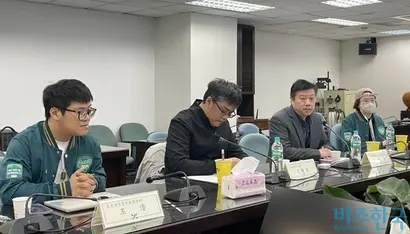
The discussion was attended by Wu Chun-chih, Director of the DPP's China Affairs Department, who is responsible for analyzing and promoting policy on China, and Wang Guo-chen, an associate research fellow at the Chung-Hua Institution for Economic Research. Director Wu is a China expert with a Ph.D. in Political Science from National Taiwan University, and Associate Researcher Wang holds a Ph.D. from the Institute of International Relations at National Chengchi University.
Director Wu explained that the DPP's ultimate goal is to maintain "a relationship where we possess the national identity of the Republic of China, are friendly with China, do not collide, and do not belong to each other." Director Wu said, "The DPP holds democracy and sovereign independence as core values. Taiwan maintains the position that it is a sovereign, independent country and that its future must be decided through a referendum."
The DPP's basic principle for cross-strait relations is clearly laid out in the 'Resolution on Taiwan's Future' adopted by the party's top leadership in 1999. Director Wu emphasized, "Taiwan and China are geographically close and share economic interests, but they must remain independent countries that do not belong to each other."
The DPP rejects the '1992 Consensus,' which acknowledges a 'One China.' Director Wu said, "We respect the historical fact that there were talks with China. Although no consensus was reached in 1992, there were cross-strait exchanges and policy cooperation."
However, Director Wu drew a line, stating that the DPP is not pursuing formal independence. "We are reflecting the overall will and public opinion of the Taiwanese people. Since we already possess a national identity called the Republic of China, we do not believe that independence needs to be realized separately."
Director Wu also noted changes in public opinion within Taiwanese society. "In the past, there were many who identified as both Taiwanese and Chinese, but over the last 30 years, those identifying as Taiwanese have increased, and now over 60% of people define themselves as Taiwanese."
Director Wu explained that Taiwan's generation in their 20s and 30s have never experienced authoritarianism and take democracy for granted. He said, "Young people naturally perceive Taiwan as an independent country and tend to prefer maintaining the status quo over unification."
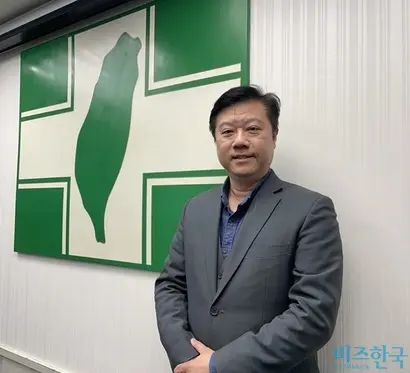
He also explained the increase in defense spending. The DPP strongly advocates for raising defense costs. Director Wu argued, "US-China conflict will intensify during the Trump administration. Taiwan must prepare a more cautious diplomatic strategy. Taiwan's defense strategy will be adjusted to balance the level of China's military threat. Peaceful dialogue with China is only possible once we achieve self-reliant defense. Therefore, we must strengthen our national defense while negotiating simultaneously."
He added, "In a situation where China's military power is continuously increasing, Taiwan can look to the Israel model. Israel's defense budget is over 5.3% of its GDP, while Taiwan's current defense budget is around 2.5%. Our goal is to increase this to 3%."
He emphasized, "It is essential for the government to strengthen national defense to protect its people, and it would be irresponsible as a ruling party to neglect this. Taiwan's economic development will inevitably be at risk if it is not supported by security."
The US Trump administration is demanding the relocation of semiconductor factories to the US, alongside 'tariff pressure' on the industry. How does the DPP view these US demands? Associate Researcher Wang Guo-chen said, "We view our semiconductor industry as stable. First of all, TSMC has an advantage because of its monopoly position. Of course, there is pressure to expand production in the US, but because TSMC is linked to various supply chains, there is a positive aspect in that investment in the US is increasing."
There are risks, of course. Associate Researcher Wang pointed out that concerns about confidential information leaks are real. "Of course, there is a possibility that sensitive information could be leaked. Information such as which suppliers provide which parts and what materials are used is highly likely to be transferred to the US. Also, simply building TSMC factories in the US will not completely resolve the trade imbalance between Taiwan and the US. Processes like final assembly, packaging, and testing are still carried out in Taiwan or Southeast Asian countries. This is the same for Korea's Samsung."
The DPP predicts there will not be major fluctuations in Taiwan's semiconductor industry. Associate Researcher Wang Guo-chen explained, "We do not believe there will be a major impact on TSMC due to US export controls on China. Semiconductors exported to China are basically legacy-node chips. Also, over the past six years, the volume of cross-strait trade has been stably and continuously decreasing."