

[비즈한국] In any era, moments of change arrive. When new technologies emerge and shake up the existing order, people are generally divided into two groups: those who resist change and those who seize it as an opportunity to adapt quickly. Historically, it has always been the latter who emerged victorious. Kim Jae-yeop, a professor at Hongik University, shares the stories of these "fast movers" in his book of the same name.
The advancement of artificial intelligence (AI) technology is no longer a story of the future. We are already living with AI. Generative AI like ChatGPT produces expert-level content in an instant, and autonomous vehicles are on the verge of surpassing human driving abilities. Given this, what kind of competitiveness should we possess in such an era? How can we survive in a world where AI is increasingly taking over more tasks?
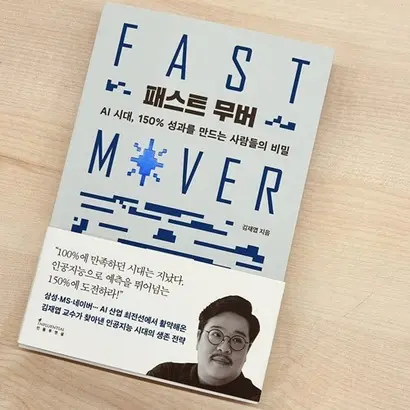
The author provides a clear answer to this question: it is not about learning simple AI utilization, but about acquiring the ability to grow alongside AI. He distills this ability into three competencies: 'Critical Thinking,' 'Elastic Mind,' and 'Experimental Insight.'
'Critical Thinking' here does not simply mean skeptical judgment. It is the ability to question what seems obvious, think outside existing frameworks, and explore new perspectives. In the past, it was important for experts to accumulate deep knowledge in their own fields. However, in today’s world, where AI can handle a significant portion of that role, what matters is 'how we define the problem.' The author emphasizes that to survive as experts, we must cultivate the ability to constantly ask questions and view problems from multiple angles.
Secondly, 'Elastic Mind' refers to the ability to embrace change quickly and adapt flexibly to new environments. In an era where AI is constantly evolving, those who cling to old methods are bound to fall behind. The faster the pace of change, the more one must be able to solve problems through flexible thinking rather than sticking to conventional ways. The author cites this as an important characteristic of a 'Fast Mover,' emphasizing that successful people always adapt quickly to their environment.
Finally, there is 'Experimental Insight.' We often think we need a 'perfect plan.' However, Fast Movers in the AI era are those who constantly experiment and adopt an attitude of learning through failure. The author defines this as 'Experimental Insight.' This experimental approach is a vital competency in the AI age, and he stresses that rather than building a perfect plan, it is more important to execute quickly, learn from failures, and generate better results.
The author presents his arguments persuasively, drawing on numerous real-world cases from his experience working at leading domestic and international IT companies such as Samsung, MS, and Naver035420.
Ultimately, it all boils down to the need to find what only humans can do in the AI era. Only those who seek ways to grow with AI, rather than fearing it, will survive. Just as the Industrial Revolution replaced human physical labor, the AI revolution can become an opportunity to expand our critical thinking and creativity. In other words, the author emphasizes that we must not merely use AI as a tool, but use it to gain new perspectives and transcend existing limitations.
Closing the final chapter of the book, two questions naturally arise: Am I resisting change, or am I discovering opportunities within it? Am I a fast mover, or am I a slow follower?
The book asks us: Will you settle for an ordinary 100%, or will you create an extraordinary 150%?
In the end, the choice is ours.