

[비즈한국] Ever since the astronauts of the Apollo missions in the 1960s and 70s returned with lunar rocks and dust, there have only been two instances in history where a mission has landed on a celestial body drifting in outer space and brought back physical samples. Both instances involved asteroids significantly smaller than Earth.
One was the Ryugu asteroid, visited by Japan's Hayabusa2 probe, and the other was the asteroid Bennu, visited by NASA's OSIRIS-REx probe. Both missions were conducted in a similar manner; strictly speaking, it wasn't a "landing" so much as a brief, forceful touch-and-go contact with the asteroid's surface. At the moment of touchdown, they collected debris kicked up from the surface into a capsule and safely brought it back to Earth. In a sense, they performed a "hit-and-run" on an asteroid.
OSIRIS-REx made contact with Bennu to collect samples on October 20, 2020. The capsule carrying the samples successfully pierced through Earth's atmosphere and returned on September 24, 2023. The total amount of Bennu's sample brought to Earth is 121.6 grams—the largest amount of asteroid material ever recovered. Recently, astronomers discovered something surprising within this dust: all the building blocks for the DNA and RNA that constitute life on Earth were found! But that’s not all. It also presents the possibility that Bennu might be a leftover fragment of a much larger, ancient planet that once harbored life.
Before sending a probe, astronomers long assumed that Bennu was a fairly ordinary asteroid. In meteorites that fall to Earth, one can easily find round, hardened mineral structures called "chondrules," which means "grain" in Greek. Although their exact origin is not yet fully understood, they are presumed to be minerals that melted in the intense solar light during the early formation of the solar system and then re-solidified. These round chondrules are commonly found in many asteroids and meteorites.
However, the reality confirmed by the probe at Bennu defied expectations. Typical chondrules were not readily visible in Bennu’s rocks. The asteroid appeared to have undergone a more chemically dynamic history. There is only one thing that can explain this unique situation: water.
Water is an ingredient that efficiently alters the properties of rocks and minerals. The samples from Bennu bear clear traces of water. Various phosphates, including magnesium phosphate, and silicates are present—representative components that can only be created in the presence of water. At the same time, carbon and nitrogen, essential ingredients for life, are found in abundance. These pieces of evidence suggest that Bennu is not just a random asteroid rock drifting through space, but potentially a piece broken off from a larger planet that once contained oceans.
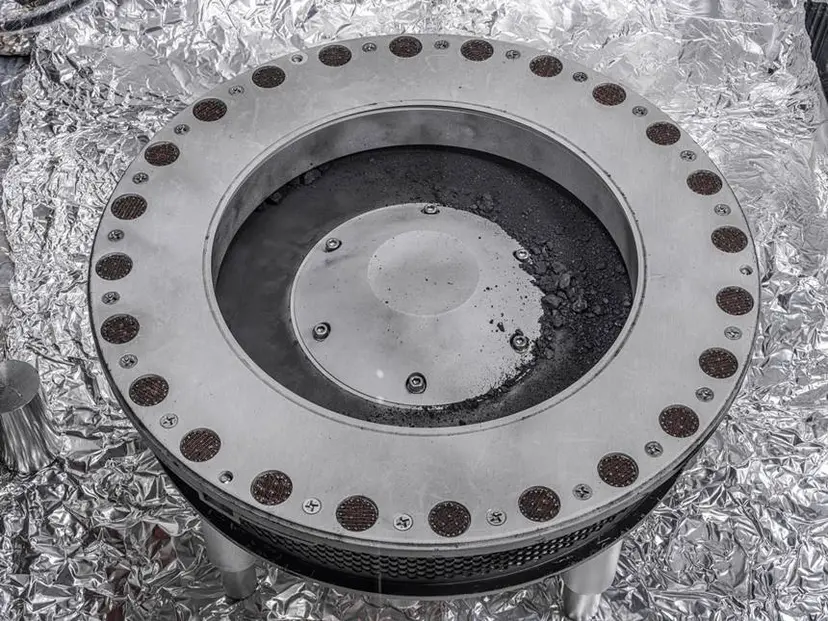
Furthermore, the latest analysis detected 14 out of the 20 total amino acids. Amino acids form the proteins of living organisms when linked together, so finding such a variety in a single asteroid is a highly intriguing result. Additionally, N-heterocycles—nitrogen-containing molecules with a ring structure—were detected in overwhelming quantities, with a density of about 5 nmol/g. While this may seem like a small number, it is 5 to 10 times higher than that of other asteroids like Ryugu, which were analyzed previously. It is particularly significant that all five nitrogenous bases that make up Earth's DNA and RNA—adenine, guanine, cytosine, thymine, and uracil—were discovered. Various other molecules, including nicotinic acid, were also detected.
Bennu does not appear to be merely a rock coated in carbon dust, but rather a fragment broken off from something that once harbored a wide variety of life's building blocks and biological materials.
Small crystals containing salt and salinity were found in the Bennu samples, implying that Bennu’s original environment contained very salty water—a salt lake. The components detected in Bennu are very similar to those of salt lakes found in places like Australia on Earth. Based on this, astronomers are lending weight to the hypothesis that Bennu is a fragment of a parent planet that once held a very salty lake. In that it contains salty seawater, Bennu is similar to Saturn’s moon Enceladus or Ceres, one of the largest dwarf planets. Perhaps one of those two was Bennu's original home.
Although the current Bennu is a small asteroid with a diameter of only 500m, it is estimated that it was originally a much larger primordial planet or dwarf planet. Its surface or interior world was filled with salty seawater and lakes, potentially brimming with various organic molecules and nitrogenous bases that serve as the fundamental ingredients of life. Then, between 2 billion and 7 billion years ago, it likely collided violently with another body of similar size, causing the parent planet to shatter. One of the surviving fragments from that event is believed to be the current Bennu. Some astronomers speculate that the asteroid Polana, which currently orbits between Mars and Jupiter and has a 1:2 resonance with Mars, might be related to Bennu’s parent body.
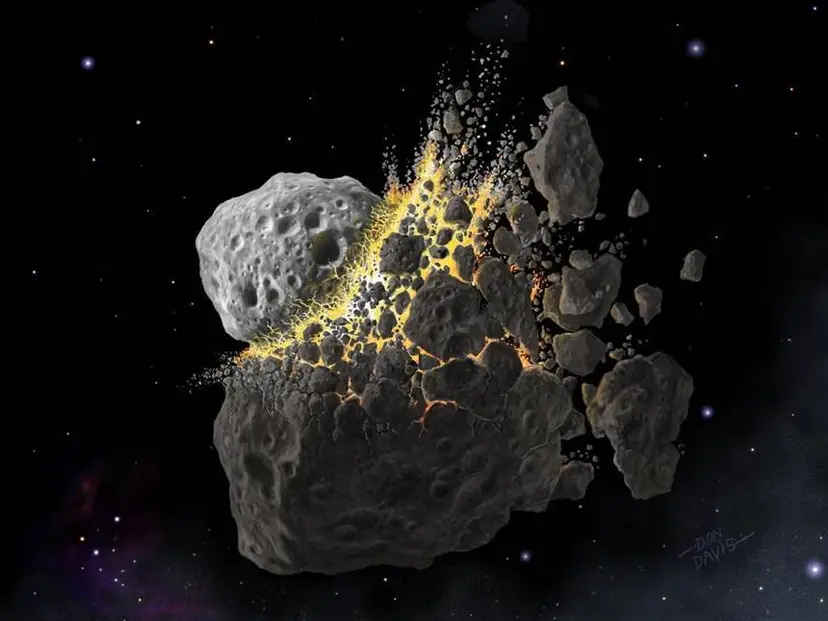
If Bennu's parent planet had been given sufficient time and had not experienced such a violent collision early on, it is possible that various forms of life, similar to Earth, could have emerged there. Earth has also experienced countless large and small collisions over the past 4.5 billion years, some powerful enough to wipe out parts of its ecosystem, but fortunately, it avoided a collision that would have destroyed the planet itself. Bennu, however, experienced a collision powerful enough to destroy the planet entirely, leaving it to drift through the outskirts of the solar system as nothing more than fragments carrying brief, brilliant memories.
If Bennu had been lucky enough to avoid that collision, the history of the solar system might have been completely different. Two ecosystems and two civilizations, each evolving on separate planets, might have discovered, invaded, or interacted with each other at a similar time, perhaps leading to a life as a multi-planetary species much earlier.
The discovery of various biological materials in the Bennu samples suggests that similar materials could very well be found on other asteroids. This means that biological materials likely exist widely and in many places within the solar system. We can even hope for the possibility that some form of microbial life has stubbornly survived somewhere, even in a minute form.
In fact, this is not the first time that organic matter and amino acids, which provide clues to the origin of life on Earth, have been found in small celestial bodies like asteroids and comets drifting in the outskirts of the solar system. It is already known through several explorations that various materials serving as ingredients for life are frozen outside of Earth. A prime example is the Rosetta mission, which attempted to land on a comet for the first time in history.
The Rosetta mission landed on the cute, rubber-duck-shaped comet 67P, and while it could not confirm the origin of Earth's seawater as expected, it did detect the unexpected amino acid glycine. This showed the possibility that the origin of life on Earth may have come from outside our planet. This Bennu sample also adds weight to the possibility that life on Earth originated not just on Earth, but in the distant cosmos.
It holds an even more exciting possibility: that Earth was not the only stage where the birth and evolution of life could take place in the ancient solar system. It is possible that this occurred commonly on many other planets, or even on primitive planets of the past that disappeared after colliding and shattering. At the very least, the ingredients for life were—and still are—very common in the solar system. If such high concentrations of biological material remain in a single location like Bennu, then surely such traces must exist on many other asteroids as well. Other remnants of ancient life must be drifting through the outskirts of the solar system.
Perhaps, as we find more of Bennu's lost fragments through future exploration, we may be able to piece together the repository of life that vanished billions of years ago, much like assembling the shards of a broken vase, and remember what it was once like.
Looking at the small asteroid Bennu and the dust inside the capsule brought back from it, we are reminded of another massive planet that vanished billions of years ago—one that perhaps held lakes and oceans, and where life itself may have emerged.
References
https://www.nature.com/articles/s41550-024-02472-9
https://www.nature.com/articles/s41586-024-08495-6
Who is the author, Ji Ung-bae? He loves cats and the universe. After watching 'Galaxy Express 999' as a child, he dreamed of sharing the beauty of the universe. He is currently researching the evolution of galaxies through their interactions at the Center for Galaxy Evolution Research and the Near-Field Cosmology Laboratory at Yonsei University. He is active in science communication through lectures and writing, and has authored books such as 'The Observatory of Crushes,' 'Thinking About the Universe All Day,' and 'Stars, the Science of Light.'