

[비즈한국] It has been confirmed that Hanwha Systems272210 and Hyundai Rotem064350 are each developing their own 'Active Protection System (APS)' technology capable of blocking enemy drones and anti-tank missiles. The two companies are expected to engage in fierce competition to incorporate their respective APS technologies into the upcoming 'K2 Tank Performance Improvement Project' and 'Next-Generation Tank Project.'
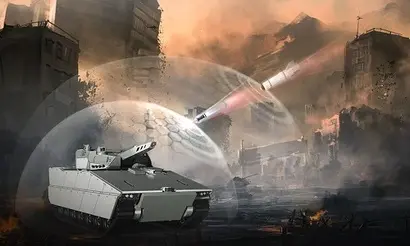
An APS is a high-tech survival system for combat vehicles that actively neutralizes threats such as anti-tank rockets and missiles before they can strike armored vehicles like tanks or armored personnel carriers.
Unlike general commercial products, the intellectual property rights for tanks are held by the Agency for Defense Development (ADD), while defense companies like Hyundai Rotem are only responsible for production. However, voices are being raised regarding redundant investment as companies are recently conducting separate R&D for APS under the pretext of creating export-oriented weapons. While companies cannot be stopped from investing individually, dividing roles could lead to much more efficient results from a national perspective. Therefore, it is standard practice to efficiently divide development areas rather than having domestic companies compete against each other.
Hanwha Systems signed a contract with the Defense Technology Promotion Institute in 2023 for a project worth approximately 36 billion KRW, titled 'Intelligent Active Protection Technology for Next-Generation Infantry Fighting Vehicles to Counter Multiple Threats.' By 2026, the company plans to secure intelligent active protection technology capable of responding to multiple threats by developing 'hybrid active protection technology' and 'ground-based directed interference technology.'
Through this project, Hanwha Systems plans to accurately detect and track threats using detection sensors such as Active Electronically Scanned Array (AESA) radar. Additionally, it aims to secure technology that uses Artificial Intelligence (AI) to analyze acquired and fused information to automatically determine the most appropriate response system for the threat. Furthermore, it is developing a hybrid approach: 'hard-kill' technology to destroy threats directly with counter-munitions and 'soft-kill' technology using Directed Infrared Countermeasure (DIRCM) equipment for ground use.
In 2011, Hanwha Systems successfully developed its own domestic radar and thermal tracking system for the 'short-range missile/rocket defense system,' a core technology of the K2 tank's active destruction system. It is the only company in Korea that possesses technology for developing aviation-grade DIRCM. DIRCM is an advanced defense system mounted on aircraft that detects enemy missile threat signals and fires a high-output infrared laser (deceptive light source) to jam the missile, drastically improving the survivability of friendly aircraft.
Hyundai Rotem is developing its K2PL (export model) APS through domestic and international cooperation. Hyundai Rotem handles the control computer, control panel, launcher, and automatic loader, while domestic partners handle the radar, optical sensors, and overhead radar. Counter-munitions are supplied by Rafael Advanced Defense Systems of Israel.
Hyundai Rotem's APS uses radar and image sensors to detect and precisely track high-speed threats like shaped-charge munitions and kinetic energy penetrators, as well as low-speed threats like ATGM and RPGs, neutralizing them by firing directional blast or EFP (Explosively Formed Penetrator) counter-munitions. It also includes soft-kill APS capabilities, featuring jammers and directed infrared interference equipment to counter drones and precision-guided weapons.
Hyundai Rotem's performance-improved K2 tank is characterized by enhanced survivability to protect crew members from various external threats. The four corners of the turret are each equipped with octagonal APS radar, a 360-degree battlefield situational awareness system, and a Laser Warning System (LWS). The turret is also fitted with a 'hard-kill' APS system capable of firing interceptor rounds on both sides. A Remote Controlled Weapon System (RCWS) is installed on top of the turret, allowing for precise firing without exposing personnel outside the vehicle. A cuboid-shaped 'drone jammer' capable of soft-kill operations is also installed in front of the RCWS.
The K2 tank performance improvement project, including the APS, finished its preliminary research in February of this year and is currently in the preparation phase for initiation. The project requirements were decided in July 2023, with deployment planned starting in 2031. It is expected that a bidding process will take place for this project to adopt the APS developed independently by Hyundai Rotem and Hanwha Systems. The two companies are also expected to clash in the next-generation tank project, scheduled for deployment in 2030.
However, some experts suggest that Hyundai Rotem, as the system integrator, might adopt Hanwha Systems' APS as a partner. An industry insider explained, "The very name of the APS project currently being developed by Hanwha Systems is 'Intelligent Active Protection Technology for Next-Generation Infantry Fighting Vehicles to Counter Multiple Threats.' This can be interpreted as having their own APS in mind for the next-generation tank. It is possible that Hyundai Rotem's APS will be adopted for the K2 performance improvement project, while Hanwha Systems' APS could be incorporated into the future next-generation tank project as a partner."