

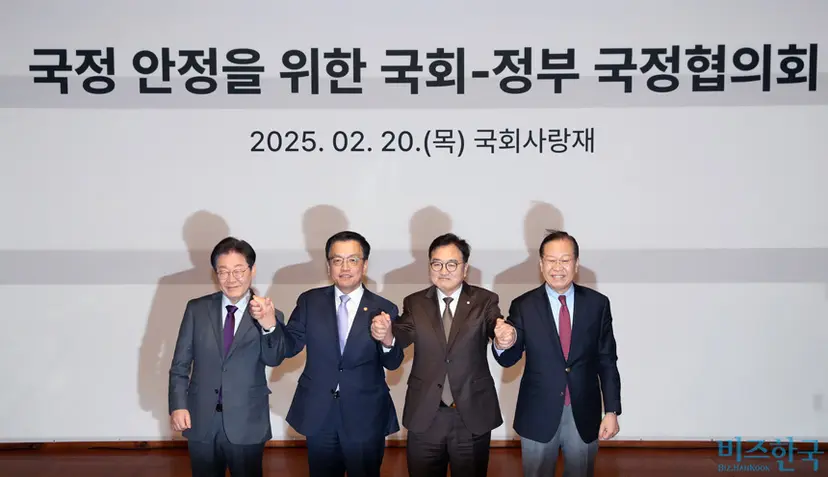
[비즈한국] With concerns over economic slowing growing due to U.S. President Donald Trump’s various tariff announcements and repeated downward revisions of South Korea's annual growth forecast, momentum is building—not just among ruling and opposition parties, but within the government as well—to compile a supplementary budget. On the 20th, government officials and parliamentary leaders from both sides gathered to discuss the semiconductor special act, pension reform, and the supplementary budget. Despite 116 minutes of discussion, they only reached a consensus on the need for a budget, failing to produce a concrete agreement.
The People Power Party views the Democratic Party's "Livelihood Recovery Consumption Voucher" program (13.1 trillion won) included in the supplementary budget proposal as a move for the next presidential election, while the Democratic Party suspects the People Power Party is lukewarm about the process because they don't want the budget to be seen as a Democratic Party achievement; this raises concerns over whether a middle ground can be found. Given the precedent of political gridlock over past supplementary budgets, which once took nearly 100 days to process, critics point out that the country may miss the "golden time" for the supplementary budget intended to revitalize the economy.
In January, the government lowered its annual growth forecast from 2.2% to 1.8% (a 0.4%p cut), and the Bank of Korea followed suit, adjusting its forecast from 1.9% to 1.6–1.7%. These revisions reflect the expectation that domestic demand will freeze due to the contraction in economic sentiment following the uncertainty triggered by President Yoon Suk-yeol’s martial law declaration. On top of this, President Trump’s recent successive announcements regarding steel and aluminum tariffs (effective March 12), automobile tariffs (to be announced in March), and reciprocal tariffs (effective early April) are expected to deal a major blow to the Korean economy, which relies heavily on exports to the U.S. for those specific items.
In response to these concerns, Acting President and Deputy Prime Minister of Economy and Finance Choi Sang-mok, National Assembly Speaker Woo Won-shik, People Power Party Interim Committee Chairman Kwon Young-se, and Democratic Party leader Lee Jae-myung held a four-party meeting of the Policy Council on the 20th. This was the first time in 51 days that the ruling party, opposition, and government had decided to convene such a council. However, they failed to produce a joint agreement as they could not narrow their gaps on major issues like the supplementary budget. The political parties are still weighing the political costs and benefits of the budget. If they cannot bridge their differences, the process could drag on indefinitely, even if the government submits the budget proposal immediately.
According to the National Assembly’s Bill Information System, a supplementary budget has been compiled 16 times since the "National Finance Act" was enacted in 2006. As most supplementary budgets are focused on economic recovery, they are typically submitted to the National Assembly in the first half of the year. Of the 16 instances, 12 were compiled in the first half and four in the second half. This reflects the judgment that a foundation for economic recovery must be laid early.
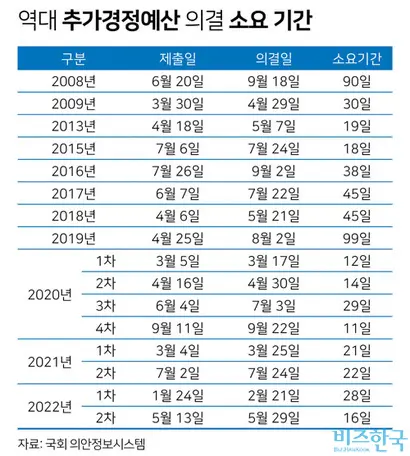
While these budgets were introduced to revive the economy in times of crisis, it took an average of 33.6 days to process them in the National Assembly. Processing took less than two weeks in only three instances: the 1st, 2nd, and 4th supplementary budgets of 2020, when the economic impact of COVID-19 began in earnest. Eight instances took between two weeks and one month: 2009, 2013, 2015, the 3rd budget of 2020, the 1st and 2nd of 2021, and the 1st and 2nd of 2022. Three instances took between one and two months (2016, 2017, and 2018), and two instances took over two months (2008 and 2019).
Among these, the fastest parliamentary review and approval occurred for the 4th supplementary budget in 2020, which took just 11 days—it was submitted on September 11 and passed on the 22nd of the same month. The 1st supplementary budget of 2020 was the next fastest, taking 12 days (submitted March 4, passed March 17), followed by the 2nd budget at 14 days (submitted April 16, passed April 30). This was because the political sphere reached a consensus on the need to quickly minimize the economic damage caused by COVID-19.
In contrast, the budget that took the longest to review and approve was the 2019 supplementary budget. It was submitted to the National Assembly on April 25 but was only passed by the plenary session 99 days later, on August 2. At the time, the ruling Democratic Party argued for the budget to preemptively respond to economic downside risks, support areas damaged by Gangwon wildfires and the Pohang earthquake, and fund fine dust countermeasures.
Conversely, the opposition Liberty Korea Party delayed the process by arguing that, apart from disaster support, the preemptive response to economic downside risks was nothing more than electioneering, with the general election only a year away. In 2008, when the ruling Grand National Party and the opposition Democratic Party clashed over livelihood support items within the budget, the proposal submitted on June 20 took 90 days to process, finally passing on September 18. Considering these precedents, even if the government submits a supplementary budget immediately, its passage by the National Assembly could drag on until the end of the first half.