

[비즈한국] As a result of a BizHankook investigation, it has been confirmed that Jung Won-ju, Vice Chairman of Jungheung Group (Chairman of Daewoo E&C047040), recently won an appeal against tax authorities, overturning a first-instance ruling regarding the cancellation of a "gift tax for corporate favoritism" (giving lucrative contracts to related parties). Tax authorities had imposed the gift tax by applying the principle of substantial taxation, concluding that the group used an indirect method: a Jungheung Construction affiliate, where Chairman Jung Chang-sun is the largest shareholder, resold public land it had acquired to a Jungheung Totten affiliate controlled by Chairman Jung's son, Vice Chairman Jung Won-ju, and subsequently outsourced the construction work to Jungheung Totten.
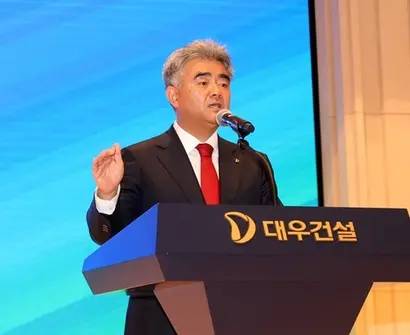
The Gwangju High Court (Presiding Judge Yang Young-hee) ruled on the 23rd of last month in favor of Vice Chairman Jung Won-ju in his lawsuit against the Head of the North Gwangju Tax Office, requesting the cancellation of approximately 4.2 billion won in gift taxes, thereby overturning the lower court's decision. The court stated, "The dispositions of gift tax imposed on the plaintiff in October 2020—400 million won for the 2013 tax year, 2.3 billion won for 2014, and 1.4 billion won for 2015—are hereby canceled."
The 'gift tax for favoritism' imposed on Vice Chairman Jung arose from transactions between Jungheung Construction affiliates and Jungheung Totten affiliates. Between 2013 and 2015, developers affiliated with Jungheung Construction resold public residential land acquired through bidding from the Korea Land and Housing Corporation (LH) to developers affiliated with Jungheung Totten. The Jungheung Totten affiliates then took over the land and signed construction contracts with their affiliate, Jungheung Totten, to carry out housing development projects. Jungheung Construction's largest shareholder is Chairman Jung Chang-sun, while Vice Chairman Jung Won-ju is the largest shareholder of Jungheung Totten. At the time, Jungheung Totten held a stake of over 50% in its affiliates.
Tax authorities viewed these transactions as an indirect form of funneling work to related parties. Under the Inheritance and Gift Tax Act, if revenue from entities with special relationships to the controlling shareholder exceeds a certain percentage of a corporation's total revenue, that portion is considered a gift to the shareholder, and gift tax is imposed. This is the so-called "gift tax for favoritism." The intent is to treat as irregular gifts any actions where a related party boosts the corporate value of a specific entity by funneling work, thereby increasing the wealth of the controlling shareholder. Applying the principle of substantial taxation, the North Gwangju Tax Office imposed a total of 4.2 billion won in gift taxes on Vice Chairman Jung in October 2020.
The principle of substantial taxation mandates that taxes be levied based on economic reality rather than external form. When taxpayers use indirect methods through third parties or multiple transactions to unfairly gain tax benefits, the Framework Act on National Taxes allows authorities to treat the transaction as if it were conducted directly by the parties, or as a single continuous act, based on its economic substance. Tax authorities determined that Vice Chairman Jung avoided gift tax through multi-stage or circuitous transactions. Consequently, they restructured the Jungheung Group's dealings as if a Jungheung Construction affiliate had directly contracted the work to Jungheung Totten.
Vice Chairman Jung Won-ju could reduce gift tax liability if Jungheung Totten dealt with its own affiliates rather than Jungheung Construction's. Under the Inheritance and Gift Tax Act at the time, when calculating this tax, revenue generated between a beneficiary corporation and a special-relationship corporation in which the beneficiary holds over a 50% stake is excluded. While revenue between Jungheung Construction affiliates and Jungheung Totten is included in the base for gift tax calculation, revenue between Jungheung Totten affiliates and Jungheung Totten is excluded, thereby lowering the tax burden.
In July 2022, Vice Chairman Jung filed a lawsuit to cancel the tax imposition, challenging the tax authorities' application of the principle of substantial taxation. His argument was that the actual entity that carried out the development projects was the Jungheung Totten affiliate that acquired the land, and that all development profits and risks belonged to those affiliates. He argued that since the legal form of these transactions matched their economic substance, the principle of substantial taxation could not be applied, and that the tax authorities' actions were illegal.
In the first trial, Vice Chairman Jung lost. The court stated, "The form and process of these transactions were merely a means to achieve the purpose of avoiding gift tax, and the reality is that it was equivalent to a Jungheung Construction affiliate signing a direct contract with Jungheung Totten," dismissing all of the plaintiff's claims and affirming that the application of the principle of substantial taxation was lawful.
However, the second trial ruled in favor of Vice Chairman Jung, stating that tax authorities could not apply the principle of substantial taxation. The appellate court ruled, "These transactions fall within the realm of legitimate tax planning and cannot be viewed as acts of unfairly avoiding taxes by creating irrational appearances different from economic reality. Therefore, it is not possible to deny the resale and construction contracts by applying the principle of substantial taxation to reconstruct them as a single contract between the initial developer and Jungheung Totten; the dispositions based on a different premise are illegal and must be canceled."
Meanwhile, the North Gwangju Tax Office has appealed the ruling to the Supreme Court on the 13th, refusing to accept the appellate court's decision. A Jungheung Group official stated regarding the ruling, "As this is a personal lawsuit involving the Vice Chairman, it is difficult for the company to provide an answer."