

[비즈한국] South Korea and Taiwan, both considered strategic hubs in the U.S.-China rivalry, share a similar fate. The second Trump administration’s demand for Taiwan to pay defense costs amounting to 10% of its GDP is a crisis that will soon reach South Korea as well. The same applies to plans for imposing tariffs on semiconductors. Through the ‘Reading the Korean Peninsula from Taiwan’ series, Bizhankook meets with key political, security, and economic figures in Taiwan to diagnose the current situation and analyze the potential impact on South Korea.
In last year’s 16th presidential election in Taiwan, Lai Ching-te of the Democratic Progressive Party (DPP) was elected. Having succeeded former President Tsai Ing-wen, who served two terms as the 14th and 15th president, the DPP secured its hold on power, marking 12 years of governance, while the main opposition party, the Kuomintang (KMT), failed to retake power. The last time the KMT held power was under the 13th president, Ma Ying-jeou. The prevailing analysis for the KMT's consecutive defeats is its strong image as a pro-China party and its inability to secure support from the younger generation.
Cross-strait relations have deteriorated further since President Lai Ching-te took office, as the DPP's stance is one of non-compromise with China. The Economic Cooperation Framework Agreement (ECFA), a mutual tariff preference treaty between China and Taiwan, is also at risk. As of last year, China had already halted tariff exemptions for 134 Taiwanese items.
How does the KMT, Taiwan's conservative and classified pro-China party, view this situation? On February 11, Bizhankook attended a roundtable discussion held at the KMT headquarters in Taipei between the KMT and the domestic NGO Peace Network to hear their thoughts.
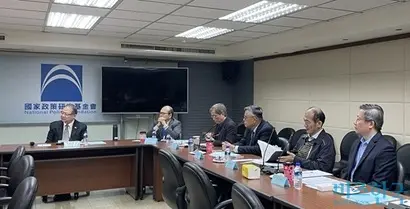
The roundtable was attended by key KMT figures including Huang Chieh-cheng, Director of the Department of International Affairs; Lin Chu-chia, Director of the Department of Mainland Affairs; Ho Ssu-shen, Deputy Director of the Department of International Affairs; Chang Kuo-pao, Deputy Director of the Department of Mainland Affairs; Li Cheng-hsiu, Associate Researcher of the National Security Team; and Lin Kuang-ting, Researcher of the Department of Mainland Affairs. Director Lin Chu-chia is a professor in the Department of Economics at National Chengchi University, and Director Huang Chieh-cheng previously served as Deputy Minister of the Mainland Affairs Council.
The KMT criticized the DPP for cutting off dialogue with China, arguing that Taiwan must maintain amicable relations with both the U.S. and China. Director Huang Chieh-cheng stated, "During the KMT's time in power, relations with neighboring countries—including the U.S., China, Japan, and South Korea—were smooth. Even after becoming the opposition, we are pushing for continuous dialogue, considering the impact of stability in the Taiwan Strait on the international situation."
There was also a point made about maintaining the '1992 Consensus,' which acknowledges a 'One China.' Lin Chu-chia, Director of the Department of Mainland Affairs, pointed out, "Based on the 1992 Consensus, the KMT maintains a foundation for dialogue with China, but the DPP has lost the basis for such conversation."
In cross-strait relations, the KMT upholds three principles: maintaining national defense, active dialogue, and a commitment to liberal democracy and the rule of law. Director Lin Chu-chia emphasized, "In the long term, Taiwan must engage in institutional competition with China, and it is crucial to allow Chinese tourists and students to directly experience Taiwan's freedom and rule of law. We must expand exchanges with China so that people from the mainland can visit Taiwan and breathe the air of its freedom, democracy, and rule of law."
What strategy should Taiwan employ during Trump’s second term? Currently, the DPP argues for increasing defense spending in line with U.S. demands, but the KMT has repeatedly blocked the budget. While the KMT agrees on strengthening defense capabilities, it stresses that "dialogue comes first." Director Huang Chieh-cheng emphasized, "Defense budgets should be set appropriately according to the level of threat. The KMT is not demanding an unconditional cut in defense spending; we are saying we should focus on acquiring the defense capabilities that Taiwan actually needs."
Director Huang also said that Taiwan should not blindly follow U.S. demands. He pointed out, "The U.S. demands that Taiwan adopt a 'porcupine strategy' to maximize defensive capabilities, but considering Taiwan's geographical and demographic characteristics, urban warfare is realistically difficult. We should not blindly follow U.S. pressure to increase defense spending; instead, we must seek ways to effectively strengthen our national defense. As Taiwan is not a member of major international organizations like the UN, it is highly likely to be in a disadvantageous position in the international community if a war occurs."
Like South Korea, Taiwan is facing a shrinking population, making it difficult to maintain sufficient manpower. Director Huang Chieh-cheng stated, "Because Taiwan's population is declining, there are issues with troop supply should tension arise in the Taiwan Strait. Currently, the DPP has very few defense experts. While the KMT believes we must strengthen our military power, we don't think the only way to do that is by listening to the U.S. and buying a lot of American weapons. In recent years, Taiwan has increased its defense budget by about 14% annually. A 5% increase in GDP is impossible. The best way for Taiwan to avoid war is to de-escalate tensions through diplomatic negotiations."
Ho Ssu-shen, Deputy Director of the Department of International Affairs, countered, "The DPP is distorting these rational voices from the KMT as 'policies of submission to the Chinese Communist Party.'"
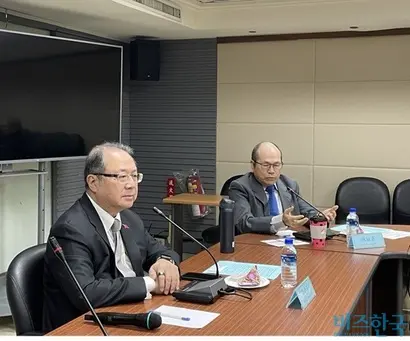
The ECFA was also discussed. Director Lin Chu-chia remarked, "Since the 2000s, Taiwan's exports to China maintained a 40% share, but it has dropped to 32.5% following the U.S.-China conflict. In particular, as the U.S. imposed tariffs on China, Taiwanese companies in China faced difficulties in exporting to the U.S. Consequently, Taiwanese firms are moving production bases to Southeast Asia or back to mainland Taiwan. Taiwan's dependence on China will gradually decrease."
Director Lin viewed the survival of the ECFA as dependent on President Lai Ching-te's attitude. He emphasized, "Through the ECFA, tariffs are exempted for about 539 items. However, in recent years, tariff benefits for some items, such as petrochemicals, automobiles, and machine parts, have been suspended. Further adjustments are expected in the future. The ECFA is an important foundation for cross-strait economic cooperation. The DPP government must maintain it."
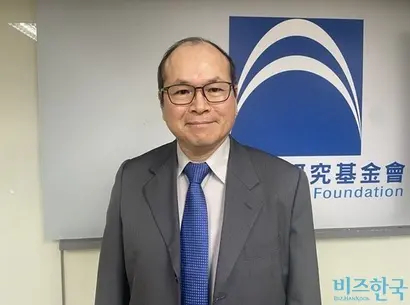
There was also a call for cooperation between the Taiwanese foundry TSMC and South Korea’s Samsung. Director Lin Chu-chia explained, "Taiwan possesses world-class competitiveness in the advanced semiconductor field (3nm and below). Cooperation with South Korea is also important. While Taiwan has an edge over Samsung in advanced semiconductor processes, it still relies on South Korea for memory semiconductors and some components. In the past, Japan was Taiwan's largest source of trade deficit, but in recent years, South Korea has become the largest. This shows that Taiwan imports many semiconductor-related parts from South Korea."
Director Lin warned that industries with relatively low international competitiveness could suffer a severe blow from U.S. tariffs. He analyzed, "Even if President Trump imposes tariffs on the semiconductor industry, TSMC’s technological prowess is so advanced that it is unlikely to be significantly affected. About 90% of advanced semiconductor chips of 4nm or better are produced in Taiwan. Rather, the burden of tariffs will be shifted to other industries. Traditional Taiwanese manufacturing industries such as steel, textiles, petrochemicals, and ceramics are likely to take the hit."