

[비즈한국] These days, as South Korea’s K-Defense industry continues to achieve one success after another, the vanguard of its defense exports is undoubtedly the "tank," the prince of ground weapon systems. The export performance of tanks is substantial. While exports are limited to two countries—Türkiye and Poland—the total scale is significant: approximately 400 units for domestic demand, around 200 units for Türkiye in terms of components and technology, an initial contract with Poland worth 18 billion won, and an additional 800 units planned for a second export phase. Competitors such as the US M1A2 Abrams or the German Leopard 2 have higher overall production numbers than our Black Panther tank, but most of those were produced before the 1990s.
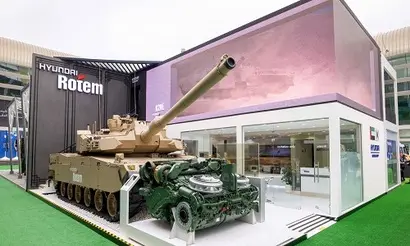
However, military experts do not hold entirely positive expectations regarding the tank, the core product of K-Defense. This is because recent trends in modern warfare have given rise to the "tank obsolescence theory," a criticism that tanks are no longer "invincible weapons" but rather "easy targets."
The tank obsolescence theory has gained further credibility due to the heavy losses tanks have suffered in the recent Russia-Ukraine war. During the three years of conflict, both Ukrainian and Russian forces have lost nearly 10,000 tanks and armored vehicles, a significant portion of which were destroyed by drones.
While the exact number of tanks lost to drones on both sides is unknown, experts have analyzed that at least 1,000 tanks have been destroyed by FPV drones costing as little as 500 dollars.
Of course, the Ukrainian and Russian forces have not been defenseless against FPV drone attacks. Like medieval fortifications, they have installed walls, wire mesh, and cages on tanks to force FPV drones to detonate at a distance, and they have also made extensive use of jammers to interfere with drone GPS signals and communications.
The problem is that technology for drones to penetrate defense systems is advancing faster than drone defense technology itself.
The EFP (Explosively Formed Penetrator) warhead developed by Ukraine's "Shockwave Dynamics" can penetrate nets and wire mesh to destroy tanks. Furthermore, FPV drones controlled via fiber-optic cables have neutralized the effectiveness of drone jammers. In the past, such technological shifts occurred over several years, but in the Ukraine war, new technologies are emerging every few months, which is a major concern.
So, will drones make tanks completely obsolete? It is difficult to conclude that. As I participated in the production of a drone documentary last year, the local Ukrainian soldiers and drone developers I interviewed emphasized that while drones have their advantages, the reason both sides are focusing on suicide drones is a forced choice due to ammunition shortages, and that drones cannot replace all weapons.
Even if it is impossible for drones to completely replace existing weapon systems like tanks and self-propelled howitzers, we have entered an era where almost every military in the world finds it hard to imagine "military operations without drones." In particular, if tanks, which can cost anywhere from several billion to over 10 billion won each, cannot respond to the evolving threat of drones, ground warfare could become impossible.
What about South Korea? Currently, efforts to strengthen drone response capabilities centered on tanks are being actively pursued. The desert-export version of the K2 tank, unveiled by Hyundai Rotem at the 'IDEX 2025' defense exhibition in Abu Dhabi, is equipped with a new drone defense system. It features an omnidirectional drone jammer system capable of jamming signals from any direction when an FPV suicide drone approaches, as well as a drone detection radar that detects incoming drones from all directions, including from above.
Furthermore, artificial intelligence is being integrated into drone defense technology. The Remote Control Weapon System (RCWS), originally intended for attacking enemy infantry or vehicles, is slated to be equipped with an AI-based target automatic tracking algorithm, enabling it to automatically aim at and destroy medium-to-large drones flying nearby.
Moreover, the K2 Black Panther is considering not just drone defense, but also active drone utilization. According to the industry, the K2 tank performance improvement project, which will begin shortly, is pushing for the integration of drones for target acquisition and reconnaissance missions. The core of this K2 tank drone functionality is to remodel the tank turret's storage box to house quadcopter drones, which can be launched when needed to gather information for combat operations.
Once this is realized, the K2 tank, equipped with drones, will transform into a "drone tank" that does not blindly charge at enemy threats but instead detects threats early using its drones and is capable of blocking drone attacks.
Of course, there are limitations. The drones currently planned for the K2 tank are small and have limited payload capacity and weight. The KF51 Panther tank from Germany's Rheinmetall, considered a competitor to the K2, can carry UVision's Hero suicide drones, but the high cost and the fact that they are non-reusable, single-use drones are pointed out as disadvantages.
So, how will future tanks integrate with drones? If the tank's power source changes to a hybrid propulsion system or hydrogen fuel cell capable of producing large amounts of electricity, it is highly likely that a "new concept tank" with drastically improved drone attack and defense capabilities will emerge. In such a scenario, tanks could use their power to charge drone batteries during attacks and repel enemy drones using laser weapons or interference-inducing dazzlers during defense.
For several years, our military and defense industry have been researching the K2 tank performance improvement project as well as the development of a next-generation tank called "K3." However, unlike its flashy design, the K3 does not deviate significantly from the existing operational concepts of the K2. It is time to draw a blueprint for a future tank that can transcend the limitations of current weapon systems and prepare for the era of drone warfare.