

[비즈한국] The Romanian parliament has approved a defense budget of 8.4 billion euros (approximately 12.64 trillion won) for 2025, amounting to 2.24% of its GDP. Amid ongoing security threats stemming from the Russia-Ukraine war, Romania has prioritized the procurement of key military equipment, including armored vehicles and anti-aircraft missiles, to bolster its defense capabilities. Consequently, weapons from South Korean defense firms are emerging as strong contenders.
According to Romanian media outlet 'DIGI24' and others, the Romanian parliament passed this defense budget to meet NATO and EU requirements and push for military modernization. Romania has set a defense budget exceeding 2% of its GDP for nine consecutive years, with 32.25% of this year's budget allocated specifically for weapons procurement. Key defense acquisition projects for this year include short-range and very-short-range air defense systems, infantry fighting vehicles (IFVs), rifles, and command, control, communications, computers, and intelligence (C4I) systems.
Romania has been allocating 2% of its GDP to defense since 2017 in accordance with its defense investment pledge. Furthermore, to address the security situation caused by the Russia-Ukraine war and prepare for potential future conflicts with Russia, it decided to increase the defense budget to 2.5% of GDP starting in 2023. More than 20% of the defense budget is being allocated to major military equipment procurement and research and development (R&D). Romanian Defense Minister Angel Tîlvăr emphasized, “The defense budget is being utilized with consideration for Romania’s security situation and is being actively invested in military equipment modernization projects.” Additionally, Minister Tîlvăr identified short-range and very-short-range air defense missile systems, infantry fighting vehicles, modern C4I systems, armored vehicles, and frigates as priorities for military procurement this year.
Hanwha Aerospace012450 plans to compete in Romania's armored vehicle market. The Romanian government plans to initiate a bidding process for the introduction of 300 armored vehicles in the second half of this year. Competitors include Germany's Rheinmetall 'Lynx,' the UK's BAE Systems 'CV90,' and the US's General Dynamics 'ASCOD.'
Hanwha Aerospace signed a supply contract for K9 self-propelled howitzers with the Romanian Ministry of Defense last July. If the Redback infantry fighting vehicle, which shares the same power system as the K9, participates in the bid, it is expected to offer high efficiency in terms of maintenance and repair. Locally, there is positive sentiment that the Redback will provide technical synergy because it uses the same engine and transmission as the K9. Additionally, the potential for local production is expected to serve as a key strength.
In a board meeting held in August last year, Hanwha Aerospace approved plans to establish a Romanian subsidiary and also intends to build a production base there. While the exact location has not been disclosed, it is reported that construction is scheduled to begin early this year.
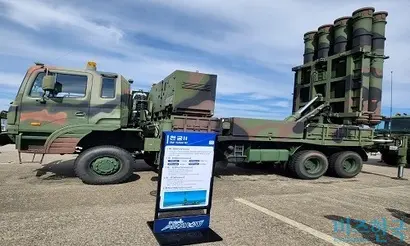
LIG Nex1's surface-to-air guided weapon, 'Cheongung,' is also a strong candidate for export to Romania. LIG Nex1 is expected to bid for the short-range air defense missile system project with 'Cheongung.' Major competing candidates include the UK MBDA's 'Mistral 3,' the 'NASAMS' joint venture by Norway's Kongsberg and the US's Raytheon, and Germany's Diehl Defence 'IRIS-T SLS.'
LIG Nex1 secured a favorable position last February by signing a Memorandum of Understanding (MOU) on the air defense missile sector with the Romanian state-owned defense company ROMARM. Both companies plan to cooperate on the development and local production of air defense missiles. LIG Nex1 previously proved its performance in Romania by exporting the portable surface-to-air guided weapon 'Shingung' in 2023.
South Korea and Romania have signed two defense cooperation MOUs, in 1997 and 2024, and have continued their strategic partnership by holding various defense exhibitions and forums.
An industry official explained, "Romania makes offset agreements legally mandatory for defense contracts," adding, "In particular, because the Romanian government views 'local production and technology transfer' as critical requirements, a bidding strategy that takes these factors into account is necessary."