

[비즈한국] As the convenience store industry struggles with market saturation, signs are emerging that even roadside stores—typically suburban locations—are facing the threat of nearby store openings. Franchisees are pointing out that the aggressive expansion competition by headquarters has crossed the line, with many pleading that their very right to survival is being threatened.
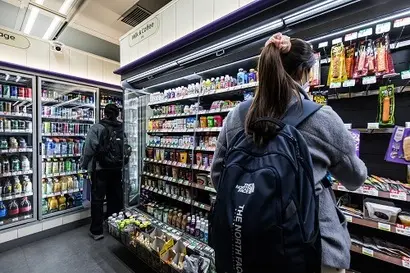
“It’s a store meant for driving customers only—but another convenience store is opening just a minute away?”
Mr. A, who operates a CU convenience store in Hwacheon-gun, Gangwon-do, has been sighing heavily lately. Last month, another CU store opened near his own. While Mr. A had heard rumors about the excessive competition for convenience store openings, he never expected such a situation to happen to him.
The convenience store Mr. A runs is a roadside store located along a national highway in Gangwon-do. Since accessing the store on foot would require walking along the shoulder of the road, the vast majority of his customers arrive by car.
The new CU store that opened last month is located about 600 meters away from Mr. A’s store, occupying a space that was previously a supermarket. “The sales representative came to tell me about the opening just two weeks before they actually opened. By then, interior work had already begun,” said Mr. A. “They just set up shop without any way for me to block it. Does it make sense to open the same brand just a stone's throw away in a rural area like this, not even in a bustling downtown city center?” he vented.
Mr. A lodged a protest with the headquarters of BGF Retail282330 regarding the proximity, but the response he received was simply that there was ‘no issue.’ The convenience store industry adheres to a voluntary agreement that limits the distance between new stores. For the same brand, new openings are prohibited within 250 meters, and because the distance between Mr. A's store and the new location exceeds 250 meters, the headquarters argued that there was no problem.

However, Mr. A argues that it is unreasonable to judge proximity solely by straight-line distance given the nature of roadside stores. “There are no pedestrian customers here. Everyone arrives by car, and if you drive, you can reach the new store in just one minute. Shouldn’t different criteria be applied based on the nature of the store?” he lamented. “Even a representative from a competing convenience store brand came by and said, ‘I don’t understand how your headquarters could open a store so close by.’”
Since the opening of the new store, Mr. A’s sales have been in decline. “Usually, my Saturday revenue exceeds 1 million won, but these days it doesn’t even reach 800,000 won. My monthly net profit, which used to be over 6 million won, has dropped below 4 million won due to the nearby opening,” he said.
He added, “This is my ninth year running this store. My contract is up for renewal next year, but I won’t be signing again. I worked every single day, without taking a day off, just to keep the store open 365 days a year. I couldn't even take breaks during the holidays or go on a proper family trip. It’s bitter to see that this is the result after all those years of protecting and growing this store.”
An official from BGF Retail, the operator of CU, stated, “In the case of CU, to ensure the business rights of franchisees, we do not open new CU stores within 250 meters of an existing store of the same brand. This applies equally to roadside stores.” They added, “We are currently focusing on a strategy of opening high-quality new stores through brand power rather than a quantitative strategy of excessively increasing store counts. To enhance the profitability and competitiveness of our franchisees, we are moving beyond simple cost-support methods and preparing mutual growth programs to help improve actual sales, while also expanding the scope of support and benefits.”
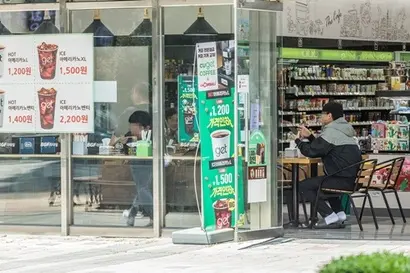
“I paid the penalty to close, now I’m just paying rent for an empty store”—the sighs of convenience store owners
The convenience store industry is focused on expanding the number of stores because the number of outlets is directly linked to total revenue. Although it was analyzed as early as the 2010s that the convenience store market had reached saturation, the industry continues to open stores aggressively. The number of convenience stores in Korea, which was 16,937 in 2010, increased to 48,094 in 2020 and surpassed 50,000 in 2021. As of the end of last year, there are 54,852 convenience stores in Korea.
There are even predictions that the number will soon surpass that of Japan, known as the "Kingdom of Convenience Stores." According to statistics from the Japan Franchise Association, there were 55,736 convenience stores in Japan at the end of last year. Despite Japan's population being 2.6 times that of Korea, the difference in the number of stores is only about 800.
Although the pace has slowed recently, the industry continues to compete in store openings. CU's store count, which was 15,855 in 2021, rose to 16,787 in 2022, 17,762 in 2023, and hit 18,458 last year. This is the highest number of stores among the four major brands as of the end of last year. GS25 also saw its count grow to 15,499, 16,448, 17,390, and 18,112 during the same period.
It is the franchisees who are sighing as competition for locations intensifies. As store profits plummet due to excessive competition, the number of franchisees hoping to close their doors is surging. Due to ongoing monthly deficits from sluggish sales, an increasing number of owners are willing to pay cancellation penalties to shut down their stores before their contracts expire.
Related disputes between convenience store headquarters and franchisees are also escalating. According to data received by BizHankook from the Korea Fair Trade Mediation Agency, 240 dispute mediation cases were filed by franchisees of the four major convenience store brands last year. This is a nearly 60% increase from 149 cases in 2022.
Some owners expect this year's closure rate to hit an all-time high. One convenience store owner said, “If I have one dream I want to achieve right now, it would be closing the store. I’m currently losing over 5 million won every month, and I have more than three years left on my contract. I asked the headquarters, and they said I’d need about 100 million won in penalties, but I think it would be better to pay the penalty and just close.”
Another owner said, “I closed my store recently after paying the penalty, just one year into a five-year contract. The more I operated the store, the more I lost, but the headquarters provided no support. Because the lease agreement is still in effect, I’ve closed the shop but I’m still paying monthly rent. The losses are astronomical. With the current economic downturn, there’s no one looking to take over the lease. You can’t describe the feeling of just paying rent for an empty shop. There are many other owners in the same situation,” they sighed.