

[비즈한국] Pickup trucks, which require ample space due to their large bodies, were long considered an unpopular category in the domestic automotive market. However, as lifestyles diversify, the release of new pickup trucks continues. Kia000270 recently unveiled the Tasman, its first authentic pickup truck, throwing down the gauntlet to KGM, which has virtually monopolized the domestic pickup truck market. KGM also plans to respond by introducing its new Musso EV model. While there may be disagreement over whether two models with different powertrains—internal combustion versus electric—are exact rivals, they are being singled out as competitors because their target demographics overlap.
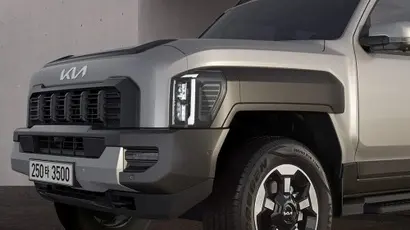
In the pickup truck genre, it is important for the exterior to clearly demonstrate strength and utility. The design of the Kia Tasman seems to have found the solution in 'restraint.' The exterior is puffed up to resemble a simple hexahedron and is excessively restrained, composed only of vertical, horizontal, and diagonal lines. From the hood to the cargo bed, it has achieved an extreme level of standardization, to the point where it feels like an enlarged electronic device, such as a laptop or a mobile phone. While this is a style that tends to polarize opinions, it is at least a clear finish in terms of emphasizing power. This simplicity also resonates with military vehicles. This is especially evident when looking at the military-concept Tasman that Kia Motors exhibited at IDEX 2025, a defense exhibition in the Middle East and Africa. In contrast, the Musso EV lacks a distinct concept. Its proportions are standard, but because it mixes various elements, it does not immediately stand out.
The name "Musso" has held special significance since the days of SsangYong Motor, the predecessor to KGM. The original Musso, which debuted in 1993, was effectively the first independently developed model created by SsangYong Motor. In the early 90s, SsangYong faced a crisis as the Galloper (1991), released by Hyundai Precision & Industry, eroded demand for the Korando Family, a 4WD station wagon of similar size. They were able to find a breakthrough by launching the Musso, which featured a completely new style built on a Mercedes-Benz engine obtained through a technical partnership. The design, which incorporated European flair that was rarely seen in Korea at the time—with input from Professor Ken Greenley’s team at the Royal College of Art in the UK—remains highly praised even 30 years later.
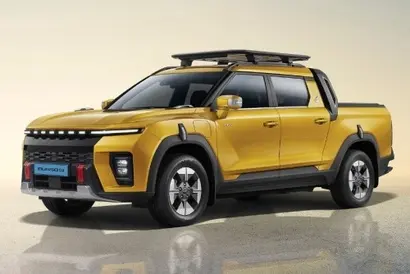
The Musso EV is also the spiritual successor to the Musso Sports, which introduced the concept of a "sports utility truck" in 2002 and planted the seeds for the pickup truck market. Rather than just borrowing the name, differentiation through the design identity of the original Musso is necessary. The original Musso had plenty of elements that could be reinterpreted, such as the sharp, triangular turn signals, the center-protruding hood panel, the side windows dynamically connected with a stepped edge, and the tailgate that drops not vertically, but in the shape of an angle bracket ( 〉). Overseas, there are many examples of brands maintaining heritage in small details even as generations change, such as the bent C-pillar that the Volkswagen Golf has maintained since its first generation, or the Hofmeister kink applied to the side windows of BMW vehicles.
They say history repeats itself. Just as the Galloper caused a stir in the 4WD category that was once SsangYong’s exclusive domain, the Tasman has now challenged the pickup truck category, which is the current backbone of KGM. For the Musso EV to counter this, it seems a more impactful design is needed. What made SsangYong Motor stand out in its prime during the 90s was its design. Just as the Hyundai Grandeur GN7 received positive reviews by reinterpreting the angular design of the first generation that debuted in 1986, I hope to see more designs that inherit the excellent legacy of the past.
About the author, Han Dong-hoon?
A typeface designer. He is interested in all fields related to letters, including writing, calligraphy, designing fonts, and teaching. Currently, he designs various corporate and retail fonts at the type studio AlignType. He has contributed to publications such as 'Monthly Design' and the quarterly 'Design Review', and conducts lectures on typeface design on both online and offline platforms. In 2021, he published the essay collection 'The Universe in a Letter'.