

[비즈한국] South Korea and Taiwan, both considered strategic hubs for the U.S. and China, find themselves in a similar plight. The second Trump administration has demanded that Taiwan increase its defense spending to 10% of its GDP, a crisis that will soon reach South Korea as well. The plan to impose tariffs on semiconductors is no different. Through the ‘Reading the Korean Peninsula from Taiwan’ series, Bizhankook meets with key figures in Taiwan’s politics, security, and economy to diagnose the current situation and analyze the implications for South Korea.
Analysts suggest that the possibility of dialogue between the U.S. and China has increased with President Trump’s return to power. Su Chi, chairman of the Taipei Forum Foundation, a leading Taiwanese diplomat and security expert who coined the ‘1992 Consensus,’ assessed, “Because President Trump tends to approach U.S.-China relations from a business perspective, his reelection could potentially expand the room for negotiation between the two powers.” Su served as a KMT legislator from 2005 to 2008 and as secretary-general of Taiwan’s National Security Council from 2008 to 2010. Although affiliated with the KMT, he is recognized for establishing a bipartisan cross-strait policy.
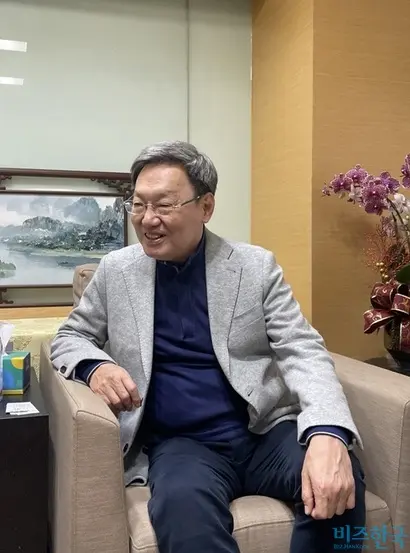
In an interview with Bizhankook on February 10, Su Chi stated that the likelihood of President Trump speaking directly with China and North Korea has increased. Su analyzed, “If the possibility of U.S.-China dialogue during the Biden administration was only 10%, it appears it will rise to the 30–40% level during Trump’s second term. Trump has strong control over the U.S. Congress. Given President Trump’s inclination, there is significant room for him to engage in direct dialogue with President Xi Jinping and Chairman Kim Jong-un.”
Su viewed this tendency of President Trump as a bad omen for Taiwan. He said, “Since his election, President Trump has rarely made extreme statements about China. With his business-minded thinking, he perceives Taiwan as an insignificant entity. Government officials in Taiwan are currently in a state of high tension.” He added that the situation for South Korea is no different.
The Trump administration's perception of Taiwan is also reflected in the demand for an increase in defense cost-sharing. President Trump has demanded that Taiwan increase its defense budget to 10% of its Gross Domestic Product (GDP). Taiwanese political figures stated that Trump’s aides have demanded an increase to the 5% level. Currently, Taiwan’s defense budget is 2.4% of its GDP (approximately 27 trillion KRW).
Su Chi pointed out, “This year, Taiwan’s defense budget is at an all-time high. It is difficult for the Taiwanese administration, the legislature, and public opinion to accept the demand for increased defense spending. The problem is that current Taiwanese politics is trapped in a ‘democratic civil war.’ The situation in South Korea is also very serious, but in Taiwan, political infighting between the ruling and opposition parties is intensifying. The opposition KMT is using political tools to recall heads of administration and local mayors, while the ruling Democratic Progressive Party (DPP) is attempting to recall legislators.”
Currently, the President of Taiwan is Lai Ching-te of the DPP, but in the Legislative Yuan, the KMT holds 52 seats while the DPP holds 51, creating a political landscape where the opposition holds the majority. Regarding U.S. economic pressure, such as the imposition of semiconductor tariffs, he was pessimistic, stating, “We will have no choice but to comply with what the U.S. demands.”
Su Chi is the politician who first coined the ‘1992 Consensus.’ The 1992 Consensus is a mutual understanding reached between China and Taiwan in 1992. It is the concept that the two sides—China and Taiwan—acknowledge ‘One China’ but interpret it in their own ways. Based on this understanding, China and Taiwan had previously signed the ‘Cross-Strait Economic Cooperation Framework Agreement (ECFA)’ and maintained exchanges.
However, the ‘1992 Consensus’ has now effectively lost its function. Not only the ruling DPP but even the KMT is distancing itself from this understanding. Su Chi said, “Under the current situation, cross-strait dialogue is impossible. Actually, what is more important than the name ‘1992 Consensus’ is ‘mutual trust.’ It was a concept maintained based on trust, but now that trust has collapsed. Private-sector exchanges across the strait have also decreased. Even within the KMT, no one talks about it anymore. It is China that is talking about the 1992 Consensus instead.”
Su Chi advised that in the current situation, maintaining relationships with both the U.S. and China is crucial. He said, “The commonality between Taiwan and South Korea is the need to maintain relationships with both the U.S. and China. That is why communication with the U.S. and China is so important. To resolve domestic political conflicts, I have also adopted a strategy of communicating with moderate conservatives and moderate progressives. Communication between political parties internally and maintaining multilateral relations externally are important. We must promote pragmatic dialogue through mutual trust.”