

[비즈한국] Andy Weir is famous as the author of the novel 'The Martian,' which inspired the movie of the same name. His third novel, 'Project Hail Mary,' is also being adapted into a film and is set to be released soon. With news that filming has recently concluded, starring Ryan Gosling, it has sparked great interest among many fans.
'Project Hail Mary' showcases unique imagination. One day, humanity discovers that the sun is losing its light. It’s a situation where the Earth's climate could change and humanity could vanish. It turns out the culprit is a space microorganism that drifts through outer space and survives by eating starlight. Based on Einstein’s mass-energy equivalence principle, this space microorganism absorbs starlight and converts it into its own energy. It is, literally, a stellar predator that devours stars. In the work, this fictional space microorganism is called 'Astrophage,' a combination of 'astro' (meaning star) and 'phage' (from bacteriophage).
Fortunately, (at least for now) this has not happened in reality. However, if we take the fascinating imagination shown in 'Project Hail Mary' and develop it just a little further, we might be able to discover the existence of an alien civilization living in a way we never expected!
There is a very small constellation called Sagitta (the Arrow) pointing toward Cygnus, which adorns the summer night sky. Because it is the season where there are many large constellations around, Sagitta feels insignificant. However, a truly amazing star is hidden here. It is the pulsar PSR B1957+20, which spews powerful energy jets and emits bright flashes, especially in the X-ray range. It is the most representative example of celestial bodies called 'Black Widow pulsars.'
Discovered in 1988, this pulsar is about 6,500 light-years away in the direction of Sagitta. It is estimated that an exoplanet much larger than Jupiter orbits it at a very short interval of about 9 hours. This pulsar emits flashes at a very short, millisecond-scale period. This is because another companion star is orbiting right next to the newly born, super-dense neutron star at a very close distance. The neutron star and its companion appear to be packed as closely as the distance between the Earth and the Moon. There is even a possibility that the two stars are practically touching, with a distance of only a few hundred kilometers.
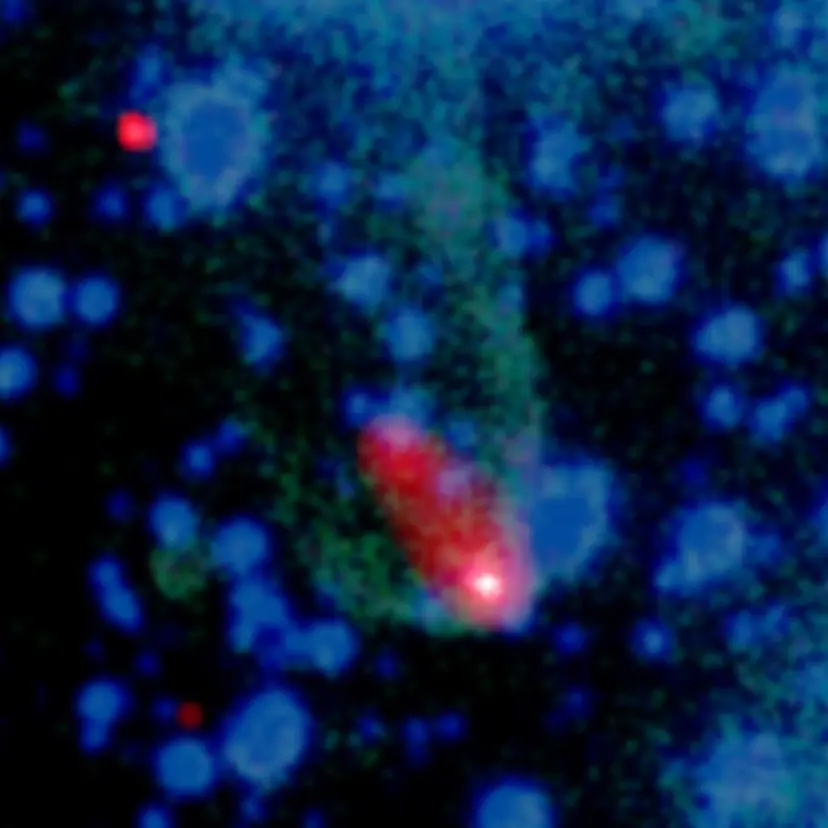
Pulsars with companions are generally divided into two types based on their scale. If the mass of the companion star is very light—less than 5% of the Sun's mass—it is called a 'Black Widow pulsar.' If the companion is much heavier, ranging from 10% to half the mass of the Sun, it is classified as a more extreme 'Redback pulsar.'
In this analysis, astronomers focused on how Black Widow pulsars use their powerful gravity to rapidly devour large amounts of material from the companion star next to them. In the process, a large amount of material is ejected along the pulsar’s strong magnetic field at nearly the speed of light. The powerful flow of energy that a pulsar spews in all directions is called a 'Pulsar wind.' It can be seen as an extreme version of the stellar wind that ordinary stars like the Sun emit. This powerful pulsar wind can gradually blow away the nearby companion. In a sense, the star is evaporating.
When the powerful pulsar wind emitted by the pulsar strikes the companion, a strong shockwave is generated. A very high temperature is instantly created on the surface of the companion, resulting in the observation of intense, high-energy X-rays. In fact, this phenomenon has been discovered in the Omega Centauri cluster, the heaviest globular cluster in our galaxy. Looking at the Omega Centauri cluster through the Chandra X-ray Observatory, about 20 traces of intensely shining X-rays are visible in very narrow areas. Most are estimated to be Black Widow or Redback pulsars.
Pulsars are some of the most extreme places in the universe that generate the most powerful energy. If there were a civilization far more advanced than ours, and if they needed far more energy than humanity to maintain their civilization, couldn't these pulsars be excellent energy sources?
Many SF works often depict a 'Dyson sphere,' where one lives by enveloping a central star with a massive artificial structure to obtain starlight energy. This is a way of obtaining energy from starlight by surrounding the star with structures. However, even more extreme imagination is possible. It is not just receiving starlight, but consuming the star itself to convert the star's mass entirely into energy. If one could convert the entire mass of a star into energy, like the imaginary space microorganism Astrophage that appeared in 'Project Hail Mary,' it would be an astonishing level of civilization that surpasses Kardashev Type II. This is the so-called 'Stellivore' (star-eater) hypothesis.

Imagine a civilization that has gone beyond its home planet and reached a level where it builds massive structures around its central star. They might have lived by building a Dyson sphere at one point. But if they do not stop there and continue to develop, the energy consumption of the civilization will increase further. Eventually, they must find a solution to create more energy. Perhaps they might choose the path of completely consuming their own star. However, a star's mass is not infinite. A star is a finite resource that will eventually be exhausted.
In that case, the civilization would likely choose to relocate to another star before their original star completely disappears. They make their original star disappear entirely, move on to a new star, and live the same way until that star disappears. One could view them as the stellar version of slash-and-burn farmers.
The companion star orbiting the pulsar can be used not just as a resource to obtain energy, but as a source of propulsion needed to fly to another new star. Due to the energy jet emitted by the pulsar, material from the companion star is rapidly blown away. This material escapes the star's gravity and flies quickly into outer space. If one can properly ride the flow of this blown-away material, one could obtain the energy needed to fly to other stars within a single galaxy. Such an attempt is possible in binary systems where two stars are held together by gravity and orbit each other.
Currently, humanity is attempting new space exploration technologies that utilize sunlight or massive artificial lasers installed on Earth to increase the speed of probes to sub-relativistic levels. This project, called 'Starshot,' is a plan to launch a probe equipped with a giant solar sail to the Proxima Centauri star system, which is the closest to our solar system at 4.2 light-years away. However, if they utilize the stellar wind emitted by a very powerful pulsar, a space sail could sail even faster. Moreover, the cycles of pulsars and their companions are quite predictable. Therefore, if the timing of the pulsar blowing energy onto the companion is well-matched, they could induce sailing toward a destination while gaining thrust in a specific direction.
It is truly movie-like imagination. If an alien civilization that has reached this level is living at pulsar PSR B1957+20, and if they are in the middle of preparing to abandon their home and run away to a second star, could we even know where they are trying to go now? Interestingly, according to this analysis, the Black Widow pulsar appears to be spewing energy toward a specific destination.
Astronomers used observation data from the Gaia satellite, which is drawing the most detailed 3D map of stars in our galaxy. And they confirmed the fact that the flow of energy being spewed by this pulsar seems to be targeting a specific star. Considering the efficiency of the energy the pulsar is spewing and the distance to the target star, they could reach their destination after a 420-year voyage.
Of course, the story so far is all based on a major assumption. It is an assumption that seems highly unlikely: that a highly advanced civilization is living on a Black Widow pulsar. It is closer to the expectations of an SF nerd than a scientific hypothesis. However, if we can overcome that big barrier, it is interesting that the various characteristics and circumstances shown by this pulsar seem to fit quite well with the Stellivore hypothesis, which suggests the existence of beings that maintain their civilization by consuming stars.
Shall we unfold one more interesting imagination? Why are so many Black Widow pulsars that cause powerful pulsar winds found specifically in the Omega Centauri cluster?
In this cluster, tens of millions of stars are packed together in a very high density within a diameter of only 150 light-years. In other words, the distance between stars is very close. On average, they are 0.1 light-years apart. Considering that the closest star system to our solar system is over 4 light-years away, this is much closer. In other words, it might be a much easier challenge to leave one's home star and fly to a neighboring star here. Could this difference have acted as an environmental factor favorable for the development of a super-advanced civilization that lives by traveling between various stars? I have the mischievous imagination that perhaps the existence of Black Widow pulsars, which are found relatively frequently in the Omega Centauri cluster, shows the existence of a group of super-advanced civilizations living there together.
The movie 'Contact,' based on Carl Sagan’s novel of the same name, has an impressive scene. When the astronomer Ellie, who is struggling because she cannot decode a message received from aliens, is asked by her sponsor and billionaire S. R. Hadden, he leaves this line:
“If you think like a Vegan (as if thinking like the Vegans).”
A single sentence implying that one must escape the Earthling's way of thinking and think in the way of the Vegans (aliens) to find the right answer. Perhaps the hypotheses that feel like absurd, excessive SF imagination right now might be the hypotheses that truly come closest to the Vegans' way of thinking.
There is one fundamental problem we must consider when searching for the technological traces of potential alien civilizations, or 'Techno-signatures.' The more highly advanced a civilization is, the more energy it consumes and the clearer signals and traces it will leave in the universe. The traces left by a civilization like Earth's, which hasn't even taken its first steps properly and is far from being a cosmic civilization, are too minimal. Therefore, more advanced civilizations have a higher probability of being discovered. This will act as a very important trend in the search for alien civilizations.
If signals of an alien civilization are detected in our grid in earnest in the near future, they will likely be a Kardashev Type I, Type II, or even higher civilization that has already far surpassed our level. They will show much more powerful and higher-level technology than we have. Such a discovery might bring humanity fear beyond wonder. It will seem as if there are only much greater civilizations far ahead of us outside the solar system.
And humanity, succumbing to fear, might stop further exploration and shrink away. We might give up the attempt to set foot outside the solar system and choose the path of dying alone and lonely, hiding our existence. All while failing to realize that many more civilizations similar to ours, living quietly like us, were hidden among the dazzling and brightly shining signals of brilliant super-advanced alien civilizations.
Will we be able to overcome this cosmic sense of relative deprivation every time we discover more brilliant civilizations ahead of us in the future? This courage will be the most important factor in determining the destiny of human history and whether humanity can leap forward into a true cosmic civilization.
References
https://baas.aas.org/pub/2023n6i220p02/release/1
https://academic.oup.com/mnras/article/526/2/2736/7283175
https://ui.adsabs.harvard.edu/abs/2024arXiv241023420H/abstract
https://academic.oup.com/mnras/article/520/3/3847/6979819
https://chandra.cfa.harvard.edu/photo/2023/spiders/
Who is the author Woong-Bae Ji? He loves cats and the universe. After watching 'Galaxy Express 999' as a child, he developed a dream to let the world know about the beauty of the universe. Currently, he is researching the evolution of galaxies through their interactions at the Center for Galaxy Evolution and the Near-Cosmology Lab at Yonsei University, and is engaged in various science communication activities such as lectures and writing. He has written books such as 'The Observatory of Flirting,' 'Thinking About the Universe All Day,' and 'Star, the Science of Light.'