

[비즈한국] While South Korea’s Social Overhead Capital (SOC)—the national infrastructure responsible for the flow of the national economy, such as railways and roads—is becoming increasingly aged, the budget for the SOC sector continues to shrink, raising concerns. This year, the SOC budget has not only decreased compared to last year, but its share of the total national budget has also fallen to an all-time low.
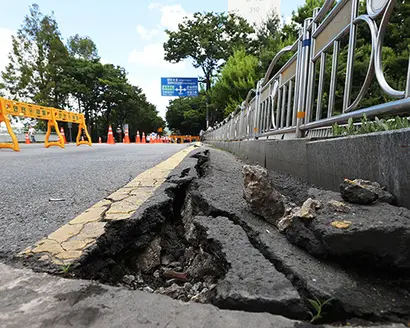
With various natural disasters increasing due to recent global warming, the combination of shrinking SOC budgets and facility aging is heightening the risk of safety accidents. Another issue cited is that while the overall SOC budget is in decline, there is a sharp surge in the budget for constructing new local airports, even as the safety of projects like the Muan Airport Jeju Air089590 incident has come under fire.
SOC, which includes railways, roads, shipping, aviation, water resources, and logistics facilities, serves as the foundation for economic growth while also providing essential services for public convenience. Government investment in SOC is not only a major factor in economic growth but has also been used as a means of economic recovery during downturns, such as the 1997 Asian financial crisis and the 2009 global financial crisis.
Investment in South Korea’s SOC began in earnest following the start of national economic development plans in the 1970s and accelerated in preparation for the 1988 Seoul Olympics. As a result, the country's SOC has been aging rapidly in recent years. According to the Facility Statistics Yearbook from the Korea Authority of Land & Infrastructure Safety, there were 50,295 facilities (excluding buildings) such as bridges, tunnels, ports, dams, and water supply systems in 2018. Of these, 8,185 facilities, or 16.3%, were over 30 years old.
However, 10 years later in 2028, the proportion of facilities older than 30 years is projected to exceed 40%, rising to 20,236 (40.2%). Five years after that, in 2032, aging facilities over 30 years old are expected to reach 29,567, accounting for 50.8% of all facilities, surpassing the 50% threshold.
If more than half of all SOC becomes aged, safety is expected to become a major issue. With the recent increase in natural disasters such as heavy rainfall, heatwaves, and wildfires due to climate anomalies, and more frequent earthquakes like those in Gyeongju and Pohang, concerns are rising that aging SOC could even lead to casualties. In fact, as sinkholes and potholes increase in frequency, the need for maintenance on aging railways, roads, and water systems is becoming more urgent.
Despite growing concerns over safety accidents caused by aging SOC, the proportion of funding allocated to the SOC sector is shrinking. In 2010, the SOC budget accounted for 8.6% of the total budget, a significant figure, but it fell to 4.4% by 2018. It saw a slight uptick to 4.7% in 2021, briefly suggesting improved investment, but it began to decline again afterward and dropped to 3.8% this year.
The share of the SOC budget is expected to continue its decline. According to the National Fiscal Management Plan (2024–2028), the proportion of the total budget allocated to SOC is projected to fall to 3.7% in 2026, 3.6% in 2027, and 3.6% in 2028. Notably, while the average annual growth rate of total government expenditure in the 2024–2028 plan is 3.6%, the average annual growth rate of total expenditure in the SOC sector is only 0.4%—one-ninth of the total. Given that the average annual growth rate of SOC total expenditure in the previous mid-term fiscal plan (2023–2027) was 2.9%, it is clear that the SOC investment plan has been significantly curtailed.
Breaking down SOC by sector, the average annual expenditure growth rate for roads (based on 2024–2028) is -8.0%, showing an actual decrease. Railways and urban rail systems saw an average annual growth rate of only 0.7%, while the water resources sector remained at 1.3% and the regional/urban sector at 1.4%. The average annual expenditure growth rate for industrial complexes is set to plummet by 15.4%. This raises the likelihood that both public safety and the economic arteries of the nation will be threatened.
In contrast, the average annual expenditure growth rate for aviation and airports reaches 31.4%. While total expenditure on overall SOC is effectively stagnant, most of the new spending is being poured into new airport construction projects. According to the Ministry of Land, Infrastructure and Transport, 15.6056 trillion won is set to be invested in the Gadeokdo New Airport, 5.4532 trillion won in the Jeju Second Airport, 806.7 billion won in the Ulleungdo Small Airport, and 807.7 billion won in the Saemangeum New Airport. Competition among local governments to attract new airports has led to a situation where many local airports are being built despite doubts regarding actual demand or safety around the airport sites.