

[비즈한국] As strategic focal points between the United States and China, South Korea and Taiwan share a similar plight. The second Trump administration has demanded that Taiwan contribute defense costs equivalent to 10% of its GDP, a crisis that will soon reach South Korea as well. The plan to impose tariffs on semiconductors is no different. Through the ‘Reading the Korean Peninsula from Taiwan’ series, Bizhankook meets with key figures in Taiwan's politics, security, and economy to diagnose the current situation and analyze the impact on South Korea.
Former Taiwanese Vice President Annette Lu (Lü Hsiu-lien) has urged East Asian nations, including South Korea, to strengthen cooperation. She emphasized, “With the United States and China locked in a massive clash of powers, South Korea, Taiwan, and Japan must cooperate to build diplomatic strategies.” Annette Lu is Taiwan’s first female vice president and served two consecutive terms as the 10th and 11th vice president from 2000 to 2008. She is currently considered a senior politician of the ruling Democratic Progressive Party (DPP) in Taiwan.
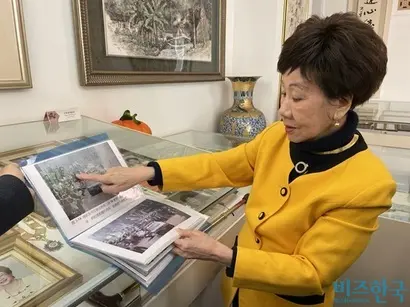
In an interview with Bizhankook on February 11, former Vice President Lu stated that South Korea, Taiwan, and Japan must respond strategically to cope with the U.S.-China conflict. “The United States and China are like two giant elephants; when they fight, smaller surrounding nations are bound to get hurt,” Lu said. She emphasized, “South Korea, Taiwan, and Japan must strengthen strategic cooperation, and democratic nations in East Asia, including the Philippines, need to work in close coordination.”
To initiate these discussions, she founded the ‘East Asia Peace Forum’ in 2018. The forum serves as a venue for politicians, scholars, and experts from various countries to discuss peace issues in East Asia. “The forum is held in South Korea, Taiwan, and Japan, and I hope the three countries will cooperate more closely in time for the ‘International Day of Peace’ on September 21 this year,” Lu said.
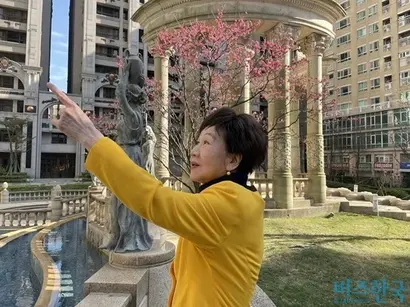
Former Vice President Lu also addressed President Trump's policy of imposing semiconductor tariffs. She analyzed, “Just as the Japanese economy took a major hit from the 1980s Plaza Accord, the U.S. is currently strengthening pressure on Taiwan, focusing on the semiconductor industry.”
The Trump administration has recently been pushing for tariffs on semiconductor and automobile imports. Taiwan, which owns TSMC, the world’s largest semiconductor foundry, is also on high alert. On the 13th, Trump announced a policy of imposing ‘reciprocal tariffs’ on countries around the world, stating, “We want semiconductors to be manufactured in our country. Most of them are currently made in Taiwan. I want those companies to come here.”
Former Vice President Lu believes this is precisely why the three countries must cooperate. “Trump is fundamentally a businessman. He intends to solve America's fiscal difficulties through high-tariff policies. South Korea, Japan, and Taiwan all play important roles in the global economic order, but it is still difficult to escape the influence of a great power,” she pointed out.
She added, “The U.S. is attempting to relocate TSMC’s production facilities to its own soil. However, many problems are currently arising at the TSMC plant in Arizona. I believe historical and cultural factors are the cause. Without cultural commonalities and consensus, it is difficult to see results even after building factories. On the other hand, the TSMC plant in Japan is not facing major issues. South Korea, Japan, and Taiwan, which share a great deal of history and Confucian values, must cooperate and respond to each other. I believe we have strengths in many fields, not just semiconductors, but also AI and the beauty industry. The strategy is to create a win-win-win situation.”
Former Vice President Lu also takes a keen interest in South Korea's recent political situation. Taiwan experienced a martial law system for 38 years, from May 1949 to July 1987. “I was very surprised to hear the news of South Korea’s emergency martial law. The emergency measure drew significant international attention,” she said. “What impressed me most was that the constitutional system remained intact despite the chaos. The fact that the National Assembly immediately convened and that the prosecution and judiciary followed procedures in accordance with the Constitution demonstrates the strong resilience of South Korean democracy,” she assessed.
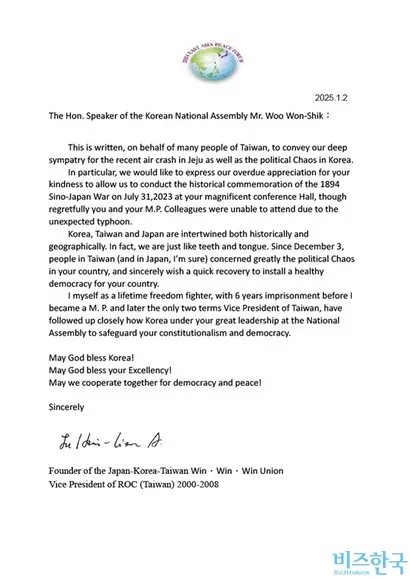
Former Vice President Lu also revealed that she had sent a personal letter to National Assembly Speaker Woo Won-shik. “I sent the letter out of a sincere desire for South Korea’s constitutional system to continue to develop. Even if someone commits a wrong, if the constitutional system is maintained, the country is stable,” she explained. “It is essential for the National Assembly to fulfill its role as the representative of the people to maintain national stability,” she said, evaluating that “the Korean National Assembly played an excellent role.”
Finally, former Vice President Lu offered a suggestion for the advancement of Korean politics. “South Korea should also consider adopting a vice-presidential system. I do not think it is appropriate for democracy to have an unelected person acting as president. A more balanced political structure rather than a single-president system would contribute to increasing the stability of Korean politics,” she advised.