

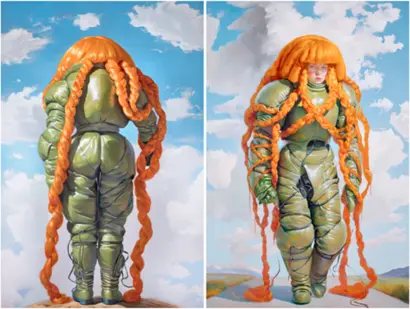
[비즈한국] The world's largest auction house, Britain's 'Christie's', is holding its first-ever auction dedicated exclusively to artificial intelligence (AI) art. The auction, titled 'Augmented Intelligence', will take place on February 20 (local time) at the Rockefeller Center gallery in New York, USA. Although Christie's has sold AI artworks in the past, this is the first time an auction has been composed entirely of AI pieces.
The art world reacted with immediate backlash. The day after the announcement on the 8th, artists sent a letter of protest to the company, citing issues with unauthorized training; over 4,800 artists joined in within four days. In a statement from its spokesperson, Christie's clarified, “The artists who submitted work are all strong and have been active in their art fields for a long time, with some recognized by major museums. The auction items are works that have had their level of completion enhanced through the use of AI.”
AI music generators, which can create 500 songs for $10 (approx. 1,400 won) a month, are shaking up the industry landscape with extreme efficiency. On YouTube, it is easy to find channels providing streaming content by putting AI-composed music over album covers or background images. Recently, it has been reported that the channel of mixed martial artist Choo Sung-hoon, which is rapidly increasing its subscribers and views, also utilizes AI music. Different background music plays in every episode, gaining a positive response for its 'B-grade' aesthetic.
As AI music spreads, clashes with creators are also intensifying. 'Suno', a representative music generation AI, was sued for damages by the German music copyright association (GEMA) on the 21st of last month, following lawsuits from the three major record labels Sony, Universal, and Warner Music last year. While Suno allows commercial use for paid subscribers, including monetization on YouTube, the music industry claims that vast amounts of copyrighted music were used for AI training without permission.
Despite the 'AI Basic Act', AI content copyright remains a 'dilemma'
The rise of generative AI has sparked a copyright war across the content industry. When AI is used for creation, the possibility of copyright infringement is always present. This is because AI functions by learning based on massive amounts of existing data. Whether such content can be placed on the same level as the output created by general authors, composers, or directors is also a subject of debate. According to current interpretations of copyright law, only 'human creations' qualify as copyrighted works; however, if a human has added their own expression to an AI creation, they may hold the copyright for the contributed portion.
Last December, South Korea became the second country after Europe to prepare a comprehensive bill related to the AI industry. While there are high expectations that the enforcement of the AI Basic Act, which focuses on industrial promotion, will resolve uncertainty, limitations are also being pointed out, such as the omission of regulations regarding the storage and disclosure of training data records.
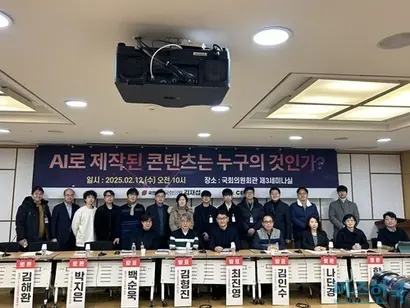
The National Assembly continues to discuss the issue of AI copyright. A related forum was held at the National Assembly on the 12th. The forum, hosted by People Power Party lawmaker Kim Jae-seob, was held under the theme, 'To whom does AI-produced content belong?' Lawmaker Ahn Cheol-soo, who serves as the chairman of the People Power Party's Special Committee on AI, explained, "Content is a far more complex field than people think. South Korea is in a reality where there is an absolute lack of data volume, and securing quality is not easy."
Movies and Comics also 'on edge'... How far do AI content's exemptions and copyrights go?
With the development of AI, the sense of crisis among creators and existing operators is gradually growing. The 'enemy' is not just outside. Two years ago, The Walt Disney Company developed an AI system that freely manipulates the age of an actor's face. While CG technology previously took weeks for video processing and modification, using AI age-manipulation tools allows for easy adjustment of an actor's aging and rejuvenation effects.
This has the potential to lead to the shrinking of fields such as makeup artistry and special effects art. Generative AI is evaluated as having potential in 'digital de-aging' technology due to its high reasoning power, and it is expected that if this ability is actively utilized, the pace of change will be even faster. The movie 'Here', starring Tom Hanks and set for release on the 19th, is the first feature film in Hollywood to introduce AI technology throughout the entire movie. De-aging technology was used in this film, which covers the protagonist's life from birth to twilight.
Kim In-soo, CEO of Cinema Service, expressed concerns about the combination of AI technology and film, stating, "Some even say that movies might become the shortest-lived art on Earth." Hollywood previously reached some agreements related to AI last year, following a large-scale strike that occurred for the first time in 63 years. CEO Kim pointed out, "The most important part of the Hollywood agreement is the clause that 'AI-generated output can never be used to infringe on the rights and contributions of writers,'" adding, "Even though an AI charter has emerged aiming to benefit all humanity, finding a balance between copyright and copyleft (copyright sharing) remains a difficult problem."
Whether creative works made by AI can hold copyright is another matter. AI art, which has been mired in controversy regarding artistry and copyright for years, is at the center of the debate. The 18-page graphic novel 'Zarya of the Dawn', created with Midjourney, had its copyright registered with the US Copyright Office before it was later canceled. Regarding this, lawyer Na Dan-kyung (of the law firm 'Moduui Law') explained, "It was registered as a compilation work. This is the concept that the human creativity involved in selecting and arranging these images was partially acknowledged. However, they refused to grant copyright to the AI-generated images themselves."
Choi Jin-young, Director of the Korea Copyright Commission, said, "The history of copyright is a history of the expansion of the scope of copyright protection. I believe it is highly likely that AI-generated works will be protected in the future," adding, "Legal precedents acknowledging the rights of AI-generated products have already emerged in foreign countries, including China."
The issue of AI copyright is not limited to content. It has emerged as a hot potato across all industries, especially after the shock of China's AI model 'DeepSeek'. Domestic and international companies and public institutions have simultaneously issued bans or taken measures to block the use of DeepSeek. Although temporary measures have been taken against DeepSeek, domestic companies are deeply contemplating how to respond to the intellectual property policies of major countries like the US in the future.
There are companies that have found a monetization model here. LG unveiled 'NEXUS', the first commercialization model of its AI Research Institute, at the 'AI Action Summit' held in Paris, France, on the 10th and 11th. It is a solution that automatically analyzes risk factors such as copyright laws, judicial precedents, and AI regulations of various countries to filter out illegally collected data in advance. The goal is to reduce disputes between data rights holders and AI model developers.
Relevant parties point out that a policy direction that fully considers the external relations and impact of the domestic industry is needed. Lawmaker Kim Jae-seob, who hosted the forum, stated, "While AI has infinite potential, it also carries potential threats such as security issues like personal information leakage," adding, "I will provide support to establish an effective legal framework that can protect freedom of creation while allowing AI technology to develop as well."