

[비즈한국] The ‘Airborne Early Warning and Control (AEW&C) Phase 2 Program,’ aimed at strengthening the aerial surveillance and reconnaissance capabilities of the Republic of Korea Air Force, will reach a final aircraft selection and basic contract signing this coming April. Three global defense companies—Boeing (E-7A) of the US, L3Harris (Global 6500 AEW&C) of the US, and Saab (GlobalEye) of Sweden—have submitted bids for this project.
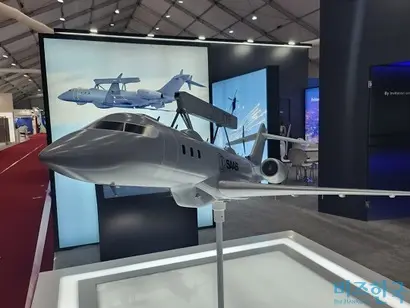
According to industry sources, the aircraft selection and the signing of the basic contract for the AEW&C Phase 2 Program are scheduled for this April. This project involves the additional acquisition of early warning aircraft by 2031, with a total budget of 3 trillion won expected to be invested. Equipped with high-performance radar, these airborne control aircraft detect trends in enemy aircraft and missile launches at long distances, report them to ground bases, and perform command and control functions for friendly fighter jets.
Currently, the ROK Air Force operates four E-737 ‘Peace Eye’ early warning aircraft. It is expected that four additional early warning aircraft will be introduced through this second phase of the program.
Boeing’s ‘E-7A,’ considered the most formidable contender among the candidates, is the next-generation model of the existing E-737 and is equipped with the Multi-role Electronically Scanned Array (MESA) ‘Top Hat’ radar manufactured by Northrop Grumman. This radar significantly reduces the 360-degree rotation interval, and the aircraft has an unrefueled range of 6,482km, with a target identification range reaching 556km. Its strengths include compatibility with the E-737s already held by the ROK Air Force and ease of maintenance and support.
Swedish defense company Saab’s ‘GlobalEye’ is a model that integrates the latest Erieye-ER radar onto Bombardier’s Global 6500 business jet. It has an endurance of 13 hours and an estimated detection range of approximately 650km. Its strengths include being a state-of-the-art airborne control aircraft capable of tracking thousands of targets simultaneously, the potential for radar technology transfer and domestic production, and a rapid delivery schedule. Saab has signed a memorandum of understanding with Korea Aerospace Industries047810 (KAI) for this project, and KAI plans to directly handle the conversion, maintenance, and repair of the GlobalEye aircraft in the future.
L3Harris has proposed the ‘Global 6500 AEW&C’ model. It is more price-competitive than existing airborne control aircraft and has promised significant domestic transfer of system integration technology and cost-saving measures for maintenance. L3Harris is partnering with Korean Air003490; if successful in winning the bid, Korean Air would play a key role in the overall production process, including conversion, parts mass production, and training for operational personnel. Korean Air signed a cooperation agreement with L3Harris in the field of airborne control aircraft back in 2022.
Experts believe that while Boeing’s ‘E-7A’ is currently evaluated as the most likely candidate, there is a possibility that L3Harris or Saab could cause an upset. This is because L3Harris is pushing the project with Korean Air as its partner, while Saab is doing so with KAI.
An industry official explained, “Boeing is currently the most likely winner because the Air Force wants the E-7A. If there is a surprise, it would only be if the Defense Acquisition Program Administration selects a different model following a comprehensive evaluation, similar to the Brazilian Embraer C-390 transport aircraft project. However, since joint operation capabilities with the US military and Link-16 connectivity are more critical factors for airborne control aircraft than for transport planes, the possibility of Boeing being selected is high.”