

[비즈한국] Aekyung Chemical161000 is driving forward with new business ventures. Recent notable moves include breaking ground on a TPC (Terephthaloyl chloride) production plant. With Aekyung Chemical having posted sluggish performance last year and concerns mounting over a prolonged downturn in the petrochemical industry, the industry is focusing on whether the company can use these new businesses as a catalyst for a performance turnaround.
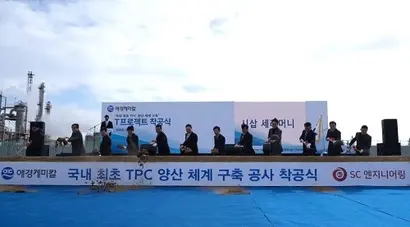
Breaking Ground for 'Super Fiber' Aramid Raw Material Plant; Opinions on Business Outlook Diverge
Aekyung Chemical is considered the most proactive among Aekyung Group affiliates regarding new business. A representative area of interest for the company is aramid. Aramid is a 'super fiber' that is lighter and stronger than steel while offering flame retardancy, making it useful in various industries such as firefighting gear, aerospace, electric vehicle tire cords, and optical cables.
In September last year, Aekyung Chemical's board of directors decided to invest 96.7 billion KRW to build mass-production facilities for TPC, which is a core raw material for aramid fiber. The groundbreaking ceremony for the TPC plant was held on February 6, with the goal of completing construction by the end of this year and beginning mass production early next year.
Pyo Kyung-won, CEO of Aekyung Chemical, stated, “With the groundbreaking of this plant, Aekyung Chemical has taken a big step toward the technological self-reliance and localization of TPC that we have dreamed of. We will continue to focus our corporate capabilities on discovering new growth engines and creating high added value.”
Opinions regarding the outlook for Aekyung Chemical’s aramid business are divided. On one hand, some view it positively due to increasing demand. Kim Sun-ho, a researcher at the Korea IR Council, noted, “Although South Korea’s aramid exports fell by 7.4% year-on-year to 8,292 tons in 2023, the 10-year average export growth rate (2013-2023) stood at 11.5%, marking double-digit growth. Looking at the trends of domestic aramid producers, export volumes are expected to continue rising.”
On the other hand, there are concerns given the recent poor performance of aramid producers. For instance, HS Hyosung Advanced Materials298050 entered the aramid business in 2009 by launching the brand ‘ALKEX,’ but it has negatively impacted their performance.
Choi Young-kwang, a researcher at NH Investment & Securities, assessed, “For (HS Hyosung Advanced Materials), super fibers such as carbon fiber and aramid have seen declines in both revenue and profitability due to sluggish demand, reduced production, and restructuring costs.” Kim Do-hyun, a researcher at SK Securities, added, “The operating loss for HS Hyosung Advanced Materials’ carbon fiber and aramid division in the fourth quarter of last year expanded to 14.4 billion KRW. It is expected that the sluggish performance for these materials will continue through the first half of this year.”
Beyond aramid, Aekyung Chemical is also pursuing a new business in eco-friendly refrigeration oil. In 2022, the company successfully localized home appliance refrigeration oil through joint technology development with GS Caltex. However, this has not yet led to full-scale commercialization.
An official from Aekyung Chemical stated, “While some say the aramid market is not doing well, we believe this is a temporary stagnation in demand, not a complete halt to fundamental growth. Since TPC solidifies if imported, it takes significant time to melt it down; however, we supply TPC in liquid form, which is advantageous in terms of energy and cost savings.” Regarding refrigeration oil, they added, “We are in the testing process before delivering the developed products. We expect more concrete news by the end of this year or early next year.”
Success of New Business Also Impacts Leadership of Chairwoman Jang Young-shin
Aekyung Chemical posted sluggish results last year. Revenue fell 8.4% from 1.7937 trillion KRW in 2023 to 1.6422 trillion KRW in 2024. During the same period, operating profit plummeted by 66.0% from 45.1 billion KRW to 15.3 billion KRW.
This performance is poor even when compared to other major Aekyung Group affiliates. Jeju Air089590 saw revenue increase 12.3% from 1.724 trillion KRW in 2023 to 1.9358 trillion KRW in 2024, though its operating profit fell 52.9% from 169.8 billion KRW to 79.9 billion KRW. Aekyung Industrial018250 saw revenue rise 1.5% from 668.9 billion KRW to 679.1 billion KRW, with operating profit falling 23.5% from 61.9 billion KRW to 47.4 billion KRW. While operating profits declined for both Jeju Air and Aekyung Industrial, their revenues still grew.
Aekyung Chemical’s poor performance is attributed to the global petrochemical industry downturn. Kim Seo-yeon, a senior researcher at NICE Investors Service, assessed, “The slowdown in the Chinese economy is lasting longer than expected, leading to continued weak demand for petrochemicals. As of 2024, South Korea’s petrochemical exports to China remain low, and the recovery of the industry is delayed beyond previous expectations.”
China accounts for over 10% of Aekyung Chemical’s revenue, a figure that cannot be ignored. Aekyung Chemical itself stated that the cause of the poor performance was “profitability decline due to oversupply from China’s facility expansions and stagnant global demand.”
As poor performance continues, the results of new business ventures are critical. However, it is expected that the Aekyung Group as a whole may find it difficult to focus exclusively on Aekyung Chemical’s new business for the time being, as the group is focused on handling the aftermath of the Jeju Air passenger plane tragedy at Muan International Airport that occurred late last year.
The success of Aekyung Chemical’s new business could also impact the leadership of Aekyung Group Chairwoman Jang Young-shin (89). The only Aekyung Group affiliates where Chairwoman Jang serves as an internal director are Aekyung Chemical and KOSPA. KOSPA is an eco-friendly material manufacturer and a joint venture between Aekyung Group and Japan’s JSP. KOSPA’s annual revenue is in the 30-billion KRW range, which is not a significant portion of the group. Therefore, Aekyung Chemical is effectively the only major affiliate where Chairwoman Jang directly participates in management.
Aekyung Chemical set its year-end dividend for 2024 at 281 KRW per share, which is higher than the 250 KRW per share dividend for 2023. Aekyung Chemical’s net profit has shrunk from 59.4 billion KRW in 2022 to 33 billion KRW in 2023, and finally to 2.5 billion KRW in 2024. Despite a sharp decline in net profit, the dividend was actually increased. While shareholder returns are important, such moves can deplete investment funds.
The aforementioned Aekyung Chemical official explained, “As part of our effort to enhance corporate value, we presented a goal of a dividend payout ratio of over 35% by 2027 last December. Various investments, including TPC, have already been secured through borrowings, and our debt-to-equity ratio is stable, so there are no issues with raising investment capital.”