

[비즈한국] Foreign investors continue to exit the domestic stock market. The foreign share of total market capitalization has failed to recover to the 30% range since August 2024, and the value of foreign-held assets has shrunk from 738 trillion won at the end of 2023 to 666 trillion won as of January 2025. Sensing a crisis, the government has pushed for a 'Value-Up Program' to resolve the 'Korea Discount' and introduced the 'Korea Value-Up Index,' comprised of 105 undervalued blue-chip stocks. Every week, we select one company from the Korea Value-Up Index to analyze its current management status and corporate value enhancement plans to see if it is a stock that can live up to expectations and prevent the 'fall of the Korean market.'
Largest Market Cap, But No Value-Up Disclosure Yet
The Corporate Value-Up Program is a system designed to resolve the phenomenon of domestic stocks being undervalued (the 'Korea Discount'). The goal is to create a virtuous cycle where listed companies voluntarily work to enhance corporate value, the government encourages participation through incentives such as tax support, and investors choose companies that respect shareholder value.
The Korea Value-Up Index is an indicator that investors can utilize; it is composed of companies expected to grow in value through continuous profit generation and shareholder returns. It includes 105 companies selected based on market representation (market cap), profitability (net income), shareholder returns (dividends/treasury stock cancellation), market valuation (Price-to-Book Ratio, PBR), and capital efficiency (Return on Equity, ROE). In essence, these are the stocks expected to lead a rally in the domestic stock market.
Samsung Electronics is the top constituent of the Korea Value-Up Index and the company with the largest market capitalization (332 trillion won) on the KOSPI. While it is considered a 'national stock' that even those who know nothing about the stock market buy, it is struggling due to a long-term decline in share price. Foreign investors are also increasingly turning away. While it remains the most widely held stock by foreigners, its ownership stake fell below the 50% threshold as of January 31.
Despite its significant position in the market, Samsung Electronics has yet to release a corporate value enhancement plan (Value-Up disclosure). It is the only one among the four major conglomerates (Samsung, SK, Hyundai Motor, LG) to do so. During the fourth-quarter earnings call on January 31, Park Soon-chul, CFO of Samsung Electronics, stated, "We are aware of the high level of interest in our Value-Up plan" and added, "We will strive to announce it as soon as possible." Although Samsung Electronics expressed its intention to participate in the corporate Value-Up meeting held by the Financial Services Commission in December 2024, it has not yet even issued a preliminary notice.
According to the financial authorities' guidelines for Value-Up disclosure, the content generally consists of: △Corporate overview, △Current status diagnosis, △Goal setting, △Plan formulation, △Implementation evaluation, and △Communication. Since Samsung Electronics has not announced its plan, we will forecast the possibility of a stock price boost based on these guidelines, focusing on its corporate overview, current status, and shareholder return policies.
First off, the stock market indicators are not very favorable. As of the 11th, Samsung Electronics' stock price was 55,700 won, a 25.8% drop compared to one year ago on February 13, 2024 (75,200 won). Its 52-week low is 49,900 won, and its high is 88,800 won. As of September 2024, its PBR (Price-to-Book Ratio) was 1.11, showing a declining trend (1.80 in 2021 → 1.09 in 2022 → 1.51 in 2023).
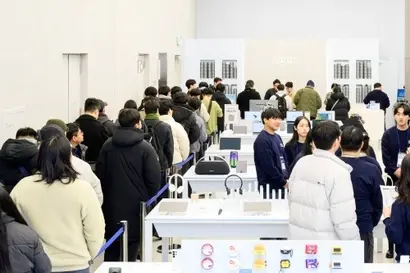
While 2024 performance was decent, it is a difficult situation to celebrate. Annual revenue reached 300.8709 trillion won, and operating profit hit 32.7260 trillion won, an increase of 16.2% and 398% year-on-year, respectively. This is the second time revenue has surpassed 300 trillion won since 2022. However, due to the downturn in the semiconductor market, fourth-quarter performance fell short of market expectations.
Samsung Electronics' business is broadly divided into semiconductors (DS Division) and electronic devices (DX Division). In its core semiconductor business, the legacy (general-purpose) memory market is sluggish and is under threat from low-cost Chinese products. While high-bandwidth memory (HBM), used in the AI industry, is attracting attention as a new growth engine for the semiconductor market, Samsung Electronics appears to be faltering due to quality controversies surrounding its HBM. Coupled with a decline in HBM memory sales, losses in the non-memory sector, and the off-season for semiconductors, the outlook for Q1 of this year is clouded. Securities firms predict that earnings will significantly miss market forecasts.
Cloudy Outlook Amid Semiconductor Downturn... Focus on New Galaxy Effect
As a result, a recovery in stock price is not expected in the short term. Song Myung-sup, a senior researcher at Hi Investment & Securities, noted, "The downward cycle of the semiconductor industry has just begun, and it will take time to confirm the recovery of Samsung Electronics' competitiveness," adding, "It will take more time for a full-scale stock price rally. Investors should take a patient approach and look for opportunities to buy at the bottom."
There are also positive factors. First, the legal risks surrounding Samsung Electronics Chairman Lee Jae-yong have been resolved. On February 3, Chairman Lee was acquitted in the second trial regarding the unfair merger and accounting fraud case involving the Samsung Group. Although the prosecution appealed, the impact on the stock price was minimal as he had already been acquitted twice before. The fact that the verdict is unlikely to be overturned in the third trial (the court of final appeal) is also positive for the stock price.
Samsung Electronics has announced plans to strengthen its technology and product competitiveness in the AI sector in 2025 and focus on meeting demand for high-value products. In the DX division, which includes the smartphone business, new product launches for the premium Galaxy S25 and Galaxy Z7 series are scheduled for this year, presenting the possibility of a stock price increase depending on sales performance.
Mindful of market concerns, the company has also shown a willingness to improve management. During the earnings call, CFO Park Soon-chul mentioned, "We are aware that the management situation is not easy, and we are doing our best to overcome it. We will recover based on our diverse business portfolio and the competitiveness of our key businesses. We will resolve this within a short period of time."
The shareholder return policy announced in lieu of a formal Value-Up disclosure is also a factor worth noting. In November last year, Samsung Electronics announced a plan to purchase a total of 10 trillion won in treasury shares over the next year. Of that, it plans to buy back 3 trillion won through open-market purchases and cancel all of them within three months, and it has currently completed approximately 90% of those purchases. The board of directors will discuss the use and timing of the remaining 7 trillion won.
In January, the company announced a plan to return 50% of the free cash flow generated over the three years through 2026 to shareholders and pay out 9.8 trillion won in annual dividends. It also decided to maintain a policy of calculating residual resources annually and considering additional returns beyond regular dividends if sufficient residual resources are available.
Park Yu-ak, an analyst at Kiwoom Securities, analyzed, "Samsung Electronics' stock price reflects significant market distrust and business uncertainty," adding, "I believe it will show signs of recovery as we pass the first half of the year."