

[비즈한국] Private equity firm (PEF) MBK Partners (MBK) acquired Homeplus in September 2015 for 7.2 trillion won. Since the acquisition by MBK, Homeplus has seen its performance head downhill. The company's scale has also shrunk compared to the past. Due to sluggish performance, MBK's efforts to sell Homeplus have not been smooth. It is reported that MBK is reviewing various options, including a split sale of the company. Amid this, voices of criticism from within Homeplus regarding MBK's "backroom" sales tactics are growing.
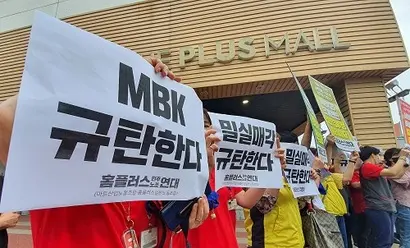
Internal opposition toward MBK has been strong since the very beginning of the acquisition. At the time, the Homeplus branch of the Mart Industry Labor Union (Homeplus Union) argued, "We are concerned that MBK has not expressed a clear position on the sustainable management of Homeplus and the job security of its workers," and added, "We urge and expect MBK to engage in dialogue with the union and state a responsible position regarding the issues raised by employees and public opinion." In response, Kim Kwang-il, Vice Chairman of MBK, stated at the time, "We respect the current employment conditions and collective bargaining agreements of Homeplus employees, and there will be no artificial workforce restructuring."
However, 10 years later, the workforce at Homeplus has significantly decreased. Jo Hye-jin, a lawyer for the Korean Confederation of Trade Unions (KCTU) Service Federation, pointed out at a debate held at the National Assembly on January 8, "When MBK acquired Homeplus, the number of directly hired employees was about 25,000, but it dropped to about 19,500 last year," adding, "Homeplus is suffering from a manpower shortage because it has frozen wages and failed to fill positions left by natural attrition."
In response, Homeplus countered, "The decrease in manpower at large supermarkets is a common situation across the industry," and "Due to excessive regulations on large supermarkets, sales have decreased, leading to lower labor demand, a trend seen in all three major supermarket chains."
Claims that workforce restructuring is being carried out coercively continue to surface from within Homeplus. The Homeplus Union stated on January 9, "The company is currently accepting voluntary retirement applications without a cap on the number of people in the Busan, Ulsan, and Gyeongnam regions. While the company claims these are voluntary, there is testimony from the field that this is happening in a coercive atmosphere," adding, "Contrary to the company's claim that it has not carried out artificial voluntary retirements, it is effectively reducing the workforce through coercion."
The number of stores has also decreased significantly. The number of Homeplus stores has dropped from 141 at the end of 2015 to 126 currently. This means 10.6% of its stores have disappeared over 10 years. As Homeplus argues, it is true that other supermarket chains have also seen a reduction in staff and store numbers. The number of E-mart139480 stores has decreased from 156 at the end of 2015 to 131 currently, and the number of Lotte Mart stores has decreased from 117 to 111 during the same period.
The problem is the performance. Since being acquired by MBK, Homeplus's performance has been on a downward trend. In the 2014 fiscal year (March 2014–February 2015), before the MBK acquisition, Homeplus recorded 8.5682 trillion won in sales. However, it has never exceeded 8 trillion won in sales since the acquisition. Most recently, in the 2023 fiscal year (March 2023–February 2024), it recorded 6.9315 trillion won in sales. Furthermore, it recorded losses for three consecutive years from the 2021 fiscal year (March 2021–February 2022) to the 2023 fiscal year.
The scale of Homeplus has also shrunk. Total equity plummeted 88.4% over nine years, from 2.2958 trillion won at the end of February 2015 to 265.3 billion won at the end of February 2024. The credit rating industry evaluates MBK as responsible for this decline in performance. Seo Min-ho, a senior researcher at Korea Ratings, analyzed, "After the change in major shareholder, (Homeplus) prioritized repaying acquisition financing through asset sales and significantly reduced facility investment, leading to a decrease in sales per store and weakening its own customer-drawing power," adding, "Although sales per store and customer-drawing power have recovered slightly through recent shifts toward food-focused store layouts, it still cannot cover the high burden of fixed costs."
In the case of E-mart, both its scale and performance have grown significantly compared to 2015. E-mart recorded 13.637 trillion won in sales in 2015, and its annual sales have exceeded 20 trillion won in recent years. Looking at its performance, it faltered with an operating loss of 46.9 billion won in 2023, but it is back on an upward trend with 124.2 billion won in operating profit for the first three quarters of 2024. Total equity increased from 7.2394 trillion won at the end of 2015 to 13.3689 trillion won at the end of September 2024.
Above all, E-mart is actively investing by leveraging its capital power. While reviews of E-mart's investments are not always positive, it has at least succeeded in expanding its scale. Lotte Shopping023530 also has the strong backing of the Lotte Group.

While not to the extent of E-mart, Homeplus is not abandoning investment. In recent years, Homeplus has converted some stores into "Mega Food Market," a food-specialized store format. The food sector is an area that is difficult for e-commerce to penetrate. In other words, it is a way to leverage the strengths of Homeplus as an offline retailer. However, this has not yet led to visible performance improvement.
Jang Mi-soo, a senior researcher at Korea Investors Service, assessed, "Homeplus continues to face a heavy financial burden due to low operating cash flow," and "It is expected to be difficult to turn an operating profit in the short term due to the high burden of fixed costs from offline store renewals and sales management expenses required to secure customers."
Given the circumstances, selling Homeplus is not easy. Rumors have been circulating in the investment banking (IB) industry that MBK has been pushing for a sale of Homeplus for several years. However, there are not many buyers for a company that has been recording losses for years. Since MBK invested 7.2 trillion won in the acquisition, it cannot sell it for less than that amount.
Consequently, MBK announced last year that it would pursue a split sale of the Homeplus Express division. Within the retail industry, there were talks that China’s Ali or Coupang were interested in Homeplus Express, but there has been no significant progress yet. Within Homeplus, rumors are also circulating that stores in the Busan, Ulsan, and Gyeongnam regions will be split off and sold separately.
A Homeplus official stated, "The split sale of the Busan, Ulsan, and Gyeongnam regions is groundless," and added, "I understand that the sale of Homeplus Express is underway, but regarding other M&As, it is not a situation where we can comment on what will happen."