

[비즈한국] Half of the universe is solitary, but the other half has a partner. Stars with companions are called binary stars. Binary star systems, where two stars form a couple, are very common in the universe. However, there is a place where these common binaries are rarely seen: around the supermassive black hole at the center of our galaxy.
For a long time, astronomers believed that the overwhelming gravity of a black hole would prevent new stars from forming in its vicinity. They assumed that any stars would have already been devoured as prey by the black hole, or that the environment was too extreme for gas clouds to stably clump together to form new stars in the first place.
However, after persistent observations, astronomers have recently confirmed, for the first time in history, the existence of a binary star system orbiting the Sagittarius A* black hole at the center of our galaxy. This discovery carries surprising implications that go beyond the romantic notion that even the harsh environment of a galactic center black hole cannot overcome the love of a stellar couple.
First, to understand how harsh the environment around Sagittarius A* at our galaxy's center is, we need to examine the world discovered there. At the center of our galaxy resides a massive black hole 4 million times more massive than the Sun. Astronomers long ago discovered that stars within a tiny space of only a few light-years from the galactic center were moving at excessively high speeds. The stars seemed to be held by something extremely massive. However, nothing bright was visible at the center of their orbits. It felt as if the stars were being held by nothing but empty black void. To have such massive weight concentrated in such a tiny space, there is only one possibility: a supermassive black hole. This realization led astronomers Andrea Ghez and Reinhard Genzel, along with physicist Roger Penrose—who mathematically defined black hole singularities—to win the Nobel Prize in Physics.
Since then, Sagittarius A* has become a popular target for astronomers, leading to extensive observations. Through this, a number of high-speed clusters, where stars orbit the black hole like a star cluster, began to be discovered one after another. These are called S-clusters. Among them are very unique celestial bodies known as G-objects. The first G-object was discovered in 2005. They are not star clusters, yet they act like a single, massive star.
However, they are too large to be simple stars. Furthermore, their size fluctuates significantly as they travel in elliptical orbits around Sagittarius A*. When they are far from the black hole, they shrink and become much denser. Conversely, when they approach the black hole, they swell up significantly, and their density decreases dramatically. For this reason, some astronomers speculate that these are not merely single massive stars, but rather loosely inflated gas clouds. They suggest that the gas clouds may expand as gravitational and tidal forces increase during their approach to the black hole.
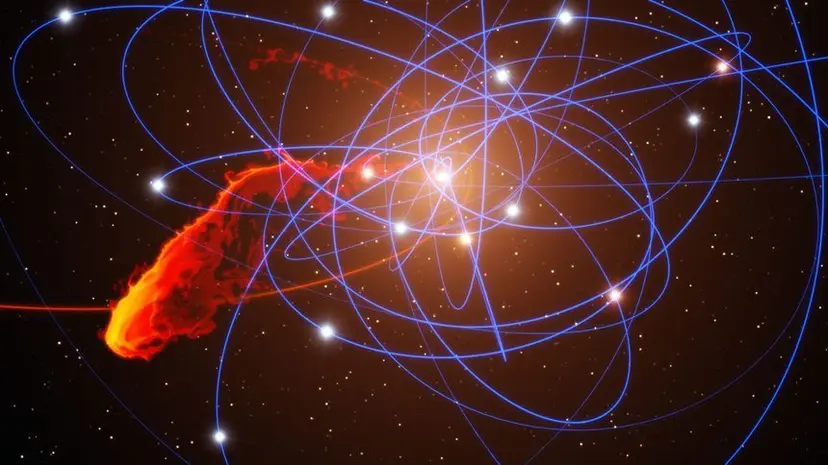
The unique characteristic of appearing like a star while being enveloped in a diffuse gas cloud makes their origin even more dramatically imagined. For example, it is possible that the original G-object was a binary star system. However, as it was continuously subjected to perturbations by the supermassive black hole right next to it, the binary's orbit might have been disrupted, causing the two stars to collide. The collision would have caused a massive gas cloud to spread out, which is what we observe today as a G-object.
So far, a total of six G-objects have been discovered. While it is an interesting hypothesis, not all astronomers have fully agreed with it. This is because they believed it was fundamentally impossible for a stable binary to form and orbit each other while living under the influence of an "overwhelming gravitational bully" like a black hole.
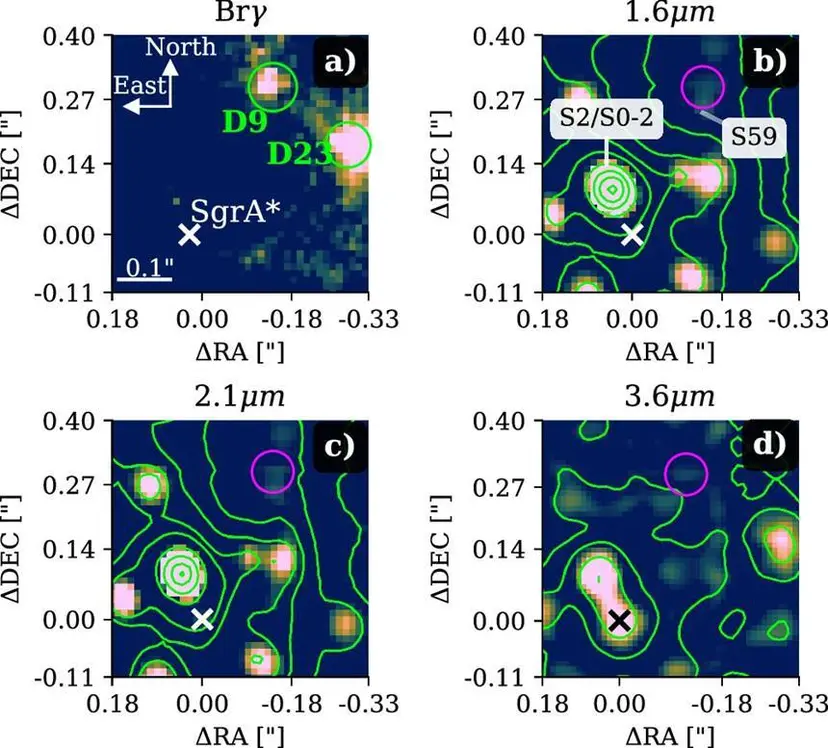
Yet, the existence of that binary star has finally been confirmed. This discovery was actually quite lucky. First of all, precisely observing stars drifting around the Sagittarius A* black hole is a very tricky challenge. Because the area is filled with stars and dust clouds of high density that block the view, it is difficult to see with simple visible light observations. Therefore, astronomers observed in infrared wavelengths, which can penetrate the dust clouds.
This analysis utilized archival data from the VLT in Chile observed between 2005 and 2019. Fifteen years is a very sufficient time for research, as the orbits of stars moving around a black hole are very small and fast, meaning their orbital periods are not very long. For more detailed analysis, data from the Keck Observatory in Hawaii since 2019 was also used, specifically sifting through long-accumulated archival data.
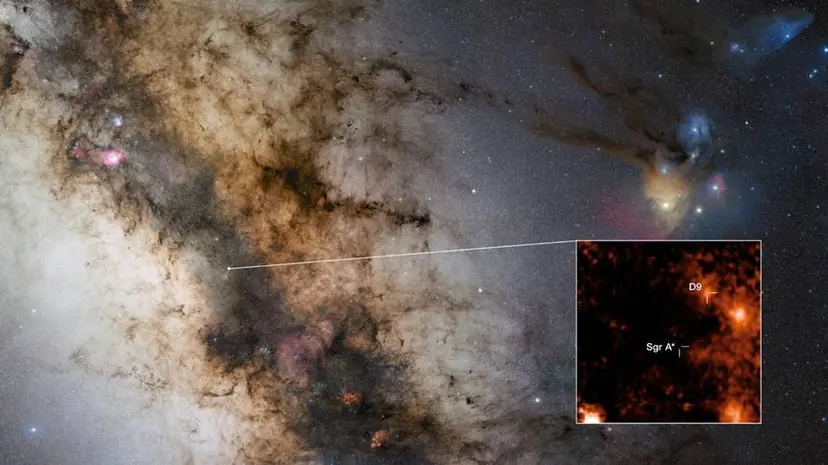
Astronomers identified clear signs of the Doppler effect in a small smudge called D9, which they had previously thought was just a diffuse gas cloud. The wavelength alternately repeated blueshifts (shortening) and redshifts (lengthening). This means the two stars are moving toward and away from the Earth in turns. There is not one star here; there are two. And those two stars are dancing a precarious waltz beside a black hole, locked by each other's gravity.
The mass of the two stars can be determined through their orbit. Astronomers estimate that the heavier star is 2.8 times the mass of the Sun, while the lighter one has about 73% of the Sun's mass. The two stars orbit each other and drift around the black hole with a period of about 372 days—a little over one Earth year.
This binary system can be seen as a site of an extreme version of the "three-body problem." Two stars with 2.8 and 0.75 solar masses, respectively, and a supermassive black hole with 4 million times the solar mass right next to them. These three celestial bodies interact gravitationally, complicating the evolution of their orbits. The mechanism by which the binary orbit is disrupted during the three-body interaction is called the Kozai mechanism, or the von Zeipel-Lidov-Kozai mechanism. Simulations indicate that the two stars will eventually succumb to the black hole's harassment and collide in about 1 million years.
More interestingly, the age of this binary is only 2.7 million years. This means the system was given only 3.7 million years of life from its formation until the eventual collision of the two stars. With 2.7 million years—three-quarters of that time—already passed, it revealed itself to us with only 1 million years remaining. Astronomically, this is capturing a mere blink of an eye. It is truly dramatic luck. If humanity had been born a little earlier to observe the universe, or if we had set up our telescopes a little more lazily, we might have missed this event entirely.
This discovery shows that star formation is possible even around a galactic center black hole. There even exist binary stars that can survive if they maintain a stable orbit. Of course, their orbits are disrupted in a much shorter time compared to other, more peaceful environments, but it proves that binaries can endure, at least for a while. This provides a crucial clue to the origin of the G-objects around Sagittarius A*, which had remained a mystery until recently. It lends weight to a hypothesis many astronomers were reluctant to believe: that they are the remaining clumps of gas and material left behind after a binary star collision.
The galactic center black hole is a mind-boggling site where many three-body and N-body problems occur simultaneously. The Kozai mechanism occurring in such environments provides an important clue to the question of how such a massive black hole, with millions of times the mass of the Sun, can form at the center of a galaxy.
Although not yet certain, the supermassive black hole at the galaxy's center must have had a period when it was relatively light. If a significant number of stars form around the black hole, those stars will eventually reach the end of their lives and leave behind small black holes. Some of these remaining small black holes can become new prey for the central black hole through complex dynamical processes like the Kozai mechanism. Through this, the central black hole gradually fattens up to reach its current size. With the confirmation that binary stars exist at the galactic center and that complex three-body mechanisms are in full swing, we can now draw a clearer picture of how the central black hole hunts its prey.
Meanwhile, stars dancing a precarious waltz beside a black hole also provide clues to the origin of "hypervelocity stars" (HVS), which wander through the Milky Way at excessively high speeds. If a binary's fate is determined not by the two stars colliding, but by one being devoured by the black hole while the other survives, the remaining star, suddenly losing its partner, is ejected at a very high speed. It is similar to holding a stone tied to a string and letting it go while spinning it. Some of these stars fly at incredible speeds reaching 6 million km/h.
Black holes, especially the supermassive ones living at the centers of galaxies, are very interesting experimental stages. Thanks to the extreme gravity they exert, they serve as stages where we can observe dynamical evolution processes—which show dramatic orbital changes—within a relatively short period. They are also excellent for testing Einstein’s general theory of relativity because they distort spacetime most extremely. In other peaceful parts of the universe, such effects are too minimal to notice, but around a black hole, it is clearly evident that the theory of relativity is at work. Moreover, a black hole is a stage where all mass is gathered in a very small region. Thus, as Stephen Hawking pondered, black holes are not only macroscopic but also microscopic. A black hole is a stage where Newton and Einstein's macroscopic physics and the quantum mechanics of the microscopic world reconcile.
Once again, the black hole has proven its worth as the final bastion and the front line of physics.
References
https://www.nature.com/articles/s41467-024-54748-3
Who is the author, Ji Woong-bae? He loves cats and the universe. After watching 'Galaxy Express 999' as a child, he dreamed of sharing the beauty of the universe. Currently, he researches evolution through galaxy interactions at the Center for Galaxy Evolution Research and the Near-Universe Cosmology Laboratory at Yonsei University. He engages in various science communication activities, including lectures and writing. He is the author of books such as 'The Thumb-Tapping Observatory,' 'Thinking About the Universe All Day,' and 'Stars, the Science of Light.'