

[비즈한국] With the start of a tariff war by the U.S. Trump administration, intense discussions are underway in political and labor circles regarding the "Semiconductor Special Act," a bill to support national high-tech industries such as domestic semiconductors and displays. The point of contention is the "exemption from the 52-hour workweek." The bill includes provisions that would make the 52-hour workweek principle an exception for research and development (R&D) tasks in high-tech industries. At the start of the new year, Acting President Choi Sang-mok repeatedly emphasized the need for a swift passage of the Semiconductor Special Act, and Lee Jae-myung, leader of the Democratic Party of Korea, recently revealed a more forward-looking stance. However, an agreement between the ruling and opposition parties remains uncertain. There is significant concern regarding the guarantee of labor flexibility through individual laws. Some argue that because the criteria for special treatment, the subjects involved, and health protection measures are all delegated to presidential decrees, the 52-hour workweek cap could effectively be neutralized.

U.S. and Japan provide exceptions for high-income researchers, but...
This bill, considered the biggest issue in the industry recently, has sparked a debate over exempting semiconductor industry workers from the 52-hour workweek. While both ruling and opposition parties emphasize national support for the semiconductor industry, the gap between them is wide. The ruling party views the work-hour extension as a "core provision," whereas the opposition party labels it a "toxic clause" and is rejecting it.
The Semiconductor Special Act, proposed by the People Power Party as a party platform late last year (led by Representative Lee Chul-gyu), contains clauses related to a "white-collar exemption." This system relaxes work-hour regulations for professionals or high-income R&D personnel, accommodating demands from Samsung Electronics005930, which claims that special extended work hours alone are insufficient to secure a competitive edge against global semiconductor firms. This system is currently implemented in countries like the U.S. and Japan.
In the U.S., high-income employees earning over $100,000 (140 million KRW) annually do not need to be paid overtime even if they exceed the 40-hour legal workweek. In Japan, for certain jobs, workers earning over 10.75 million yen (102 million KRW) per year are exempt from the 40-hour weekly standard and overtime pay regulations. Taiwan operates a work-hour system similar to ours, but a culture of intense 70-hour workweeks has taken root at TSMC. A semiconductor industry official said, "Due to the nature of the industry, workload fluctuates significantly depending on client schedules. Annual salary levels and the nature of the work are also different. The structure involves repeated periods of intensive work, so the current system (the 52-hour workweek) has its limits (in competing with them)," adding, "We expect that applying work-hour exceptions will help in securing global competitiveness."
Concerns over 'damaging' work-hour principles and inadequate standards
However, as this measure touches upon the principles of working hours, voices of opposition are also strong. Looking at the bill's detailed clauses, the scope of application for special provisions and the duty to protect workers are unclear. There is concern that since specific details are delegated to presidential decrees, it could be implemented without any "brakes." Article 34, Paragraph 1 states that as a "special case regarding working hours, etc.," separate standards for working hours, break times, holidays, and extended/night/holiday work can be applied through written agreement between the parties. However, Paragraph 2 stipulates that matters necessary for the application of labor standards and the protection of workers' health shall be determined by presidential decree.
While proponents of the introduction cite overseas cases as their main justification, critics point out that these competing nations have clear restrictions, such as consultations with unions and health protection measures. Democratic Party Representative Lee Yong-woo argued, "In Taiwan, there is no 'blanket exception for working hours' law for semiconductors or any other industry. Only measures like 4 hours of daily overtime or 54 hours of monthly overtime are possible with union consent," adding, "Samsung applied for special extended work hours for nearly 2,000 people last year, and the Ministry of Labor approved them all. They are essentially trying to make a 64-hour workweek into a special law." Taiwan does not have an exception system that removes work-hour caps for specific industries or high-income earners. In the case of Japan, they have various health protection clauses in place, such as guaranteeing at least 104 holidays per year for R&D job categories and prohibiting unfavorable treatment for workers who do not consent.
Son Woo-mok, Chairman of the National Samsung Electronics Union, explained, "Samsung Electronics is justifying overwork by citing the TSMC case, but it has already been fined 12 times in the past two years for violating overtime limits," adding, "In Taiwan, they hire more staff for 3-shift rotations; they don't wear out existing developers." Questions are also being raised about the approach that views flexible working hours as a solution to strengthen semiconductor industry competitiveness.
In the case of SK Hynix, which successfully developed HBM and is supplying it to NVIDIA, they have not implemented extended work hours. Jung Gwang-hyun, Vice Chairman of the SK Hynix Icheon Union, emphasized, "Under the selective working hour system, ideas and satisfaction have increased based on the autonomy and responsibility of the members. The result is HBM," adding, "The total working hours average about 43 hours per week. This is proof that R&D is possible under the current system."
Starting with tax and financial support
The Semiconductor Special Act includes provisions for national subsidies, power, water, and workforce training support to enhance the competitiveness of semiconductor companies. Although this is a matter upon which the ruling and opposition parties have agreed, the debate over the 52-hour provision has rendered the "speed war" meaningless.
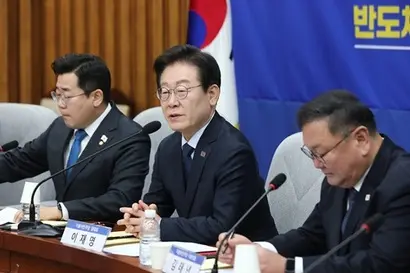
The government and the ruling party are promoting the Semiconductor Special Act daily. Their stance is that in a crisis where semiconductors, Korea's representative export industry, are hit by the direct fire of a global trade war, all available means must be used to secure industrial competitiveness. The Democratic Party, which had conflicting internal opinions, shifted its direction toward a "phased processing plan" to process support measures first and discuss the 52-hour exception later. When leader Lee Jae-myung stated at a party policy debate on the 3rd, "In my personal opinion, (if this law is introduced) it should be temporary and extended if necessary," political circles speculated that the Democratic Party might turn toward deregulation and pass the bill. However, on the 6th, the Democratic Party effectively confirmed a plan to first pass tax and financial support, on which both parties have reached an agreement.
The four-way ruling-opposition-government policy council meeting, originally scheduled for the 10th-11th, is expected to be postponed following the ruling party's decision. Jin Sung-joon, Policy Committee Chair of the Democratic Party, said in a press conference on the 6th, "Let's first handle the national support parts where there is no disagreement between ruling and opposition, and continue to discuss the labor hour exemption issue, where there are disagreements between ruling-opposition and labor-management, and process it as soon as an agreement is reached." Kim Sang-hoon, Policy Committee Chair of the People Power Party, stated after a party meeting on the 7th, "We judged it would be better to clear the path in working-level consultations and reach a level where we can agree before holding the policy council meeting, so we will set the schedule based on the results of the working-level consultations next week."