

[비즈한국] The Trump administration of the United States has imposed sanctions on defense exports to Colombia. Colombia, which has heavily relied on American weaponry, is now facing an immediate emergency. Due to these sanctions, a weakening of its military power is expected, placing the country at risk of losing the upper hand in its ongoing war against drug cartels. Experts suggest that with Colombia currently discussing defense cooperation with South Korea, now is an opportune time to expand South Korean defense exports as the U.S. imposes these sanctions.
According to the Spanish defense media outlet ‘infodefensa,’ the U.S. government officially began imposing sanctions on the 26th of last month, announcing that all arms supplies, sales, and defense system management for Colombia would be subject to ITAR (International Traffic in Arms Regulations).
As a result of this measure, the U.S. is expected to cease providing satellite imagery to the Colombian Air Force. The maintenance of security boats previously provided to the Colombian Coast Guard will also be halted. It is also reported that the U.S. is reviewing guidelines to not only suspend operational support for Lockheed Martin’s UH-60A/L Black Hawk helicopters used by the Colombian police and army but also to prohibit their operation entirely.
Until just before the current administration, Colombia had maintained a very close relationship with the U.S., with a high level of defense dependency. However, relations began to sour after Trump returned to power. During his first term, Trump demanded that Colombia take action against illegal drug production, and he continues to call for strong countermeasures even after his return. Issues surrounding the repatriation of illegal immigrants are also fueling tensions between the two nations.
The U.S. defense sanctions are expected to have a negative impact on Colombia's defense sector as a whole. Most major defense projects, including the upcoming fighter jet procurement program for the Colombian Air Force, involve the U.S.; these sanctions are expected to delay these projects indefinitely. Colombia is facing an immediate crisis. With American military aid vanishing, it is predicted that Colombian military strength will significantly weaken, likely placing the country at a disadvantage in its ongoing war against drug cartels.
Experts emphasize that the current timing of U.S. sanctions represents a great opportunity for the South Korean defense industry to expand into the Colombian market. In fact, South Korea and Colombia have been continuously discussing defense cooperation. At the ‘4th High-Level Policy Consultation’ between South Korea and Colombia last year, Colombian Vice Minister of Foreign Affairs Jorge Rojas Rodríguez and South Korean First Vice Minister of Foreign Affairs Kim Hong-kyun held discussions regarding defense. Vice Minister Kim stated, "We hope that South Korean defense companies, which possess excellent technological prowess and abundant experience, can contribute to enhancing Colombia's security."
Among domestic firms, LIG Nex1079550 was the first to establish a foothold in the Colombian market. In 2011, LIG Nex1 became the only South Korean defense contractor to open a local office in Colombia to strive for the expansion of defense exports to Latin America. The Colombian Air Force, in particular, has shown significant interest in the ‘KGGB,’ a GPS-guided bomb that can be integrated into existing fighter aircraft without requiring modifications to the avionics.
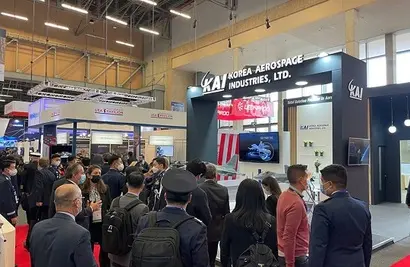
Colombia is a potential export destination for the FA-50 light attack aircraft from Korea Aerospace Industries (KAI). Although a contract has not yet been signed, expectations for the introduction of the FA-50 have risen since the South Korean Defense Acquisition Program Administration (DAPA) and the Colombian military airworthiness authority signed a mutual recognition agreement for military aircraft airworthiness in February of last year.
Kim Min-seok, a member of the Korea Defense and Security Forum, explained, "Among the major programs in Colombia's defense business where dependency on the U.S. is severe are wheeled armored vehicles, helicopters, light attack aircraft, and unmanned aerial vehicles (UAVs)—all of which are products where South Korea has export competitiveness." He added, "In the past, when faced with such pressure from the U.S., the Colombian government would respond by introducing Russian-made weapons, but it is not easy to acquire Russian weapons after the war in Ukraine. As long as no diplomatic issues arise with the U.S., now is a prime opportunity for us to expand defense exports to Colombia."