

[비즈한국] As the domestic robot vacuum market continues to grow to the 400 billion won level, the offensive from Chinese brands is heating up. Since the beginning of the year, two of the "High-End Robot Vacuum Big 3," Dreame and Ecovacs, have released new products, and Roborock, the number one brand in domestic market share, is set to unveil its latest model on the 21st. Conversely, domestic companies, which hold a combined market share of around 30%, are struggling to find a turning point. Although Samsung Electronics005930 and LG Electronics066570 introduced vacuum and mop all-in-one robot vacuums last year, the barrier set by Chinese manufacturers who preempted the market remains high. It is evaluated that know-how and technical skills built over several generations ahead, along with user-friendly designs, have widened the gap.
Roborock, Ecovacs, and Dreame Target Korea with Consecutive New Releases
Robot mops have a short history, but their pace of development is rapid. In Asia, where mopping floors and wooden flooring is common, market potential is particularly high. Chinese companies, having captured domestic demand early on, are actively targeting overseas markets such as South Korea and Japan. With Chinese firms unveiling new products in succession at the start of the year, Korea is expected to become the center of robot vacuum competition this year.
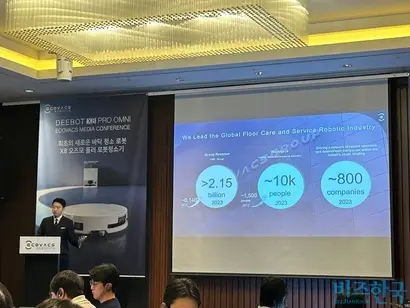
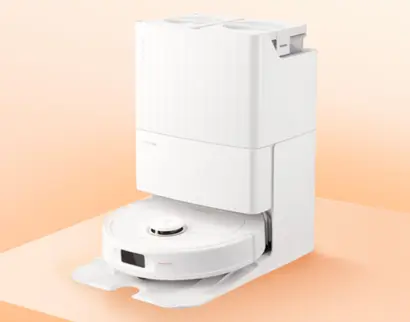
On the 5th, the Chinese robot appliance company Ecovacs unveiled its roller-type robot vacuum, the "Deebot X8 Pro Omni." Korea is the first country outside of China where Ecovacs has launched this product. Ecovacs CEO David Qian, visiting Korea for the first time in two years, personally introduced the company's innovative technology and new products at a media conference held at the Conrad Seoul Hotel in Yeouido, Yeongdeungpo-gu, Seoul. CEO Qian expressed confidence, stating, "Solving consumers' pain points is the ultimate innovation. While several companies like Samsung and LG have entered the market, Ecovacs can differentiate itself through long-standing know-how, a diverse product lineup, massive investment in R&D and supply chains, and core technologies."
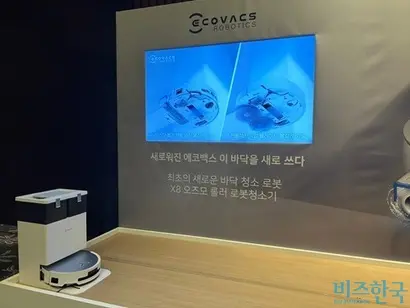
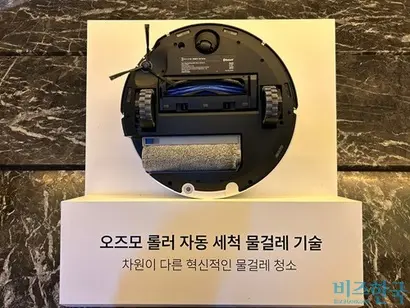
The Deebot X8 Pro Omni features improved specifications over previous versions and applies a new automatic washing roller mop technology. The key is to continuously supply clean water to the rollers and automatically clean the mop in real-time. Kim So-won, marketing manager at Ecovacs Korea, explained, "Although products with similar appearances and functions are being released, the difference in user experience felt by customers is not significant. Most companies already achieve a very high level of dust removal. Our new product focuses on the problem where cleaning effectiveness is halved as the mop gets dirty after a certain amount of cleaning time."
The three Chinese robot vacuum companies are focusing on making devices slimmer for cleaning under beds and sofas and improving obstacle avoidance capabilities. They are all engaged in a fierce competition for the "world's first" title, highlighting newly introduced detailed technologies. Earlier last month, the Chinese home appliance firm Dreame officially launched the "X50 Ultra" in Korea through department stores and online sales channels. It is equipped with robot legs that can climb thresholds up to 6cm and an LDS sensor that automatically adjusts height in spaces as low as 89mm. Roborock is also scheduled to launch its new flagship model, the "S9 MaxV Ultra," on the 21st.
Samsung and LG Regroup, but China Dominates Globally Through Aggressive Investment
Samsung Electronics and LG Electronics, lagging behind the Chinese firms, are preparing a counterattack. New product launches are planned for the first half of this year. Both companies reorganized by releasing all-in-one lineups in April and August of last year, respectively. Samsung launched the "Bespoke AI Steam," which enhances hygiene management with a high-temperature steam sterilization function for the mop, while LG released the "Roboking AI All-in-One," which applies a self-management agent to suppress odors in the wastewater tank. Domestic companies had previously manufactured products with separated functions rather than all-in-one models combining dust suction and mopping, judging that performance might drop or odors could occur. However, the situation changed as the robot vacuum market became a promising sector expected to grow by an average of 18% annually globally, and 40% annually in the Asia-Pacific region. According to the industry, the domestic robot vacuum market, which was worth 210 billion won in 2021, grew rapidly to 290 billion won in 2022 and exceeded 400 billion won in 2023.
However, evaluations suggest that the two domestic firms have not significantly narrowed the technology gap. Most Chinese brands have incorporated features like mop washing and drying, as well as direct water supply and drainage systems that connect to plumbing to automatically fill and empty water. Unlike other Chinese products targeting "cost-effectiveness," these companies are strong in the premium market thanks to their high-performance technology. Compared to this, domestic products lag in terms of automation that reduces consumer inconvenience.
It is no exaggeration to say that China holds the reins of the global robot vacuum market. The combined global market share of Chinese companies reaches 95%. The leader, Roborock, recorded a market share in the high 40% range in Korea last year. Ecovacs, which has secured about 40% of its home market, is putting all its efforts into increasing its relatively stagnant market share in Korea.
The reasons for the domestic companies' lag are complex. Shim Woo-joong, a senior researcher at the Korea Institute for Industrial Economics & Trade, said, "Samsung and LG have been releasing robot vacuums for a long time, but they were slow to launch new products because they judged the market size to be limited and difficult to secure significant revenue relative to the company's size. In the area of product innovation, Chinese companies are highly competitive and respond much more agilely. China also has favorable conditions for reducing production costs."
Some analyze that the dominance of Chinese companies comes from massive R&D investment. Roborock spends over 7% of its revenue on R&D every year. More than half of its 1,500 total employees are engineers. From 2019 to 2023, it invested 1.9 billion yuan (approximately 377.4 billion won) in R&D alone. It is estimated that annual investment has increased further, as it invested about 410 million yuan (approximately 81.4 billion won) in the first half of last year, a nearly 43% increase from the previous year. Ecovacs also invested 446 million yuan (approximately 88.6 billion won) in R&D in the first half of last year.
However, Chinese products are often cited for weaknesses in security and accessibility to after-sales service. Last year, security vulnerabilities were raised in the U.S. after cases where some Ecovacs products were hacked to shout profanities or follow pets. When asked about this, CEO Qian emphasized, "Due to the nature of the product moving around the house, we prioritize security above all else. However, the U.S. case was a localized incident rather than a cloud-level breach. We are complying with each country's security standards."
An industry insider remarked, "There is an aspect where domestic companies viewed robot vacuums as auxiliary appliances compared to their existing core sectors. Since they do not lag in source technology, there is a possibility that their influence will grow in the future." Senior researcher Shim predicted, "With the economic downturn in China and sluggish domestic demand, the global expansion of Chinese companies is expected to accelerate. For high-priced premium product lines, they will likely take even more aggressive steps in the Korean market."