

[비즈한국] The Defense Acquisition Program Administration (DAPA) has disclosed for the first time that the United Arab Emirates (UAE) has expressed interest in the CIWS-II system currently being developed by the South Korean military. It is highly unusual for a foreign nation to show interest in a weapon system that is still in the development phase. Should an export agreement be reached upon the project's completion, it is expected to draw significant attention from other Middle Eastern countries that are in urgent need of drone and missile interception capabilities.
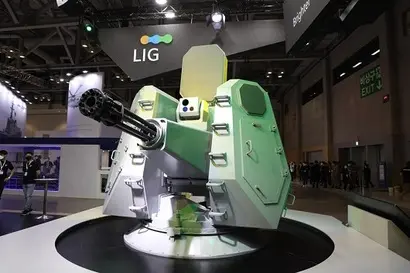
At a discussion held on the 4th to explore the development direction of domestic and international naval projects, DAPA drew attention by revealing that the UAE has expressed interest in the CIWS-II currently under development, with discussions taking place on several occasions. The Close-in Weapon System (CIWS-II) is a powerful defense system capable of intercepting enemy super-large multiple rocket launchers, suicide drones, cruise missiles, and supersonic anti-ship missiles. It is also planned to be adapted and applied as a ground-based air defense system.
According to DAPA, the development of CIWS-II is a large-scale project with a budget of approximately 350 billion won, aiming for completion by 2027 and deployment by 2030. The existing naval CIWS consisted of the RAM and Phalanx systems from the U.S. company Raytheon, and the Goalkeeper system from the Dutch company Thales. However, the need for performance improvement and localization emerged to counter the threat of North Korea's supersonic cruise missiles traveling at speeds of Mach 2 or higher.
For the development of CIWS-II, LIG Nex1 plans to apply the Active Electronically Scanned Array (AESA) radar technology secured through the KF-21 project and leverage domestic and international technological cooperation to neutralize targets including supersonic and sea-skimming missiles. When installed on the ground, it is also expected to be used for point defense, such as for air force runways and military command facilities.
The South Korean military is also pushing for the evolutionary development of CIWS-II. The goal is to develop it to counter threats like swarm drones, which are considered potential "game changers" and key security threats. The CIWS currently in operation uses only armor-piercing ammunition, making it difficult to respond to swarm drones.
CIWS-II is scheduled to be equipped with forward-fragmentation ammunition through future performance upgrades. Forward-fragmentation ammunition is designed to release submunitions in front of a target, which then spread out due to centrifugal force to neutralize aerial threats. The forward-fragmentation ammunition of the CIWS-II is expected to form a barrage of fire to suppress incoming swarms of drones.
Experts analyze that the UAE has taken notice and shown interest due to the superior capabilities of the CIWS-II in defending against missiles and drones associated with the Iranian Navy. Kim Min-seok, a senior researcher at the Korea Defense and Security Forum (KODEF), stated, "Current CIWS systems from the U.S. and Europe are aging and are not suitable for defending against the Iranian Navy's new anti-ship missiles," adding, "Turkey's CIWS, a rival to our CIWS-II, would likely fail to properly defend UAE ships from Iranian Navy missiles due to its slower cannon fire rate."