

[비즈한국] Sejong City and the Hunminjeongeum Commemorative Project Association are reviewing plans to build a large-scale memorial tower to mark the creation of the Hunminjeongeum. According to the city, the monument, slated for a cultural park site near the National Museum Complex along the Geum River, is likely to take the form of a 28-story, 108-meter-tall traditional Korean wooden pagoda. The 28 stories represent the 28 consonants and vowels of the Hunminjeongeum, while the 108 meters signify the 108 characters of the original royal preface, which begins with the phrase, "Because the speech of our nation is different from that of China..." The octagonal floor plan is said to symbolize the eight scholars who authored the Hunminjeongeum Haerye. The city plans to develop the surrounding site into a landmark representing a "Hangeul Cultural City." Once completed in 2028 (projected), it will be the tallest wooden structure in the world.
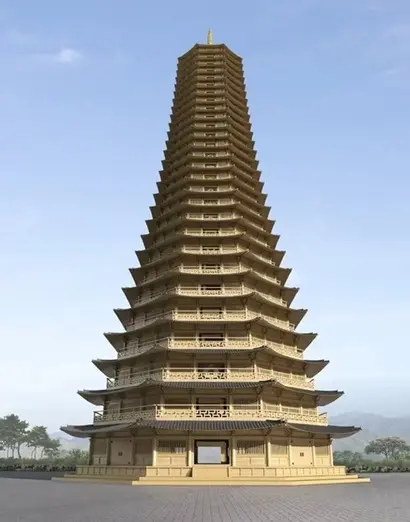
Reactions from various sectors regarding its construction are mixed, with strong negative opinions prevailing. Beyond criticisms of "show administration" and concerns over the budget of approximately 80 billion won, the design itself is problematic. Looking at the released conceptual images, the appearance of a roof stacked 28 stories high on a limited height feels bizarre. It even brings to mind an arthropod like a centipede. If the symbolism cannot be abandoned, could the number 28 not be utilized elsewhere? For some reason, it brings to mind the many neglected places across the country that fall into slum-like conditions and end up in haunted house tour content.
The reason for building it as a wooden pagoda is also unclear. It seems that Sejong City intends to erect a traditional wooden Hanok—the dominant style of the Joseon Dynasty—simply because the Hunminjeongeum was created during that era. However, Hangeul possesses a modernity that ranks among the world’s most advanced writing systems. A wooden memorial tower that does not resonate with the contemporary era is ill-suited to commemorate it. If they wish to promote the creation of the Hunminjeongeum, they should apply a style considered the most advanced in the present day. Of course, that style must possess lasting vitality rather than being a fleeting trend.
If the plan itself is not withdrawn, perhaps a progressive improvement could be an alternative. What kind of form would be suitable for a Hunminjeongeum memorial? For the Hunminjeongeum, which is composed of vertical, horizontal, diagonal, and circular lines, architecture with clear, defined massing—rather than the amorphous, hard-to-parse architecture like the DDP (Dongdaemun Design Plaza)—would be more appropriate. While utilizing the character components (jaso) is a good idea, a one-dimensional interpretation that simply scales them up is not sufficient. A process of deconstruction and recombination is necessary. I am reminded of the Maehyangri Peace Memorial, which represents the letter 'M'—symbolizing Maehyangri, Museum, and Memorial—in the shape of sound waves. I also wonder about a design motif based on the pages of the Hunminjeongeum Haerye, where the elegant curves of Hanja and the modernity of Hangeul harmonize.
Actively revealing the material properties on the exterior would also be effective. For a script to be widely used, the script itself is important, but the role of infrastructure capable of large-scale implementation, such as movable type and printing facilities, is significant. Historically, King Taejong of Joseon cast the Gye-mi metal type, and around the time of the creation of the Hunminjeongeum under King Sejong, Hangeul metal types were cast along with the Gyeongja and Gabin types, used for works such as 'Donggukjeongun' (1448). During this period, type was primarily made of copper, and woodblocks and clay were used in the casting process. These are all elements that could be reinterpreted and applied.
The directions suggested here seem far removed from the plans of Sejong City and the Hunminjeongeum Commemorative Project Association. While I do not claim these examples are the absolute best, my hope is that instead of a meaningless design, a distinct structure that leaves a mark on modern architecture will be built. Furthermore, I hope its purpose will be utilized as a practical space that collects and exhibits digital Hangeul design materials and supports related work, rather than just focusing on the Hunminjeongeum itself. Building a memorial out of sync with the times would merely add another entry to the list of wasteful budget expenditures.
Who is the author, Han Dong-hoon?
A font designer. Interested in all fields related to letters, including writing, calligraphy, designing typefaces, and teaching. Currently designs various corporate and retail fonts at the font studio AlignType. Has contributed to 'Monthly Design', the quarterly 'Design Review', and conducts font design lectures on various online and offline platforms. Published the essay collection 'The Universe within Letters' in 2021.