

[비즈한국] What mission will NASA undertake next? There is a place where we can foresee the future of space exploration and the missions that will unfold in the coming years. Every year, the U.S. National Academies of Sciences (NAS) gathers astronomers to outline a long-term plan for the next decade of exploration. These plans are not just for the immediate future, but for ten or even several decades ahead. Therefore, by looking at their Decadal Survey, which is released periodically, we can observe the future direction of the current astronomical community.
In 1972, astronomers conceived a large space telescope capable of observing the universe across various wavelengths—ultraviolet, visible, and infrared—directly from space. This proposal eventually led to the Hubble Space Telescope. In 2001, they declared a new super-large space telescope aimed at intensively observing the early universe just after the Big Bang as a priority, directing funding toward the Next Generation Space Telescope (NGST). Twenty years after that historic declaration, this telescope took to the skies under the name James Webb.
So, where will the space exploration of the next 10 or 20 years, dreamed up by astronomers today, be headed? The new interest of astronomers is turning toward extraterrestrial life and finding planets where such life might dwell. They are conceiving new telescopes dedicated solely to the search for life.
The ambition announced in 2023 is grand: to find as many planets as possible around the hundreds of millions of stars wandering in our galaxy. The most active hunter for exoplanets to date has undoubtedly been the Kepler Space Telescope. Kepler retired after discovering over 5,000 exoplanets. It was followed by TESS, and when combined with candidate planets, the number of exoplanets discovered so far exceeds 10,000.
However, we cannot be satisfied with this. We have yet to definitively discover an exoplanet harboring life. Astronomers are now designing a new space telescope focused exclusively on exoplanets and "biosignatures," the signs of life. According to the plan, the telescope will have a diameter of about 6m, similar to James Webb. An important difference, however, is that unlike James Webb, which only observes infrared, this new telescope will be able to observe light across various wavelengths, including infrared, visible, and ultraviolet. This plan combines what were originally two separate projects.
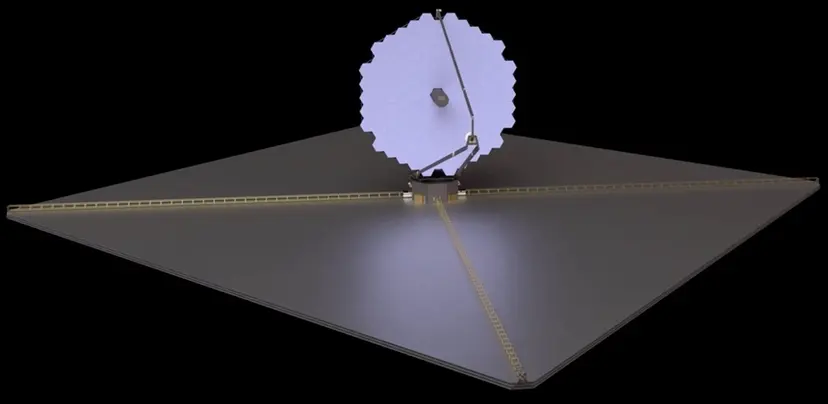
There is a project with a very straightforward name: LUVOIR (Large Ultraviolet Optical Infrared Surveyor). The proposal suggests launching a massive space telescope with a size of 10 to 15m to observe light across a wide range of wavelengths—from infrared to visible and ultraviolet—with high resolution. While there is a suggestion to launch it in 2034 to commemorate the 100th anniversary of Carl Sagan's birth, it is such a massive undertaking that its realization remains uncertain.
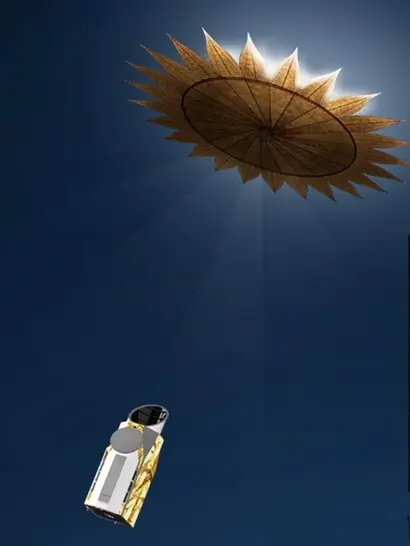
Another project is HabEx (Habitable Exoplanet Observatory). It is also a new space telescope specializing in the search for exoplanets. Many existing observations, including those from the Kepler Space Telescope, primarily utilized the "transit" method, where the light of a star dims slightly as an exoplanet passes in front of it. However, HabEx envisions a more proactive approach: floating a massive artificial sunshade in front of the star targeted by the telescope to minimize the interference of starlight from the beginning. If successful, the exoplanets hidden in the glare of the bright star could be captured in clear, actual images.
The newly announced plan is a harmonious merger of the two projects, LUVOIR and HabEx. It is called the "Habitable Worlds Observatory," or HWO for short. The goal of the HWO is not merely to find whether a planet exists next to another star, but to precisely identify signs of life.
With James Webb already up and active, is there a need to launch HWO as well? While James Webb is excellent, it has realistic and significant limitations. James Webb is not a telescope dedicated solely to exoplanets. It is a multipurpose telescope performing various astronomical tasks, such as observing the early universe after the Big Bang, solar system planets, and the birthplaces of stars and galaxies. Exoplanets are just one part of James Webb's total mission. Therefore, it is difficult to secure sufficient time to search for exoplanets and signs of life.
There is also a scientific issue. To identify signs of life, we must determine the atmospheric composition of the exoplanet. Like other existing observations, James Webb identifies atmospheric components during the transit moment when an exoplanet passes in front of its star. It estimates the composition through chemical traces left in the spectrum as some of the starlight passes through the exoplanet's atmosphere.
However, this method requires a long wait. It is difficult to obtain sufficiently good data from just a single observation. We must wait for another cycle until the exoplanet passes in front of the star again. Only by witnessing multiple transits can we collect statistically significant data.
The transit method itself has inherent problems. As just explained, to collect sufficient data, one must witness multiple transits. Therefore, it is easier to observe exoplanets with short orbital periods, meaning they orbit their stars quickly. One only needs to wait a few days or weeks to see the next transit. But this leads to another problem: a short orbital period means the exoplanet is very close to its central star. In other words, its orbital radius is too small. Because it is so close to the star, the exoplanet is easily exposed to flares exploding from the star's surface. Even if the temperature is moderate because the star itself is dim, a single flare could quickly eliminate any life. Ultimately, relying solely on the transit method can create a bias toward observing only those exoplanets where signs of life are unlikely to be found in the first place.
To overcome this limitation, HWO plans to adopt two main methods. The first is a coronagraph, utilizing the principle of the starshade envisioned by HabEx. A small, circular mask is inserted into the telescope's light path. This masks the star's light, allowing the hidden, dark exoplanet nearby to emerge. In fact, this method was attempted by James Webb, and the Nancy Grace Roman Space Telescope, another next-generation telescope soon to be launched, will also utilize it.
The biggest advantage of this method is that it does not have to rely on transits. In fact, transits have another fatal problem: they can only be used if the orbit of the exoplanet is tilted at just the right angle to pass in front of the star. If the orbital inclination is off even slightly, the exoplanet will never pass in front of the star no matter how many times it orbits, and we will not be able to see a meaningful decrease in starlight.
However, a coronagraph is a method of directly photographing an exoplanet hidden nearby by simply blocking the star. Therefore, it can be used regardless of whether a transit is possible. This will allow us to discover more exoplanets that were previously missed because their orbits were too tilted to confirm their existence via transit.
However, there are still technical challenges to solve. Ultimately, we are not looking for gas giants like Jupiter, but rocky planets as small as Earth. If an exoplanet is small, the starlight reflected from its surface is naturally dim. Detecting an exoplanet hidden within the glare of a bright star requires extreme sensitivity to distinguish between very bright and dark light. We must be able to detect a small speck as much as 10 billion times darker than the bright starlight in the same frame. Current technology can barely detect objects 100 million times dimmer than the brightest light, so there is still a long way to go. This is one of the important challenges to be solved by mobilizing all available optical technology.
Another special technology to be included in HWO is the IFU (Integral Field Unit). Existing observations analyze the light of an exoplanet as a whole spectrum. However, an IFU allows for observations as if splitting the image and spectrum of an exoplanet into multiple smaller pixels. Instead of looking at the light of an exoplanet as a single lump, we can scrutinize exactly where on the exoplanet's surface signs of life are more clearly observed.
NASA has already allocated a budget for HWO and is discussing its launch schedule. The plan is to launch it into space in the 2040s. It may feel like a plan for the distant future, but considering the current situation where the launch of James Webb—which many thought would never happen—was ultimately realized and its results are pouring in daily, I believe the day HWO becomes reality will come soon.
Meanwhile, the ESA (European Space Agency) is also conceiving a new space telescope specialized in searching for exoplanets and signs of life. Although smaller than NASA's HWO, it has undergone much more discussion and is planned to be launched much earlier, around 2029. The name of the exoplanet exploration telescope prepared by the ESA is the Atmospheric Remote-sensing Infrared Exoplanet Large-survey, or ARIEL for short. It is the same as the name of the character from the animation 'The Little Mermaid.' It seems like a well-chosen name, given the goal of finding exoplanets that are highly likely to possess liquid oceans like Earth.
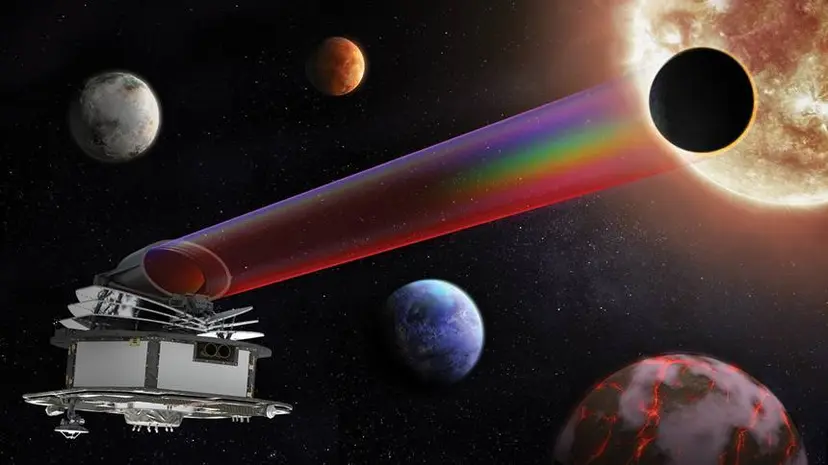
ARIEL is scheduled to be sent to the L2 point beyond the moon's orbit, just like the current James Webb. ARIEL is not very large. Uniquely, it contains an elliptical, off-center mirror; the mirror's long diameter is about 1m, and the short diameter is about 70cm. ARIEL will investigate the atmospheric composition of over 1,000 diverse exoplanets in more detail across visible and infrared regions. Similar to the U.S. National Academies' Decadal Survey, the ESA announces its "Cosmic Vision," which provides a big picture of its future space exploration plans every year, and ARIEL is a newly confirmed plan.
Both HWO and ARIEL have important differences from other existing ground-based and space telescopes. Their primary goal is entirely to understand exoplanets, especially their atmospheric composition. For example, while James Webb does observe infrared, it was designed to also observe other astronomical objects such as galaxies and stars, meaning it cannot look at all the various infrared wavelengths that would be helpful for understanding the more diverse atmospheric components of exoplanets. It made certain compromises to capture all its diverse objectives. However, because HWO and ARIEL are primarily focused on the atmospheres of exoplanets from the start, they can achieve designs specialized for that purpose.
It is very interesting that most of the astronomical community has set the search for exoplanets and extraterrestrial life as a goal that humanity must pay the most attention to and strive for over the next 10 or 20 years. This shows just how much the status of the field concerning exoplanets and extraterrestrial life—which were treated like science fiction until just a short while ago—has risen.
Looking back, while many exoplanets have been discovered and the number of astronomers seriously contemplating the possibility of extraterrestrial life has steadily increased, professional space telescopes dedicated solely to exoplanets and the signs of life have almost never been built. (There was the Kepler Space Telescope, but Kepler did not look closely at the atmospheres of exoplanets.) In a sense, we may never have properly peered into the signs of extraterrestrial life until now. We must consider this as having prepared our hearts and minds to finally dream of a full-scale first exploration.
References
https://science.nasa.gov/about-us/science-strategy/decadal-surveys/
https://www.esa.int/Science_Exploration/Space_Science/Ariel_moves_from_blueprint_to_reality
https://arielmission.space/index.php/press-releases/
https://nap.nationalacademies.org/catalog/26141/pathways-to-discovery-in-astronomy-and-astrophysics-for-the-2020s
Who is author Ung-bae Ji? He loves cats and the universe. After watching 'Galaxy Express 999' as a child, he dreamed of sharing the beauty of the universe. Currently, he researches galaxy evolution through galactic interactions at the Center for Galaxy Evolution Research and the Near-Universe Cosmology Laboratory at Yonsei University. He is also engaged in various science communication activities, including lectures and writing. He has written books such as 'The Flirting Observatory', 'Thinking About the Universe All Day', and 'Stars, the Science of Light'.