

[비즈한국] DeepSeek, DeepSeek, DeepSeek. Over the past week, the word "DeepSeek," which has flooded global media, has brought about such immense repercussions that it has literally caused a "deep sick" headache. In the politically unstable climate of Europe, the moves of the U.S. and China following Trump’s return to power are of critical concern, and DeepSeek has been like pouring oil on the fire.
As the Chinese AI startup DeepSeek launches a low-cost, high-performance AI model, the European tech ecosystem is offering various perspectives on the development. In particular, people have been busy debating whether this situation will serve as an opportunity for Europe or a looming, irreversible crisis.
With the repeal of U.S. AI executive orders, the implementation of the European AI Act, and the success of DeepSeek all coinciding, the European AI market is seeing both opportunities and threats highlighted simultaneously. In this article, I will introduce three perspectives from European AI firms, startups, and venture capital (VC) investors on DeepSeek, and analyze the impact it will have on the European AI ecosystem moving forward.
A New Opportunity for European AI Firms
Upon taking office, Trump chose a radical path by repealing the "AI executive order" that had been implemented by the Biden administration. Even before DeepSeek became a hot topic, the prevailing view was that this move by Trump would be an opportunity for European AI companies.
The assumption is that U.S. AI suppliers will not comply with the security standards required by the European AI Act, which will inevitably increase the concerns of corporate clients in highly regulated industries—such as healthcare, finance, and energy—regarding AI adoption. Those who view this as an opportunity argue that European companies, which are ahead in security and regulation, can secure a competitive advantage by developing AI solutions that prioritize trust. It is also a fact that there is significant anxiety regarding the security and data privacy of the Chinese firm DeepSeek.
Amidst this public sentiment, European AI firms now have the potential to take a leading position in the AI sector by building reliable AI infrastructure and specialized systems in the healthcare, finance, and energy fields.
Some also believe that European AI startups will accelerate their businesses by leveraging DeepSeek's development. The idea is that DeepSeek could be a great opportunity for European startups that have not yet built services based on models like ChatGPT, Perplexity, or Claude. Since it is cheaper, more sustainable due to lower hardware and computing power requirements, and is a game-changing open-source solution, there are many voices welcoming it. The fact that DeepSeek's R1 model is priced at less than one-tenth of comparable OpenAI models, creating an environment where developers can build AI applications more affordably, also acts as a favorable factor.
A Negative Factor for Emerging LLM Startups
The launch of DeepSeek's low-cost AI model was disheartening news for existing LLM (Large Language Model) startups in Europe. European AI startups that were emerging as rivals to OpenAI, such as France's Mistral AI and Germany's Aleph Alpha, are now in a position where they must re-examine their differentiation strategies.
Mistral AI is a startup founded in Paris, France, in May 2023 by AI researchers from Meta and Google. Within 10 months of its founding, it developed its own LLM and chatbot, gaining attention as the "European ChatGPT." Last Thursday, Mistral AI praised DeepSeek's R1 model as "an excellent piece of technology that can complement current tech." At the same time, they did not let their guard down, launching a new model called "Mistral Small 3."

The reason Mistral has been in the spotlight is that it was much more competitive in terms of energy and cost compared to U.S. AI companies. However, unlike before when they emphasized energy and cost savings, the launch of Mistral Small 3 emphasized how it can "complement" the recently released large-scale open-source reasoning model of DeepSeek, highlighting a shift in their differentiation strategy.
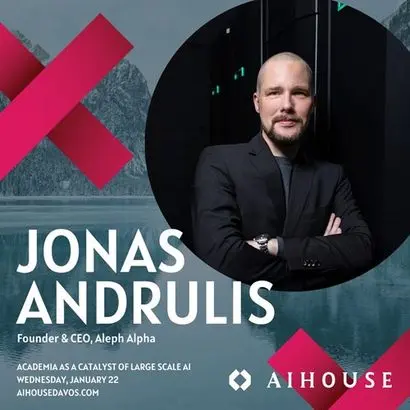
Aleph Alpha is a German AI company developing LLMs with support from the German government. It is contributing to strengthening European AI sovereignty by building models specialized in various European languages, including German. Jonas Andrulis, CEO and co-founder of Aleph Alpha, stated in an interview with Sifted, a media outlet specializing in European startups, "Honestly, the DeepSeek model is great, but soon Meta's Llama 4 model will be better, and in 12 months, all of these will be obsolete," suggesting that it is not the time to jump to hasty conclusions.
However, Nathan Benaich, founder and partner of London-based AI-focused venture capital firm Air Street Capital, pointed out, "Companies developing AI applications now have a way to achieve high performance at a much lower cost, so European LLM development firms will take the biggest hit."
Some experts warn that this event could bring about an "existential crisis" for European AI startups. This is because existing LLM developers have tried to dominate the market by raising large amounts of capital, but DeepSeek's utilization of open-source models has exposed the limitations of this approach.
Investors Focus on Startups Using DeepSeek
As a result, some investors are looking for opportunities in the AI application layer rather than existing LLM models. The application layer is the stage responsible for the "practical use" of generative AI—actual services that individual users or companies access to solve specific problems or increase work efficiency. In other words, it is the realm of services that provide direct value to users.
Alex Ball, Investment Director at Block Dojo, a London-based Web3 and AI venture builder, emphasized in an interview with European tech media Tech.eu, "DeepSeek has emerged, and it seems like the rules of the game have changed in an instant. But a month from now, another innovation will appear. And it will continue after that. Therefore, AI startups should focus on creating products that are better for the end-user than the provider."
DeepSeek's success has caused a rethink of existing investment strategies regarding AI model development. Some VCs are reviewing their valuation of AI companies, and investors who have poured massive funds into the LLM field, in particular, have raised questions about profitability.
Oliver Schoppe of Germany’s UVC Partners mentioned in an interview with Sifted, "There may be some losses in the LLM field, where a lot of capital has been invested." However, across the industry, interest is already moving away from foundational models toward areas like AI applications or AI agents. DeepSeek's open-source model is expected to accelerate new innovations and the emergence of startups. Investors should pay more attention to application development firms that utilize the DeepSeek model.
These changes present both new challenges and opportunities across the European AI ecosystem. Europe has the opportunity to secure competitiveness through AI innovation based on trust, but LLM startups have reached a point where they need to rethink their survival strategies. The direction of the European AI market will be determined by where investors choose to concentrate their capital in the future.
The Drivery, Europe’s largest mobility startup hub, will attend the Shanghai Auto Show in April with its partners and plans to organize a delegation to visit DeepSeek’s headquarters, located one hour away from Shanghai. This shows the immense interest in DeepSeek within the European tech ecosystem.
The European AI ecosystem is currently at the center of change. Innovation based on trust and regulation will become a new growth opportunity, and it is important to observe how existing LLM-centered investment strategies evolve. The impact of DeepSeek on the European AI market over the next few years will be a key point to watch.
The author, Lee Eun-seo, majored in law in Korea and studied theater in Berlin. Based in Berlin, a city of art and a hub for European startups, she leads 123factory, which connects the startup ecosystems of Korea and Germany while growing alongside the city.