

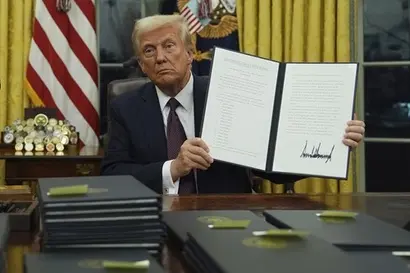
[비즈한국] As U.S. President Donald Trump decided to impose comprehensive tariffs on Canada, Mexico, and China starting the 4th (local time), the tariff war sparked by Trump is intensifying with relevant countries retaliating or filing complaints with the World Trade Organization (WTO). While critics within the U.S. argue that American citizens will also suffer from these measures, President Trump shows no sign of backing down. He stated, “There may be some short-term pain, but the people will understand,” adding, “In the long term, the U.S. has effectively been ripped off by almost every country in the world, and I will change that.”
Choi Bo-won, a researcher at Korea Investment & Securities, estimated, “Canada, Mexico, China, and the EU account for over 60% of the U.S. trade deficit; if tariffs on these four regions are applied at the levels proposed by the Trump administration, the average U.S. tariff rate will rise from 3% to 13%.”
Ultimately, a rise in U.S. prices is inevitable due to tariffs being borne by U.S. importers. If inflation resurges, it is expected to put a brake on the Federal Reserve’s interest rate cut stance, as well as the Bank of Korea’s base rate cuts. Researcher Choi said, “Rising import prices not only increase inflationary pressure in the U.S. and heighten the burden of a prolonged high-interest, strong-dollar trend, but are also bound to affect global trade structure and reduce imports from regions subject to additional tariffs.”
The White House stated that while these tariff measures might be passed on to some consumers and cause short-term disruption, it is not worried about market reactions. It dismissed concerns about the potential for widespread inflation, arguing that mid-to-long-term impacts would be minimal; however, consumers believe tariffs will be passed on to prices. The recent significant rise in U.S. inflation expectations also reflects concerns over tariffs. Kim Ji-na, a researcher at Eugene Investment & Securities, noted, “Even if the actual price-raising effect of the tariffs themselves is minimal, a preemptive shift in expectations regarding inflation can create short-term upward pressure on prices, much like the central bank’s ‘anchoring effect.’”
The problem is that this will not stop at tariffs on Canada, Mexico, and China. With President Trump foreshadowing tariff measures against other trading partners such as the European Union (EU), as well as sector-specific tariffs on items like steel and semiconductors, it is expected to become a "Third World War" without gunfire.
Kim Yong-gu, a researcher at Sangsangin Investment & Securities, pointed out, “It is noteworthy that this decision to impose tariffs on the three major importers follows the exact February timeline that Trump mentioned in his previous threatening remarks regarding tariffs and trade.”
As of the end of 2023, the breakdown of total U.S. imports was led by Germany (5.2%), Japan (4.8%), and South Korea (3.8%). Researcher Kim said, “Following the fact that Commerce Secretary nominee Howard Lutnick warned of universal tariffs on the EU during his confirmation hearing in April, trade pressure and tariffs on the top six importing countries are highly likely to go into full swing during the second quarter.”
Because of this, some advise that investors should select countries and sectors expected to benefit from the changing trade structure from a mid-to-long-term perspective. Researcher Choi Bo-won suggested, “Companies with relatively limited tariff burdens include those in the IT sector such as AI/software, communications, large financial firms, U.S. infrastructure stocks, global defense, and retail companies.”
The Asian financial market that opened on the 3rd also showed signs of instability. In particular, the KOSPI, which had been struggling since the second half of last year and was attempting a rebound last month, plunged as it was swept into the vortex of the tariff war. On this day, the KOSPI fell by around 2-3%, sliding to the 2,430 range.
Even if views on the effects of tariffs are divided and concerns are already priced in, the policy uncertainty felt by the financial market remains high, making a composed investment attitude crucial. Moon Hong-cheol, a researcher at DB Financial Investment, said, “Maintaining your composure amidst high volatility in financial markets caused by political risk is the priority,” adding, “Since frequently changing positions based on news may not be appropriate given the political situation, the best strategy in these times is to make time your ally.”
Investors should focus on long-term investments in undervalued assets amid the market fluctuations. In particular, in the case of the domestic market, political risk could ease if the impeachment trial concludes between February and March. Lee Kyung-min, a researcher at Daishin Securities, forecasted, “With pension funds continuing net buying, if domestic political risks subside and pressure for dollar stabilization and won appreciation increases, foreign capital inflows will also improve.” Since a rebound is expected after the temporary adjustment in financial markets, now is the time to take differentiated approaches by sector.