

[비즈한국] Looking in any direction, the universe appears the same, and from any location, it looks identical. This is called the isotropy and homogeneity of the universe. These two concepts are the very foundation of modern astronomy today. Of course, there are star clusters and galaxies gathered throughout the universe. Galaxies also live in groups, forming galaxy clusters. While there are superclusters and filaments where galaxies are more densely packed than their surroundings, there are also voids, which are vast, empty spaces with a much lower density of galaxies than the surrounding areas.
However, these are merely local-scale irregularities, and astronomers have long assumed that on a massive, universal scale, all these minor irregularities would be diluted. The idea is that the universe is identical, uniform, and equitable everywhere. While there may appear to be differences in density—more or less matter—on a localized level, the universe as a whole is essentially homogeneous. It was thought that this grand premise could never be overturned.
Recently, however, some astronomers have begun to challenge this premise. Perhaps our universe is not a uniform world after all. The filaments and voids of the cosmic web might, in fact, represent significant irregularities that cannot be erased simply by considering the universe’s massive scale. This perspective, which views the universe as no longer homogeneous, is called the 'Timescape' hypothesis.
Is this hypothesis merely an interesting mathematical exercise? Or is it a new clue to solving the daunting challenges facing modern astronomy?
There are still many mysteries in the universe that we do not fully understand. The most prominent example is dark energy. Since the late 1990s, by observing supernovae in increasingly distant parts of the universe, astronomers have traced how the expansion rate of the universe has changed from the past to the present. Their conclusion was that the expansion of the universe has accelerated as time has progressed. To explain this observation, it was necessary to hypothesize a new "anti-gravity" energy that counteracts the gravity attempting to contract the universe. Eventually, it was concluded that an unknown energy called dark energy dominates the universe, but its true nature remains unknown.
The Timescape hypothesis, which argues that we should no longer view the universe as a uniform world, points to the conclusion that dark energy might actually be an illusion. It suggests that it was merely a misinterpretation of observations—something we never even needed to worry about the identity of in the first place. Arguments have been raised that an alternative model using the Timescape hypothesis actually fits the existing supernova observation data better than the standard model based on dark energy. Could dark energy have been a massive misunderstanding born from our misguided expectations of the universe?
To determine whether the expansion of the universe is speeding up or slowing down over time, it is necessary to observe galaxies at various distances, ranging from the distant universe—which shows us the past—to the relatively nearby universe. In particular, distant galaxies representing the universe of the far past are very faint. Supernovae are incredibly useful for observing distant galaxies because they explode with such brilliance that they release as much energy in an instant as the Sun emits over its entire 10-billion-year lifespan.
Among supernovae, Type Ia supernovae are even more useful. This type of supernova is known to occur when a white dwarf, having finished its evolution long ago, breaks through a limit and explodes. There are two main ways a Type Ia supernova occurs: one is when matter from a companion star, such as an ordinary main-sequence star or a red giant, flows onto the white dwarf, causing it to explode; the other is when two white dwarfs collide with each other.
While there is ongoing suspicion that the duration or peak brightness of the explosion might vary slightly depending on the method, it is traditionally known that the peak brightness of the explosion is similar for both. In other words, if a Type Ia supernova explodes, one can estimate its actual brightness to a certain degree. This is why they are accepted as "standard candles," which allow researchers to determine distance by finding the actual brightness when the distance is unknown. Therefore, Type Ia supernovae are used as a yardstick to measure distances to far-off galaxies.
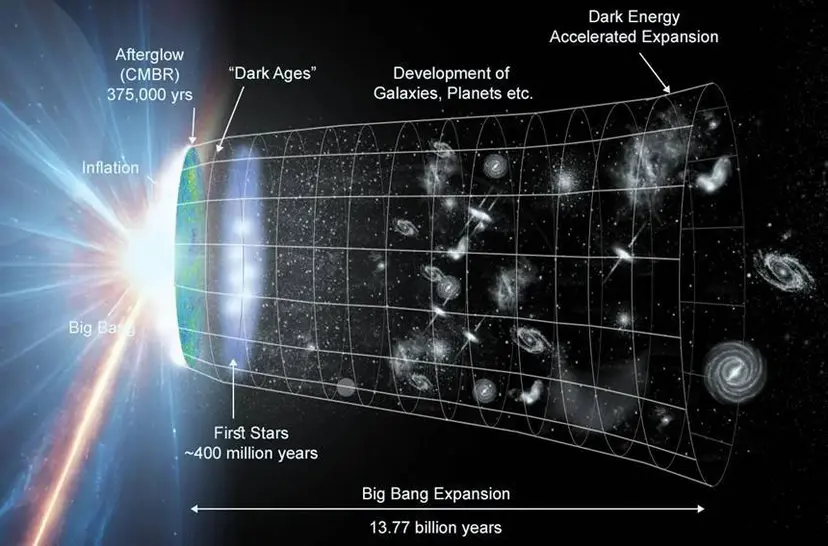
However, one cannot wait for a supernova to explode at a specific time or place. We only ever observe the slowly fading embers after the explosion has already occurred. Thus, since the 1990s, astronomers have begun a "hunt" by forming a network of telescopes across the globe, continuously observing the same patches of sky as periodically as possible to automatically detect supernova flashes. Through this, the first set of observation data for 40 Type Ia supernovae was collected in 1998. It was here that evidence was found that the expansion of the universe has become faster as time has passed.
It was a surprising result. However, analyzing only 40 supernovae was not enough. Since then, various large-scale observations dedicated to hunting for supernovae have been carried out. A prime example is the Pantheon project. The Pantheon team released their first observation data in 2018, and later in 2022, they completed the upgraded Pantheon+ data, providing a total of 1,500 Type Ia supernova observation data points. The significantly increased volume of supernova data seemed to support the existing accelerated expansion hypothesis with smaller margins of error.
Today's astronomy estimates that the universe is composed of 25% dark matter and 70% dark energy. Only the remaining 4–5% consists of atoms that we can see through light. However, this estimation is predicated on the grand assumption that the universe is homogeneous on a macroscopic scale. If that assumption is fundamentally wrong, all predictions about the universe could change drastically.
Let’s look at the large-scale structure of the universe. Depending on the region, there are superclusters and filaments where galaxies are gathered at high density, and there are empty voids where almost no galaxies exist. Gravity is weak in voids. Therefore, they can expand faster than other areas with higher density. If light travels across a void, the expansion is more intense than elsewhere, which can cause the wavelength of the light to stretch further, making it appear as if it is undergoing a greater redshift.
Meanwhile, differences in gravity also affect the rate at which time passes. According to Einstein's theory of relativity, time flows more slowly in areas with strong gravity. Compared to empty voids, superclusters filled with galaxies have stronger gravity, and therefore, the flow of time may be slower. We live in a corner of a galaxy cluster where galaxies are relatively densely packed. Consequently, we may perceive the flow of time as slower than the cosmic average. Conversely, time would flow more rapidly in empty voids where there are almost no galaxies.
If the density differences in the large-scale structure of the universe are indeed non-uniform enough to be significant even from a macroscopic perspective, the story changes completely. Differences in expansion rates due to local gravitational variances and differences in time dilation can have complex effects. Living in a high-density galaxy cluster, we might be misinterpreting the light that has traveled through empty voids, leading us to believe that the universe is undergoing accelerated expansion—where the expansion rate is higher now than in the past. It could be making the universe appear to be expanding faster than it actually is.
When comparing the existing standard ΛCDM model, which views dark energy as the force driving the universe's accelerated expansion, with the Timescape model, which argues for a more active reflection of the universe's non-uniformity, it is interesting to see which model better explains the Pantheon+ supernova observation data.
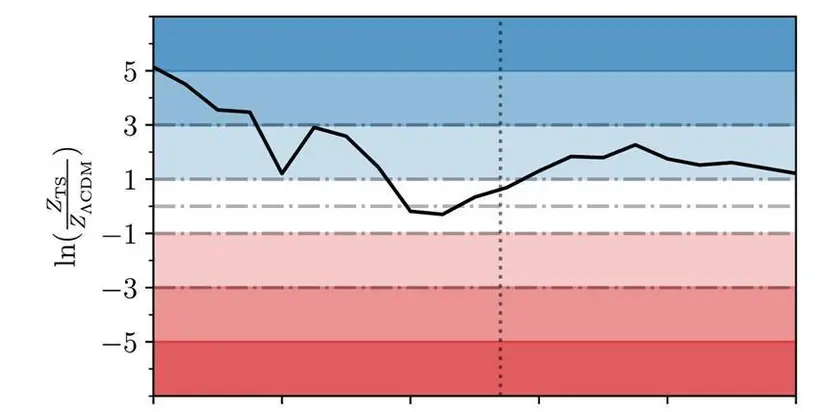
The graph above compares which of the two models better describes the observation results based on the distance to supernovae confirmed in the Pantheon+ observation data. The black line represents the trend of the actual supernova observation data. The closer the line is to the blue area at the top, the better it follows the Timescape model, and the closer it is to the red area at the bottom, the more it favors the existing ΛCDM model.
Although the margin of error remains large, the actual observation data (the black line) is overall closer to the blue area above. The Timescape model actually explains the observation results slightly better than the existing ΛCDM model. This difference is especially prominent for supernovae at closer distances with smaller redshifts.
Supernova observation data is useful, but the quantity is still insufficient. Therefore, it is difficult to conclude which is correct. However, an interesting fact is that problems, both big and small, that cannot be simply resolved by the existing standard model alone have been piling up. Just a few years ago, astronomers tried to extend the lifespan of the standard model by tweaking minor assumptions and calibration values without touching the big picture. But now, astronomers have become more radical and courageous. They have even begun to question the fundamental premise of modern astronomy: that the density of the universe is generally flat on a macroscopic scale.
The Timescape model argues that we should not overlook the gravitational effects caused by large and small density differences in the universe. It suggests that the universe is not as flat or uniform as we thought, but is a very complex world. Perhaps the universe needs to be treated with much more nuance than we previously imagined.
References
https://academic.oup.com/mnrasl/article/537/1/L55/7926647
https://academic.oup.com/mnras/article/533/3/2615/7737665
https://iopscience.iop.org/article/10.3847/1538-4357/ac8b7a
Who is the author, Woong-bae Ji? He loves cats and the universe. After watching 'Galaxy Express 999' as a child, he dreamed of sharing the beauty of the universe. Currently, he researches galaxy evolution through interactions at the Center for Galaxy Evolution Research and the Near-field Cosmology Laboratory at Yonsei University. He engages in various science communication activities, including lectures and writing. He is the author of books such as 'The Observatory of Flirting,' 'Thinking About the Universe All Day,' and 'Stars, the Science of Light.'